Introduction
2025 brought Poland’s renewable energy market a brutal economic lesson.
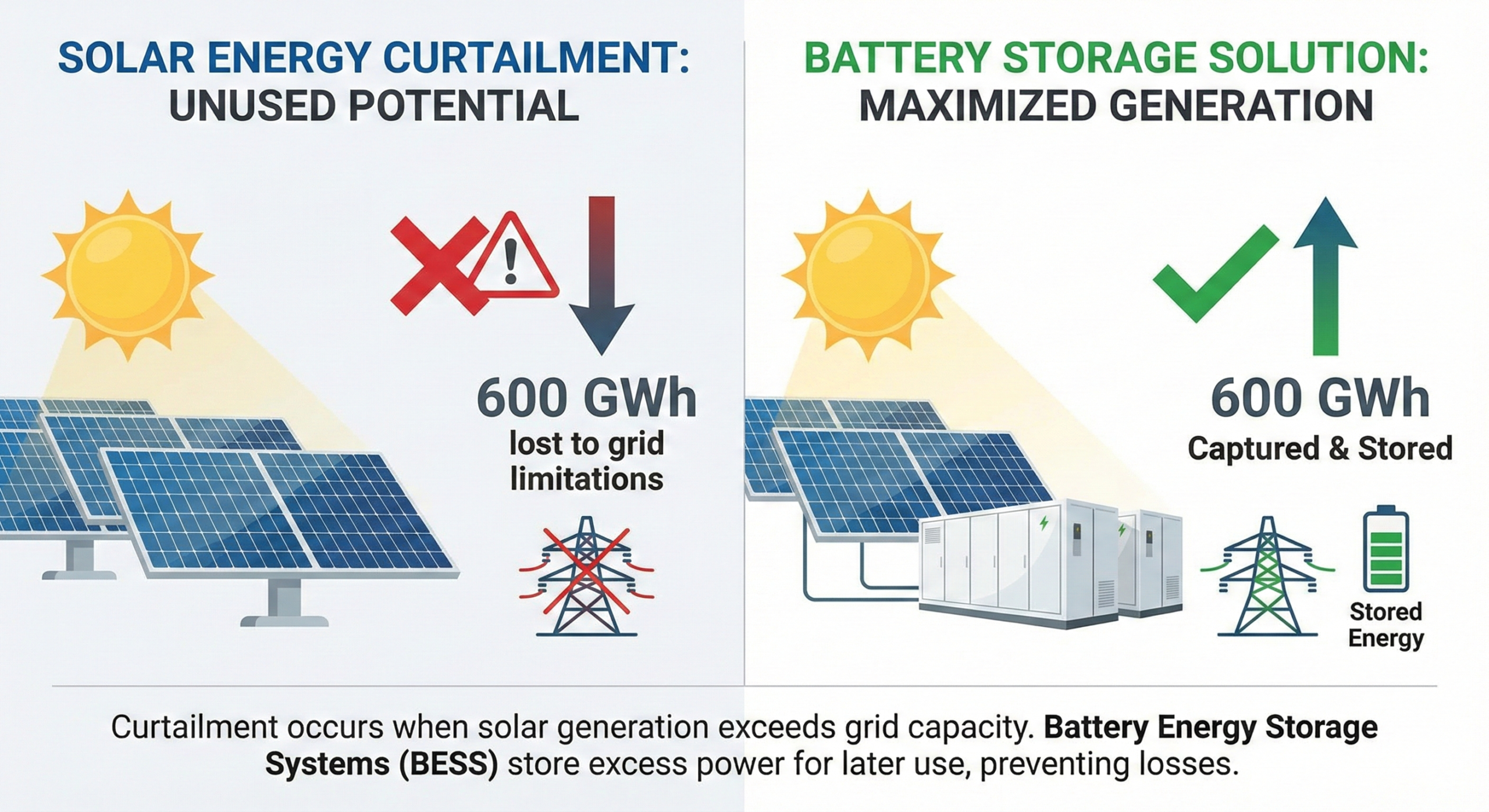
According to data from EC BREC Institute of Renewable Energy (https://ieo.pl/aktualnosci/1710-premiera-raportu-rynek-fotowoltaiki-w-polsce-2025), in the first half of 2025, PSE (Polish TSO) reduced approximately 600 GWh of solar energy – a 34% increase compared to the same period the previous year. Forum Energii data (https://nowa-energia.com.pl/2025/08/07/miesiecznik-forum-energii-lipiec-2025-oze-w-cieniu-lata/) shows that by the end of September 2025, cumulative curtailment exceeded 1.1 TWh – significantly more than 731 GWh for the entire year 2024.
These aren’t abstract numbers. According to Lighthief portal (https://lighthief.com/redysponowanie-fotowoltaiki-w-polsce/), in April 2025, PSE curtailed solar production for 25 days in the month, reducing 251.3 GWh of energy. Some solar farm operators are already openly discussing the threat of bankruptcy.
Simultaneously, energy prices during midday hours are systematically falling. The problem of so-called price cannibalization deepens month by month – PV farms sell energy for less and less because they all produce at the same time.
In this situation, standalone PV is becoming increasingly difficult to finance. Banks are tightening criteria. PPAs for pure solar are being signed only at very low prices – because developers bear the risk.
However, there’s a solution that changes this dynamic: hybrid PV + BESS projects.
The Problem: Curtailment and Price Cannibalization
Curtailment in Poland – Scale of the Issue
Curtailment (limitation of renewable energy production by grid operator) is a relatively new phenomenon in Poland. As recently as 2023, it was marginal. But the situation is changing dramatically.
According to pv magazine (https://www.pv-magazine.com/2025/07/09/solar-curtailment-on-the-rise-in-poland/), renewable energy curtailment in Poland in the first five months of 2025 reached nearly 590 GWh, representing a 36% year-over-year increase. The elektro.info portal (https://www.elektro.info.pl/artykul/najnowsze/215280,w-tym-roku-pse-wymusilo-juz-zaniechanie-produkcji-ponad-1-twh-energii-z-oze) confirms that by the end of September, renewable sources failed to produce 1.123 TWh of energy due to PSE-mandated reductions.
Gramwzielone.pl data (https://www.gramwzielone.pl/trendy/20331632/produkcja-energii-z-oze-w-polsce-z-trzecim-najlepszym-wynikiem-w-historii-wegiel-ponizej-50) shows that in August 2025, PSE curtailed 127.2 GWh of generation – 87% more than in July.
97% of curtailment in Poland affects solar – because PV produces during hours when the grid already has excess energy.
Why Does PSE Have to Cut?
The problem is simple: at noon on a sunny day, Poland produces more renewable energy than it needs. And the electricity system must be balanced every second.
Poland has (data from late 2024 / early 2025):
- ~22 GW of installed PV capacity – according to IEO (https://lighthief.com/rynek-fotowoltaiki-w-polsce-2025/), Poland reached 21.994 GW at the end of Q1 2025
- Only ~200-300 MW of BESS online (mid-2025 status)
- Limited export capacity (interconnectors)
- Coal power plants that cannot quickly shut down
Result: PSE issues power reduction orders, and when that’s not enough – simply disconnects PV from the grid.
Price Cannibalization – The Second Problem
Even when a PV farm produces, prices during peak production hours fall. This is the result of solar’s success – the more PV capacity in the system, the lower prices at noon.
The capture rate coefficient (ratio of price achieved by PV to average market price) is systematically declining. While it was 90-95% in 2022, by 2025 PV projects achieve a capture rate of 55-65%.
This means a PV farm sells energy for significantly less than the “average market price” on which financial models from a few years ago were based.
The Solution: PV + BESS Colocation
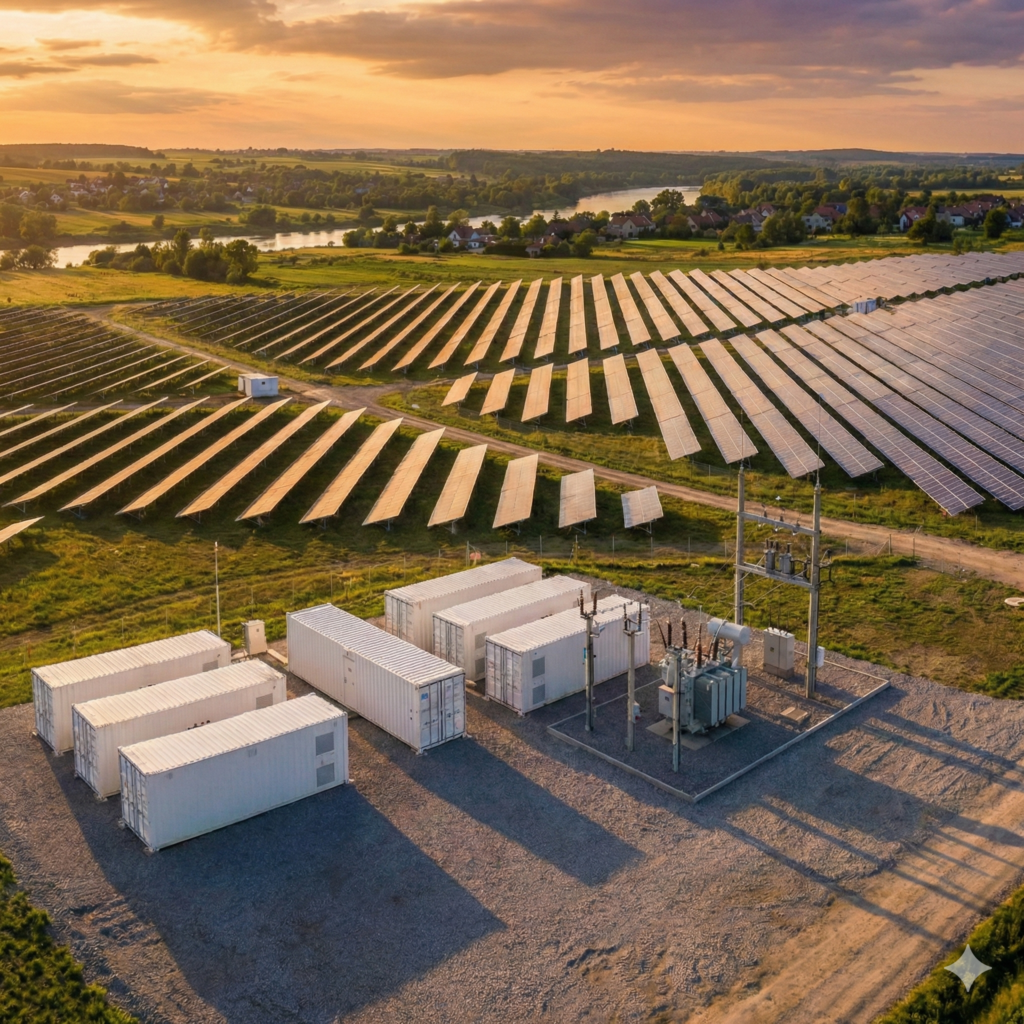
A hybrid project is an installation where a PV farm and energy storage share a common grid connection point. They can also share infrastructure (transformers, cable lines) – this is called cable pooling.
How Does a Hybrid Work?
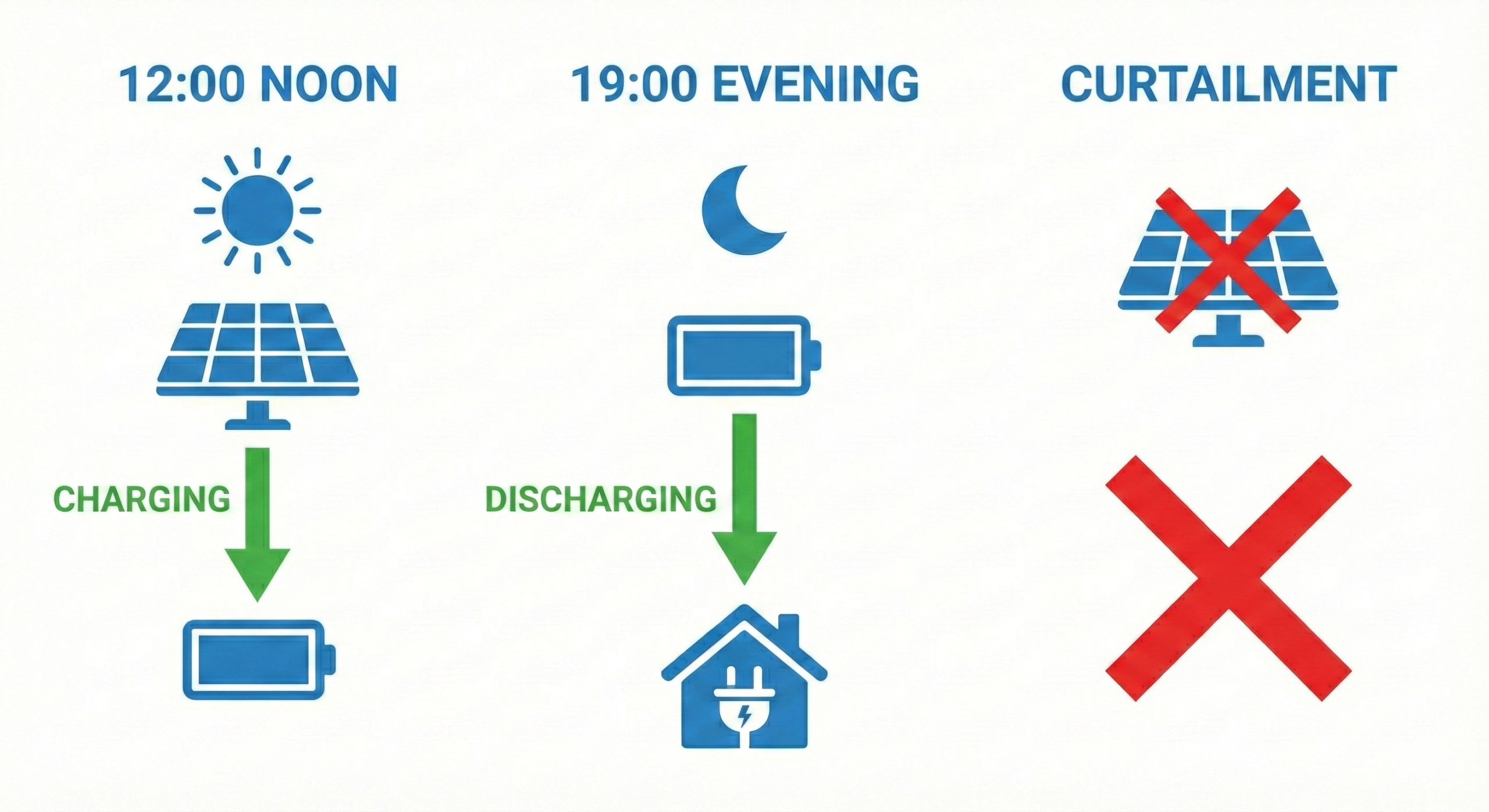
During overproduction hours (noon):
- PV produces energy
- Part goes to the grid (if prices are positive and there’s no curtailment)
- Excess charges the battery storage
During peak demand hours (evening):
- Storage discharges to the grid
- Energy is sold at evening prices (higher)
- Price spread = profit
In case of curtailment:
- Instead of “wasting” energy, storage absorbs it
- Energy is not lost
- Discharge occurs when the grid can accept it
Price Spread Mathematics
Example from the Polish market (TGE data, 2025):
| Hour | Typical Price | Action |
| 12:00 | 150 PLN/MWh (or negative) | BESS Charging |
| 19:00 | 600 PLN/MWh | BESS Discharging |
| Spread | 450 PLN/MWh | Profit before losses |
With 85% RTE and 10 MWh capacity:
- Energy discharged: 8.5 MWh
- Revenue: 8.5 × 600 = 5,100 PLN
- Cost of energy “purchased”: 10 × 150 = 1,500 PLN
- Gross profit: 3,600 PLN/day
With 300 days of good spread: over 1 million PLN annually from arbitrage alone.
And this is just one BESS revenue stream.
Advantages of Hybrid Projects
- Protection Against Curtailment
Standalone PV loses 100% of energy during curtailment. A hybrid project or colocated system loses only what doesn’t fit in storage.
Example:
- 50 MW PV farm, 4-hour curtailment at full production
- Standalone PV: loss ~200 MWh
- Hybrid with 50 MW/100 MWh BESS: storage absorbs 100 MWh, loss only 100 MWh
With curtailment growing to 10% of annual production (trend confirmed by Forum Energii data https://nowa-energia.com.pl/2025/08/07/miesiecznik-forum-energii-lipiec-2025-oze-w-cieniu-lata/), the difference becomes critical for the business case.
- Higher Capture Rate
BESS allows “shifting” energy from low-margin to high-margin hours.
- Standalone PV capture rate: 55-65%
- Hybrid PV+BESS capture rate: 80-95% (depending on sizing)
Key principle: If price cannibalization turns out greater than assumed, BESS will earn more on spreads. This is a natural hedge in the financial model.
- Easier Grid Connection
In many Polish regions, the queue for standalone BESS connection is 3-5 years. For projects colocated with PV, the path may be shorter because:
- We utilize existing connection infrastructure
- Cable pooling allows fitting more capacity in existing connection
- DSOs are more favorable to projects that “solve problems”
Note: This is not a universal rule. Each case requires individual analysis with the specific DSO.
- Better Bankability
Banks like predictable cash flows. Hybrid projects offer:
- PV component: PPA with guaranteed price (though lower)
- BESS component: Merchant + grid services + capacity market
This combination creates a more diversified risk profile than a standalone asset.
Financing Structures: Hybrid PPAs
Three PPA Models for Hybrids
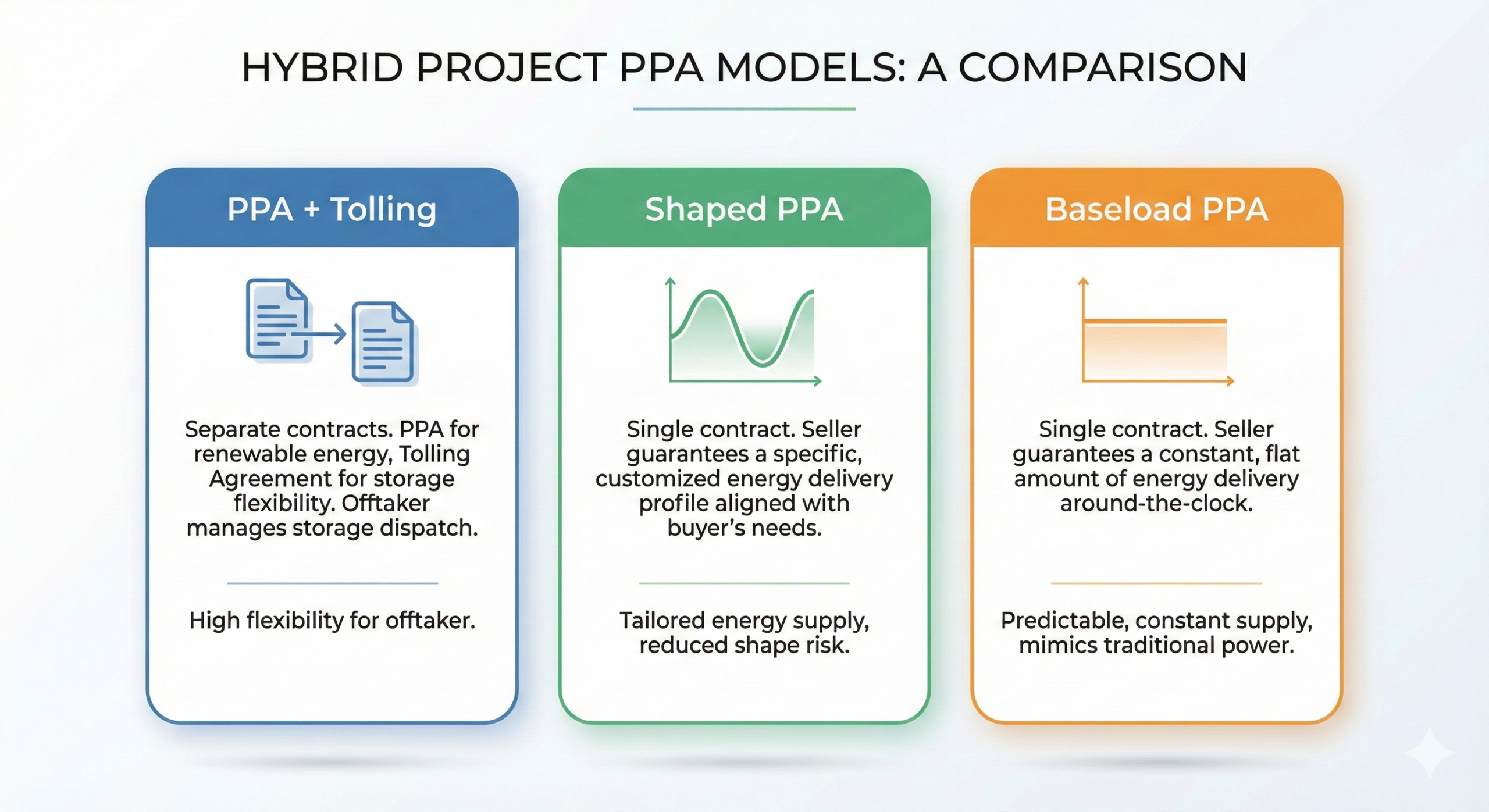
The market hasn’t established a single standard yet, but three main structures are emerging:
Model 1: PPA + Tolling Agreement
How it works:
- PPA for PV component (pay-as-produced or pay-as-delivered)
- Separate tolling agreement for BESS
- Offtaker pays for “access” to storage
Advantages: Transparency, easier financing
Disadvantages: Two separate contracts to negotiate
Model 2: Shaped PPA
How it works:
- Single contract for “shaped” delivery profile
- Developer commits to deliver energy at specified hours
- BESS serves to “shape” PV production
Advantages: Higher price for “on-demand” energy
Disadvantages: Risk on developer’s side if underdelivery occurs
Model 3: Baseload/Quasi-baseload PPA
How it works:
- Developer commits to constant delivery (e.g., 5 MW for 12h/day)
- PV + BESS combination enables “flattening” the production curve
- Most attractive for corporate offtakers
Advantages: Highest prices, long-term stability
Disadvantages: Requires precise sizing and advanced management
Revenue Swap – New Model
Some banks promote a “revenue swap” structure:
- Bank guarantees floor price for total project production
- In exchange, takes part of the upside
- Developer has certainty of minimum revenues
This solution is particularly “bankable” according to market participants.
Case Studies: Hybrids in Poland and the Region
VSB Brzezinka – One of Europe’s Largest
In November 2025, VSB Poland began construction (https://www.vsb.energy/de/en/newsroom/press/press-detail/vsb-poland-breaks-ground-on-303-mwp-photovoltaic-park-plus-battery-energy-storage-system/) of a hybrid project in Oleśnica municipality:
- PV: 303 MWp
- BESS: 106 MW / ~424 MWh (4h duration)
- Wind (planned): up to 245 MW
According to VSB Group information (https://www.vsb.energy/de/en/newsroom/press/press-detail/vsb-poland-breaks-ground-on-303-mwp-photovoltaic-park-plus-battery-energy-storage-system/), the project is scheduled for completion by the end of 2027. Transformation into a full hybrid park combining PV, wind, and storage is planned.
What distinguishes Brzezinka:
- One of the largest PV+BESS installations in Poland and CEE region
- 15-year CfD contract ensuring revenue stability (https://renewablewatch.in/2025/07/28/vsb-group-wins-contract-for-303-mwp-solar-park-in-poland/)
- Area of 260 hectares, over 467,000 PV modules
- 70 km of underground cables to connection point
GoldenPeaks Capital – BESS Strategy
GoldenPeaks Capital announced in January 2025 (https://goldenpeakscapital.com/news) BESS as a main pillar of its investment strategy. In August 2025, the acquisition (https://www.ess-news.com/2025/08/07/goldenpeaks-capital-acquires-two-bess-projects-in-poland-totaling-216-mwh/) of two BESS projects was finalized:
- Baczyna: 46 MW / 184 MWh (110 kV connection)
- Jelenia Góra: 8 MW / 32 MWh (20 kV connection)
According to Business Wire (https://www.businesswire.com/news/home/20250805652738/en/GoldenPeaks-Capital-Has-Successfully-Acquired-Two-New-Battery-Energy-Storage-Systems-in-Poland), both projects secured a 17-year Capacity Market contract from the 2024 auction, achieving maximum rates for 4-hour systems.
Strategic significance:
- Total BESS portfolio in Poland: 124 MW
- GPC also runs pilot BESS+PV projects
- “Last heavily subsidized CM contracts” – long-term positioning
According to Battery-Tech Network (https://battery-tech.net/battery-markets-news/goldenpeaks-capital-and-huawei-team-on-500-mwh-bess-in-europe/), in October 2025 GoldenPeaks Capital signed an MoU with Huawei for 500 MWh BESS, showing the company’s scale of ambition in the energy storage segment.
Challenges and Risks of Hybrid Projects
- Technical Complexity
Hybrids aren’t “PV + BESS next to each other.” They require:
- Integrated EMS (Energy Management System)
- Real-time optimization
- Component coordination
- Competent optimizer
Risk: Poorly integrated system won’t leverage synergy potential.
- Higher CAPEX
Obviously – we’re adding storage to a PV project. The question is: does additional CAPEX generate sufficient additional revenue?
Key variables:
- BESS cost (currently 150-200 EUR/kWh installed)
- Expected price spread
- Curtailment level
- PPA structure
- “Colocation Penalty”
When BESS is colocated with PV, its flexibility is partially limited:
- Must charge when PV produces (not always optimal)
- May lack capacity for grid charging opportunistically
- Connection point can be a bottleneck
Studies show that “colocation penalty” is smaller than assumed – especially with good power, capacity sizing, and optimization.
- Regulatory Uncertainty
Polish regulations for colocated (hybrid) projects are evolving. Issues to monitor:
- Definition of “hybrid installation” in law
- Settlement rules for cable pooling
- Requirements for capacity market participation
- Grid services certification
Sizing Optimization: How Much BESS for How Much PV?
The most common question is: what should be the ratio of BESS power and capacity to PV power?
The answer depends on project goals:
Scenario 1: Curtailment Protection
Goal: Protect against energy loss
Typical sizing: BESS = 20-30% of PV power, 2-4h duration
Example:
- PV 50 MW → BESS 10-15 MW / 40-60 MWh
- Absorption of most curtailment on typical days
- ROI depends on actual curtailment level
Scenario 2: Price Arbitrage
Goal: Maximize spread revenues
Typical sizing: BESS = 30-50% of PV power, 2-4h duration
Example:
- PV 50 MW → BESS 15-25 MW / 60-100 MWh
- One full cycle daily on days with good spread
- ROI depends on spread stability
Scenario 3: Baseload PPA
Goal: Deliver constant power for specified hours
Typical sizing: BESS = 50-100% of PV power, 4h+ duration
Example:
- PV 50 MW → BESS 25-50 MW / 100-200 MWh
- Ability to “flatten” production curve
- Highest PPA prices, but largest CAPEX
Key Factors in Optimization
Analysis must consider:
- PV production profile at location (irradiation, seasonality)
- Historical and projected hourly prices
- Curtailment probability (DSO data)
- Connection availability (contracted capacity)
- Offtaker requirements (if PPA)
- Possibility of participating in ancillary markets
GreenEdge Solutions offers detailed financial modeling with sizing optimization for specific projects.
How to Prepare for Bank Discussions?
Hybrid projects are more bankable than standalone PV but require better documentation preparation.
What Banks Want to See:
- Diversified Revenue Profile
- PPA (fixed or shaped) – 40-60% of revenues
- Merchant energy (arbitrage) – 20-30% of revenues
- Capacity Market – 10-20% of revenues
- Grid services (FCR/aFRR) – 5-15% of revenues
- Price Scenario Analysis
- Base case (most probable)
- Downside case (energy prices -30%, spread -40%)
- Upside case (growing curtailment = greater arbitrage)
- Stress Testing
- What happens if battery degradation is faster?
- What if curtailment is lower than assumed?
- What if PPA isn’t extended after 10 years?
- Team Experience
- Track record in BESS projects
- Trading and optimization competencies
- Operational management capability
- Contractual Structure
- EPC contract with performance guarantees
- O&M agreement with min. 95% availability
- Insurance (construction, operational, performance)
Typical DSCR Requirements
- Standalone PV: DSCR min. 1.4-1.5x
- Hybrid PV+BESS: DSCR min. 1.3-1.4x (lower due to diversification)
Bank may accept lower DSCR if:
- Strong sponsor with experience
- Long-term PPA with credible offtaker
- Conservative assumptions in financial model
How GreenEdge Solutions Can Help?
Hybrid projects require expertise at the intersection of technology, finance, and regulation. GreenEdge Solutions offers comprehensive support:
🔍 Hybridization Potential Analysis
For existing PV or wind projects:
- Technical assessment of BESS addition possibilities
- Connection and cable pooling analysis
- Financial model hybrid vs status quo
📊 Hybrid Project Feasibility Study
For new projects:
- PV/BESS sizing optimization
- Revenue model (PPA + merchant + grid services)
- Price scenario analysis
- Business case for banks
📋 PPA Process Support
- Preparation for offtaker negotiations
- Contractual structure analysis
- Risk and security assessment
🏗️ Development and Implementation
- Connection coordination
- Technology and supplier selection
- Owner’s engineering
Contact us (https://www.greenedge-solutions.com/) – we’ll analyze whether a hybrid project makes sense for your development.
Summary: Hybrids are the New Standard
The renewable energy market is undergoing fundamental change. The era of “pure” PV or wind projects is ending – at least for utility-scale projects without subsidies.
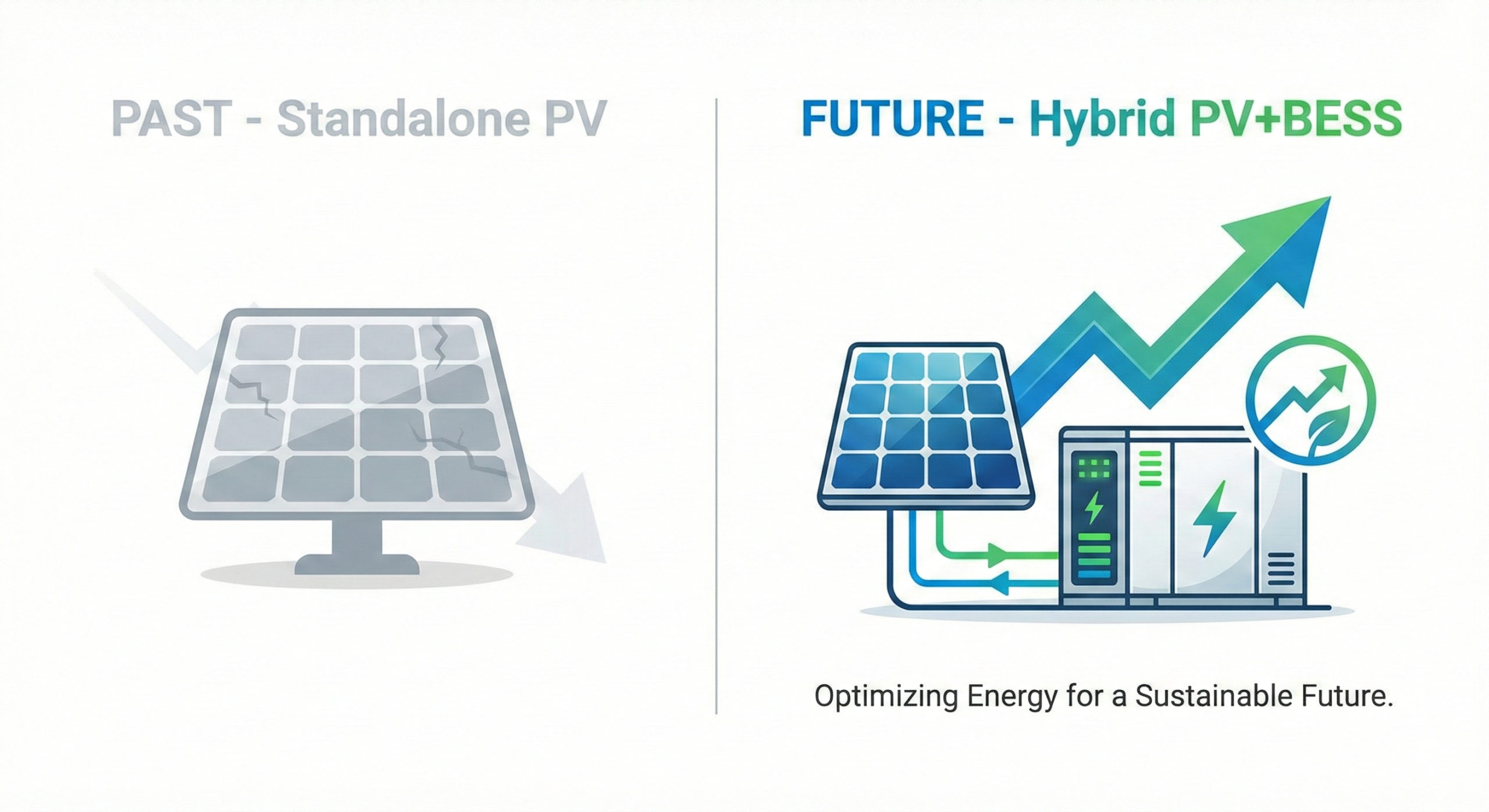
Key Conclusions:
- Curtailment will grow – without BESS, PV projects lose more and more energy. 2025 data (https://www.elektro.info.pl/artykul/najnowsze/215280,w-tym-roku-pse-wymusilo-juz-zaniechanie-produkcji-ponad-1-twh-energii-z-oze) shows over 1 TWh of lost renewable production.
- Price cannibalization will deepen – capture rate will decline with growing PV penetration in the system
- Banks prefer hybrids – diversified revenue profile = lower risk = better financing terms
- PPA structures are evolving – shaped and baseload contracts are becoming standard for large corporate offtakers
- Poland is catching up with Europe – what’s happening in Germany and Spain will be the norm in Poland in 2-3 years
If you’re planning a renewable project in Poland, the question isn’t “whether to add BESS” but “what sizing and what structure”.
FAQ
Can I add BESS to an existing PV farm?
Yes, this is called “retrofitting” or “repowering with storage.” It requires analysis of:
- Do connection conditions allow additional capacity?
- Does the transformer have sufficient throughput?
- Will the DSO agree to cable pooling?
GreenEdge Solutions can conduct such analysis for your project.
What BESS sizing is optimal for a PV project?
It depends on the goal. Typical proportions:
- Curtailment protection: BESS = 20-30% of PV power, 2-4h duration
- Price arbitrage: BESS = 30-50% of PV power, 2-4h duration
- Baseload PPA: BESS = 50-100% of PV power, 4h+ duration
Optimization requires modeling with specific project data.
Sources
- EC BREC IEO – “Solar Market in Poland 2025” Report (https://ieo.pl/aktualnosci/1710-premiera-raportu-rynek-fotowoltaiki-w-polsce-2025)
- pv magazine – Solar curtailment on the rise in Poland (https://www.pv-magazine.com/2025/07/09/solar-curtailment-on-the-rise-in-poland/)
- Forum Energii – Monthly July 2025 (https://nowa-energia.com.pl/2025/08/07/miesiecznik-forum-energii-lipiec-2025-oze-w-cieniu-lata/)
- elektro.info – Renewable production reduction exceeded 1 TWh (https://www.elektro.info.pl/artykul/najnowsze/215280,w-tym-roku-pse-wymusilo-juz-zaniechanie-produkcji-ponad-1-twh-energii-z-oze)
- Lighthief – Solar Market in Poland 2025 (https://lighthief.com/rynek-fotowoltaiki-w-polsce-2025/)
- Lighthief – Solar Curtailment in Poland (https://lighthief.com/redysponowanie-fotowoltaiki-w-polsce/)
- Gramwzielone.pl – Renewable Energy Production in Poland (https://www.gramwzielone.pl/trendy/20331632/produkcja-energii-z-oze-w-polsce-z-trzecim-najlepszym-wynikiem-w-historii-wegiel-ponizej-50)
- VSB Group – Brzezinka hybrid park construction (https://www.vsb.energy/de/en/newsroom/press/press-detail/vsb-poland-breaks-ground-on-303-mwp-photovoltaic-park-plus-battery-energy-storage-system/)
- Renewable Watch – VSB Group wins 303 MWp contract (https://renewablewatch.in/2025/07/28/vsb-group-wins-contract-for-303-mwp-solar-park-in-poland/)
- Energy Storage News – GoldenPeaks acquires BESS projects (https://www.ess-news.com/2025/08/07/goldenpeaks-capital-acquires-two-bess-projects-in-poland-totaling-216-mwh/)
- GoldenPeaks Capital – News (https://goldenpeakscapital.com/news)
- Business Wire – GoldenPeaks Capital acquires BESS (https://www.businesswire.com/news/home/20250805652738/en/GoldenPeaks-Capital-Has-Successfully-Acquired-Two-New-Battery-Energy-Storage-Systems-in-Poland)
- Battery-Tech Network – GoldenPeaks and Huawei partnership (https://battery-tech.net/battery-markets-news/goldenpeaks-capital-and-huawei-team-on-500-mwh-bess-in-europe/)
Listen to podcastu
 You can find more in our podcast: episode 08 BESS project development: from idea to RTB
Related articles:
Battery Energy Storage for Manufacturing: When Does BESS Make Sense for Industrial Facilities?
BESS Project Development in Poland: Why Most Energy Storage Projects Never Get Built
Complete Guide to BESS Project Delivery Models in Poland – EPC vs BoP