Introduction
Let’s talk honestly about what’s happening in the Polish energy storage market.
Gigawatts in pipelines. Hundreds of projects with grid connection agreements. Presentations full of maps with pins showing “secured locations.” Sounds impressive?
The reality is that most of these projects will never be built. This isn’t pessimism – it’s an observation based on what I see in the market every day.
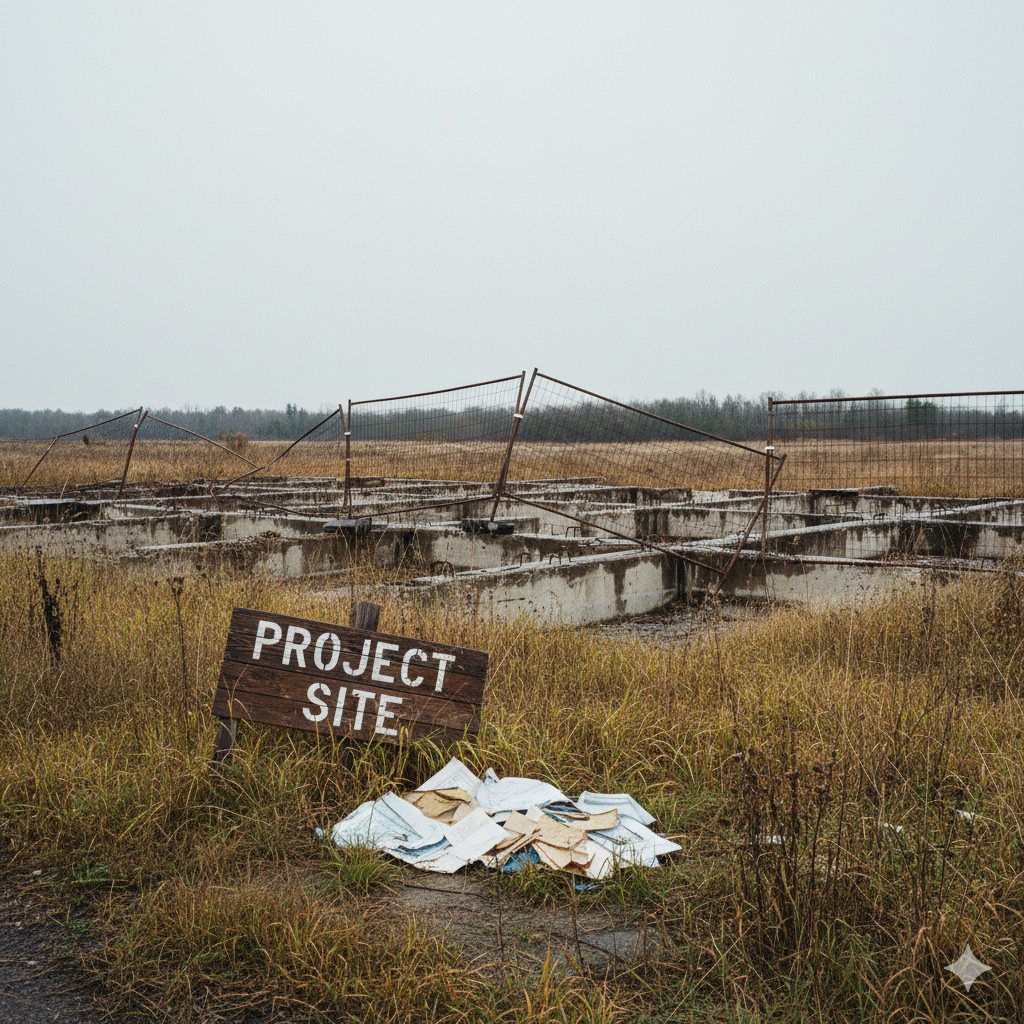
And no, the problem isn’t a bottleneck on the DSO or TSO side. The problem is the developers themselves – projects thrown together without any real feasibility analysis, hoping for a quick sale to a bigger player. This is how zombie projects are born – projects that look great in Excel but have no chance of ever being realized.
In this article, I’ll show you where BESS projects actually die and how to distinguish a real investment opportunity from marketing fiction.
Most Common Mistakes in Energy Storage Development
Grid Connection Conditions Are Just the Beginning
Obtaining grid connection conditions (GCC) is cause for celebration for many developers. “We have a project!” – I hear this often. Meanwhile, GCC represents maybe 10-15% of the journey to an operating energy storage facility. Sure, if the goal is project realization, it’s a huge milestone, but let’s not kid ourselves – most developers want to sell, not build!
What happens after obtaining grid connection conditions? Looking for a buyer! Only then comes the moment for profitability analysis, cable route mapping, and connection feasibility verification. DEVEX, CAPEX, OPEX and suddenly it turns out that yes, we have Grid Connection Conditions, but now we need to find someone who doesn’t know better and sell high!
The Connection Line – Where Most BESS Projects Die
Let’s be honest: most energy storage projects in Poland have grid connection conditions, but nobody has calculated how much it actually costs to run the cable to the connection point.
Typical scenario:
- Developer gets GCC with connection point 5 km from the site
- Enters “estimated line cost: PLN 1.5 million” in Excel
- Nobody checks the route – through whose land, what approvals, how long
- A year later it turns out the route requires crossing 24 plots, a forest, a national road, and railway tracks
- Actual cost: PLN 10 million and 18 months of negotiations
Result? The project becomes unprofitable. But in the presentation, it still appears as “secured GCC, ready for sale.”
Unrealistic CAPEX Assumptions in BESS Projects
Another classic: CAPEX taken from a conference presentation or “European benchmark.”
I’ve seen financial models where someone entered BESS cost at 150-180 EUR/kWh “because that’s what was on the slide at the Munich conference.” Except that cost didn’t include:
- Transformer and MV switchgear costs
- Connection line (see above)
- EMS/SCADA system integrated with DSO requirements
- Detailed design and approvals
- Auxiliary transformer
Actual CAPEX? Often 30-50% higher than that “benchmark.”
Development Timeline – Add a Year to Every Plan
If a developer tells you the energy storage project will be ready in 12 months – in 90% of cases you can safely add another 12 months.
Why? Because nobody accounts for:
- The third request for document completion from the county office
- Extension of Grid Connection Conditions issuance deadline by the DSO
- Noise analysis requirement because the plot is within city limits
- Holidays at the office that leave your case sitting for 6 weeks
- Discovery that the owner of one of the plots along the cable route has died and heirs need to be identified
- Confirmation of public road access required by the county office, which certification is also issued by the county office, but a different department – two desks away
- Providing a Map for Design Purposes including not only the construction plot but also neighboring plots

BESS Project: The Difference Between Pipeline and Ready-to-Build (RTB)
What Does “Project in Pipeline” Actually Mean?
In practice, “pipeline” means everything – from an idea written on a napkin to a project with building permit. That’s why this category is useless for assessing the value of a developer’s portfolio.
Secured hectares already count as “early stage.” Connection capacity? Whatever fits in Excel! Nearest connection points? They exist! Granted, they’re 20 years old without modernization, but surely they’ll renovate them someday and capacity will free up! The gigawatts add up, reality not so much.
Of course, not everyone does this, it doesn’t always look like this, but in recent years we’ve seen a strong trend in this direction. The vision of quick and easy money attracted a lot of capital, which in many cases was simply wasted on securing projects that could never be built from the start. We see this in the NFOŚiGW (National Environmental Fund) subsidy where over 480 applications were submitted. These are gigawatts of capacity reserved in Grid Connection Conditions that effectively block investors who actually want to build something. We used to say that Grid Operators were the bottleneck and that’s why we couldn’t develop renewable projects. Today, I think it’s different.
What Does Ready-to-Build (RTB) Mean for Energy Storage?
An RTB project is one where you can sign an EPC contract and start construction within weeks, not months. This means:
Land rights:
- Ownership or long-term lease
- Agreements accounting for energy storage specifics, not just PV as is often the case
- Secured cable route (all plots)
Grid connection conditions:
- Valid (not expiring in 3 months)
- With realistic route analysis and connection line costs
- With DSO scope that is either completed or in progress – year 2032 is not attractive
Permits and approvals:
- Construction design
- Valid building permit covering all infrastructure required for project implementation
- Environmental approvals (if required)
18-24 Months of Development and Hundreds of Thousands of Euros
That’s what separates a typical “pipeline project” from RTB status. That’s how much time and money you need to invest to turn an idea into something that can actually be built.
So when you hear “we have 500 MW in pipeline” – ask how much of that is RTB. The answer is often: 10-20%. The rest is hope, Excel, and PowerPoint. There’s still a long way to completing the process. It’s worth keeping this in mind if you’re planning to buy an early-stage project with an agreement to complete BESS development to RTB status paid in milestone installments. It’s not a bad solution, but it’s worth adjusting the timeline presented by the seller.
BESS Development in Poland – Challenges for Foreign Investors
Teams Calls Don’t Work with Polish Authorities
I observe this regularly: an international developer based in London, Amsterdam, or Munich tries to develop energy storage projects in Poland remotely.
Theoretically it makes sense – you have a team of analysts, lawyers, project managers. Procedures are similar across Europe. What could go wrong?
Everything.
Elaborate structures, slow decisions: Every decision requires approval through 4 organizational levels. By the time you get approval to submit a Grid Connection application for a given location and prepare the deposit required by the DSO, 10 other applications have already been submitted for that connection point.
Lack of direct relationships: One conversation accomplishes more than ten emails. A phone call to the right person and understanding a given office’s requirements, a meeting at the county office, coffee with the designer. You can’t do this via Teams from thousands of kilometers away.
Western European timelines: “In Germany, building permits take 3 months” – great, but this isn’t Germany. Here it can take 10 months and three appeals. It often happens that administration asks for documents we’ve never sent before, often some certificate is missing or a stamp duty of PLN 17.
Language barrier: Documentation in Polish. Negotiations in Polish. Regulations in Polish. A translator will help, but nuances get lost in translation – and those nuances often contain details that a foreign investor won’t understand.
The Result? Zombie Projects in Every Pipeline
A Western developer buys a “project in development phase” from a local broker. In the presentation it looks great – GCC exists, land exists, “building permit in preparation, cable route being secured.”
10 months later the project still isn’t RTB. Development management costs are rising. Grid connection deadlines are approaching, annexes need to be prepared, etc. I know projects like this that have been hanging in pipelines for 3 years. On paper still “active development.” In practice – they’ll never be built because it turned out that CAPEX exceeds the profitability threshold.
What happens to these projects? Some expire – grid connection conditions lose validity, lease agreements aren’t extended. Some are sold on to the next “optimistic” buyer. And some just sit there – blocking connection capacity that could be used by investors who actually want to build.

BESS Project Due Diligence – What to Look For
Red Flags When Evaluating an Energy Storage Project
If you’re considering buying a project or investing in development, here are the warning signs:
🚩 Grid connection conditions without cable route analysis GCC says “connection point: GPZ XYZ.” Great. But has anyone checked how to get there? Through whose land? How much does it cost? Are directional drills required, or just trenching?
🚩 No connection line cost estimate “We estimate 2-3 million” is not a cost estimate. A cost estimate is a valuation based on actual route, approvals, material and labor prices. If this doesn’t exist – assume the worst-case scenario.
🚩 “Building permit in progress” for 18 months If something has been “in progress” for 18 months, it means there are problems. What kind? The developer won’t tell you, because they may not know themselves. Or they know and don’t want to say.
🚩 Land lease without BESS clauses A standard lease agreement for a PV farm is not the same as an agreement for energy storage. Different requirements, different infrastructure, different risks. If the agreement wasn’t made with BESS in mind – the landowner may cause problems.
🚩 Developer without a local team Who leads the negotiations? Who travels to DSO meetings? Who monitors deadlines at offices? If the answer is “our partner / consultant / external company” – ask who specifically and what experience they have.
🚩 Financial model based on “market assumptions” Capacity market revenues? “We assumed price X EUR/kW/year.” Arbitrage? “We assumed spread Y EUR/MWh.” Where do these numbers come from? “Benchmark / market analysis / public data.” This isn’t a financial model – it’s wishful thinking in Excel.

How to Evaluate a BESS Project Before Investment
Independent Verification Is Essential
The biggest mistake you can make? Relying solely on information from the developer selling the project.
This doesn’t mean developers lie – most provide information in good faith. The problem is they may not know about all the risks themselves, or they’re looking at the project through rose-colored glasses. The developer’s goal is to reach RTB status. Whether the project gets built one way or another isn’t their problem anymore.
Independent project verification, or due diligence, isn’t a cost – it’s insurance against multi-million losses. For me, such analysis should include not only document verification but also checking heavy equipment access, conducting a site visit directly on the plot, walking through the cable route and accounting for all obstacles, estimating costs related to public road repair because during deliveries the 21st truck drove onto the sidewalk and demolished it, and finally estimating construction costs, connection costs, but also security, insurance, and above all maintenance for the next 15 years.
The Value of Local Expertise in BESS Development
Knowledge of the Polish market isn’t “nice to have” – it’s a necessary condition. Someone who has been through the energization process, who knows DSO procedures, who knows how Polish offices work – such a person will identify risks that a foreign analyst won’t find in a week.
It’s not that Polish procedures are worse or better. It’s that they’re different. And you need to know them.
FAQ – Frequently Asked Questions About BESS Development
How long does energy storage project development take in Poland?
From obtaining grid connection conditions to ready-to-build (RTB) status typically takes 18-24 months. This assumes smooth process progression – in practice it often takes longer due to administrative delays, cable route problems, or changes in operator requirements.
What is ready-to-build (RTB) in the context of BESS?
Ready-to-build means a project that is ready for immediate construction start. It requires: valid grid connection conditions, valid building permit, secured land rights, then approved detailed design and confirmed financing. An RTB project allows you to sign an EPC contract and start work within weeks, not months. Where developer responsibility ends and investor responsibility begins is a matter of contract formulation.
How much does it cost to bring a BESS project to RTB status?
Development costs depend on project scale and location, but typically amount to 2-5% of planned CAPEX. Main components are: design, approvals, administrative fees, securing land and connection line, and project management costs.
What are the most common causes of BESS project failure?
The most common causes are: unrealistic connection line valuation, underestimated CAPEX costs, overly optimistic timeline, lack of local development team, and not accounting for Polish administrative specifics. Many projects “die” after verifying the real possibilities of building an energy storage facility accounting for all additional costs related to both the cable route and connection, but also those related to infrastructure maintenance, monitoring, and facility security.
Can a foreign investor independently develop a BESS project in Poland?
Theoretically yes, practically it’s very difficult without a local team. Polish administrative procedures, documentation requirements, and relationships with operators require physical presence and language knowledge. Most foreign developers succeeding in Poland collaborate with local partners or employ a Polish team.
How to verify if a BESS project is worth the investment?
Key verification elements are: checking validity and realism of grid connection conditions, route and cable line cost analysis, permit status verification, evaluation of land agreements for BESS specifics, and financial model validation based on actual EPC offers. Independent verification, or project due diligence, is the best investment before buying a project.
How Can We Help?
Have a BESS project in your pipeline? Considering buying a project? Want to know if what you’re being offered is a real opportunity or a zombie project?
GreenEdge Solutions offers comprehensive support in energy storage project development and evaluation:
🔍 Technical Due Diligence for BESS Projects
Independent project assessment before investment decision:
- RTB status verification against real criteria
- Technical and administrative risk analysis
- Timeline and budget realism assessment
- Red flag and hidden cost identification
- Report with recommendations and risk valuation
📋 Energy Storage Development Support
Guiding the project through all administrative stages:
- Grid connection conditions acquisition and analysis
- DSO/TSO approval coordination
- Building permit documentation preparation
- Landowner negotiations (cable route)
- Design and approval supervision
📊 Portfolio Assessment for Investors
For funds and investors evaluating developer pipelines:
- Project scoring against RTB criteria
- Financial assumption verification
- Comparative portfolio analysis
- Recommendations before investment decision
- Identification of highest-potential projects
🏗️ BESS Development Management
Full project management from concept to RTB:
- Local presence and relationships with authorities
- Coordination of all administrative tracks
- Development timeline and budget management
- Regular progress reporting
- Project preparation for sale or construction
Don’t let your project become another zombie in someone’s pipeline.
📧 contact@greenedge-solutions.com
🌐 www.greenedge-solutions.com
Related articles:
Complete Guide to BESS Project Delivery Models in Poland – EPC vs BoP
How to Choose an EPC Contractor for Your Battery Storage Project in Poland