Introduction
ESG is no longer just a topic for conferences and CSR reports. It’s now a hard regulatory requirement affecting an increasing number of companies.
The CSRD directive has entered into force. In the EU alone, approximately 50,000 companies will be required to report ESG data in the coming years. In Poland specifically, this number is estimated at 3,500-3,800 firms (https://grantthornton.pl/publikacja/dyrektywa-csrd-raporty-esg-obowiazkowe-dla-tysiecy-polskich-firm-poczawszy-od-2025-r/). And even if your company isn’t yet subject to mandatory reporting, your customers, suppliers, and banks are already asking about your carbon footprint.
This raises an important question: where do battery energy storage systems fit into all of this?
The answer is straightforward: BESS is not just a tool for optimizing energy costs. It’s a concrete element of ESG strategy that impacts all three pillars – Environmental, Social, and Governance.
In this article, I’ll show you how energy storage can genuinely support ESG reporting, which metrics it improves, and why banks are increasingly willing to finance projects with a storage component.
Who Is Subject to ESG Reporting?
Before we dive into BESS, let’s establish the facts. Who must report and when?
NOTE: In December 2025, the “Stop the clock” directive (part of the Omnibus package) came into force, postponing deadlines for the second and third wave of companies. The timeline below reflects these changes.
From 2025 (reports for 2024):
- Large public-interest entities (over 500 employees) – continuation of NFRD obligations
- In Poland, this covers approximately 150 companies (https://www.pwc.pl/pl/artykuly/dyrektywa-csrd-jakiezmiany-wprowadza-w-raportowaniu-esg.html)
From 2028 (reports for 2027) – POSTPONED from 2026:
- Other large entities meeting 2 of 3 criteria:
- Over 250 employees (or 1,000 under Omnibus for full ESRS scope)
- Total assets exceeding EUR 25 million
- Net revenues exceeding EUR 50 million
From 2029 (reports for 2028) – POSTPONED from 2027:
- Listed SMEs
- Subsidiaries of non-EU parent companies
Sources:
- European Commission – CSRD Overview (https://finance.ec.europa.eu/capital-markets-union-and-financial-markets/company-reporting-and-auditing/company-reporting/corporate-sustainability-reporting_en)
- EU Omnibus Package and timeline changes (https://akademiaesg.pl/baza-wiedzy/raportowanie-esg-w-2025-roku/)
Important: The Omnibus package introduced significant simplifications – the employee threshold for full ESRS reporting was raised to 1,000. Companies with 250-1,000 employees will be able to use the simplified VSME standard. But this doesn’t mean smaller companies can rest easy.
Why? Because even if you don’t report directly, your corporate customers do. And as part of their value chain analysis (Scope 3), they’ll be asking you about emissions, energy consumption, and decarbonization efforts.
The Three ESG Pillars – Where Does BESS Fit?
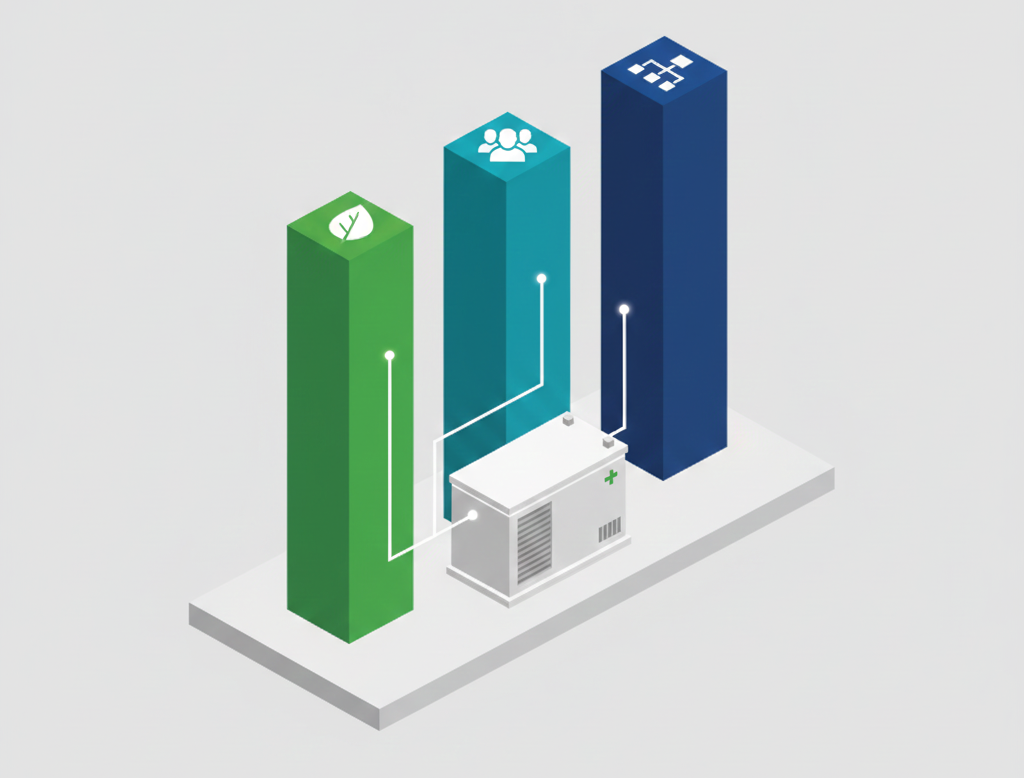
ESG encompasses three areas: Environmental, Social, and Governance.
Energy storage impacts each of them – though the strongest influence is obviously in the environmental domain.
E – Environmental
This is where BESS has the greatest impact. Specifically:
- Scope 2 Emissions Reduction
Scope 2 refers to indirect emissions from purchased electricity. For many industrial companies, these account for approximately one-third of their total carbon footprint – in some cases even more (https://www.climatepartner.com/en/news-insights/glossary/scope-2-emissions).
How does BESS help?
- Storing cheap renewable energy (from your own installation or the grid) and using it during peak hours
- Avoiding grid consumption during hours when the energy mix is most carbon-intensive
- Integration with on-site PV – maximizing self-consumption
Grid emission factors vary throughout the day. Energy consumed at night (when coal dominates) has higher carbon intensity than energy during midday (when solar is generating). Storage allows you to “shift” consumption to lower-emission hours.
- Reducing Renewable Energy Curtailment
If you have your own PV installation, you probably know the overproduction problem. On weekends, holidays, or simply on sunny days, generation exceeds consumption.
Without storage, this energy is wasted or fed back to the grid at a fraction of its value. With storage, you use it later.
This isn’t just about savings. It’s also a concrete metric for your ESG report: “X MWh of renewable energy utilized through storage instead of being curtailed.”
- Supporting Climate Neutrality Goals
More and more companies are declaring net-zero or carbon neutrality targets. Energy storage is one of the tools to achieve them – especially when combined with renewables.
S – Social
Less obvious, but real:
- Energy Security
BESS can provide backup power for critical processes. In ESG terms, this is an element of organizational resilience.
- Employment Stability
Companies with predictable energy costs are more stable employers. This may seem like a stretch, but ESG reports consider the holistic picture.
- Local Communities
BESS projects (especially utility-scale) create jobs during construction and maintenance. Some companies also report positive impacts on local grids – storage can relieve infrastructure in the region.
G – Governance
- Energy Risk Management
Storage is part of a strategy for managing price and availability risk. In ESG terms, this demonstrates organizational maturity in managing climate and transition risk.
- Long-term Planning
Investing in BESS is a 15-20 year decision. It shows the company is thinking strategically about energy transition.
- Transparency
Data from the energy management system (EMS) of your storage can feed ESG reporting with concrete, measurable indicators.
EU Taxonomy – Is BESS “Green”?
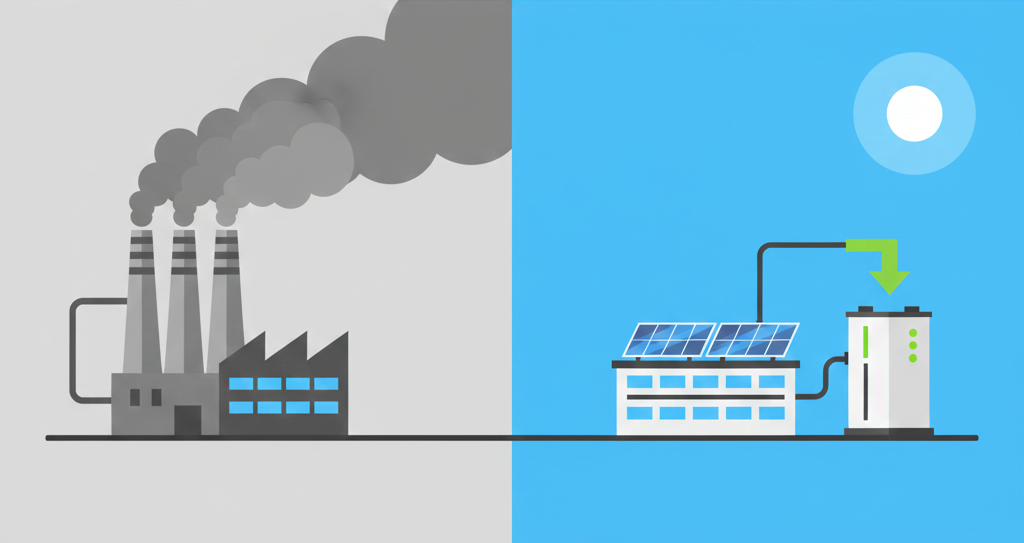
This is a key question for anyone seeking financing or wanting to demonstrate compliance with EU sustainability standards.
Short answer: YES.
Electricity storage is an eligible activity under the EU Taxonomy in the “Climate Change Mitigation” category.
Specifically:
- Activity 4.10: “Storage of electricity”
- Objective: supporting RES integration and grid stability
- Legal basis: Delegated Regulation (EU) 2021/2139 – Climate Delegated Act, Annex I (https://finance.ec.europa.eu/regulation-and-supervision/financial-services-legislation/implementing-and-delegated-acts/taxonomy-regulation_en)
Conditions for qualifying as a sustainable activity:
- The installation serves to store energy and subsequently release it to the grid or user
- Does not cause significant harm to other environmental objectives (DNSH principle – Do No Significant Harm)
- Meets minimum social safeguards (human rights, labor standards)
Sources:
- European Commission – EU Taxonomy (https://finance.ec.europa.eu/sustainable-finance/tools-and-standards/eu-taxonomy-sustainable-activities_en)
- Florence School of Regulation – The importance of EU taxonomy for electricity storage (https://fsr.eui.eu/publications/?handle=1814/70475)
What does this mean in practice?
If your company reports Taxonomy alignment (and large companies must), investing in BESS can increase:
- Share of turnover from environmentally sustainable activities
- Share of CAPEX in Taxonomy-aligned activities
- Share of OPEX in Taxonomy-aligned activities
These are concrete KPIs that investors and banks analyze.
Green Financing – Why Banks Like BESS

In 2024, green bond issuance by Polish companies reached a record USD 3.2 billion according to Bloomberg (https://esgnews.com/polands-state-fund-to-drive-green-bonds-and-730m-annual-investment-in-energy-transition/). In June 2025, Poland issued its first sovereign green bonds in 6 years, worth EUR 1.2 billion (https://www.bloomberg.com/news/articles/2025-06-30/poland-is-selling-green-bonds-for-first-time-in-six-years).
Energy storage is among the preferred targets for green financing. Why?
- Taxonomy Compliance
Banks must report their “Green Asset Ratio” – the share of assets aligned with the EU Taxonomy. Financing BESS improves this ratio.
- Clear Environmental Objective
Unlike some investments where “greenness” is debatable, energy storage has an unambiguous purpose: supporting renewables and decarbonization.
- Measurable Impact
The environmental benefit of BESS is easy to calculate: how many MWh of renewable energy were stored and used instead of carbon-intensive grid power. The methodology for calculating environmental benefits is described, for example, in NFOŚiGW documentation (https://www.gov.pl/web/funduszmodernizacyjny/magazyny-energii-elektrycznej-i-zwiazana-z-nimi-infrastruktura-dla-poprawy-stabilnosci-polskiej-sieci-elektroenergetycznej2).
- Growing Market
Poland’s state development fund PFR SA plans to allocate most of its annual investment budget (PLN 3 billion / ~EUR 700 million) to energy projects, including energy storage and offshore wind (https://esgnews.com/polands-state-fund-to-drive-green-bonds-and-730m-annual-investment-in-energy-transition/).
Globally, sustainable finance issuance in Central and Eastern Europe has been booming – total issuance in Q1-Q2 2025 grew from USD 19.5 billion in 2024 to USD 31.5 billion in 2025 (https://think.ing.com/articles/global-sustainable-finance-2025-mixed-results-highlight-regional-differences/).
Sources:
- ESG News – Poland’s State Fund to Drive Green Bonds (https://esgnews.com/polands-state-fund-to-drive-green-bonds-and-730m-annual-investment-in-energy-transition/)
- ING Think – Global sustainable finance 2025 (https://think.ing.com/articles/global-sustainable-finance-2025-mixed-results-highlight-regional-differences/)
- Ørsted Green Finance Framework – BESS as eligible project (https://orsted.com/en/investors/debt/green-financing)
What does this mean for investors?
BESS projects with well-documented ESG strategy can expect:
- Lower credit margins (green premium)
- Better access to long-term financing
- Greater interest from ESG funds
But be aware: banks require concrete data. “We’re planning energy storage” isn’t enough. You need to show:
- Projected CO2 emission reductions
- Expected share of renewables in stored energy
- Impact on the company’s ESG metrics
How BESS Affects Specific ESRS Indicators
The European Sustainability Reporting Standards (ESRS) define what and how companies must report.
Energy storage can positively impact several key areas:
ESRS E1 – Climate Change
This is the main standard for BESS. It requires disclosure of:
GHG Emissions:
- Scope 1 (direct) – BESS doesn’t directly impact this
- Scope 2 (indirect from energy) – here BESS can significantly reduce emissions
- Scope 3 (value chain) – for BESS manufacturers/suppliers
Climate Targets:
- BESS as part of decarbonization strategy
- Measurable contribution to emission reduction targets
Emission Intensity:
- CO2 emissions per unit of production or revenue – BESS can improve this metric
ESRS E2 – Pollution
Less direct impact, but:
- Reducing emissions from coal-based power = reducing air pollutants (SO2, NOx, particulates)
- This can be shown as an indirect positive impact
ESRS E5 – Circular Economy
For BESS manufacturers and operators:
- Battery recycling policy
- Second-life applications (using batteries after their primary cycle for other purposes)
- Responsible end-of-life management
ESG vs. ROI – Are They Mutually Exclusive?
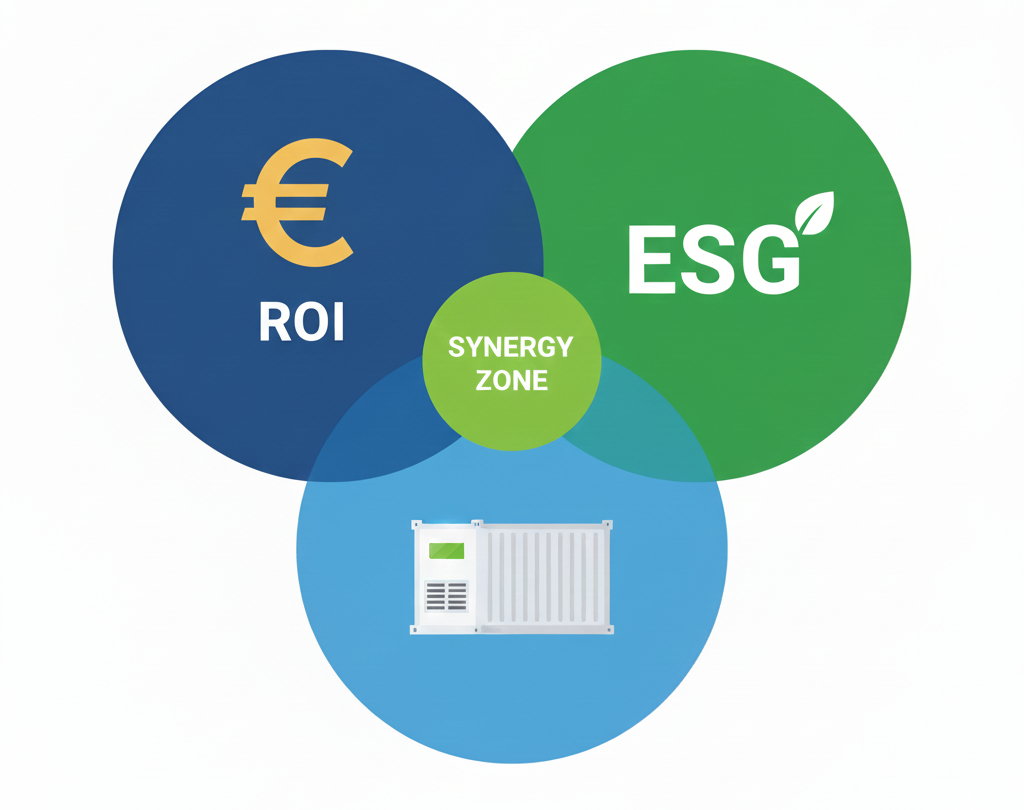
A common question: “Does investing in BESS for ESG purposes make economic sense, or is it just a compliance cost?”
The answer depends on context, but increasingly ESG and ROI go hand in hand.
Where BESS delivers returns + ESG value:
- High energy consumption industries
- Energy cost optimization (arbitrage, peak shaving)
- PLUS: Scope 2 reduction, improved emission intensity
- Companies with own PV
- Maximizing self-consumption
- PLUS: Higher share of renewables in energy mix
- Projects with subsidies
- NFOŚiGW, Modernization Fund – grants up to 65%
- Significantly improve ROI
- PLUS: All ESG benefits
Where ESG may be the primary driver:
- Companies in large corporations’ value chains
- Customers require emissions reporting
- BESS as part of a “green” offering
- Companies seeking green financing
- BESS improves ESG profile
- Easier access to capital
- Companies preparing for IPO or M&A
- ESG increasingly important in valuations
- BESS as a “hard” decarbonization investment
Practical Steps – How to Include BESS in Your ESG Strategy
If you’re considering energy storage as part of your ESG strategy, here’s what to do:
- Energy and Emissions Audit
Before investing, you need to know:
- What is your current energy consumption profile?
- What are your Scope 2 emissions?
- Where are the biggest opportunities for reduction?
- BESS Scenario Analysis
Not every storage system delivers the same ESG benefits. Key questions:
- Stand-alone or integrated with PV?
- What will be the charging source (grid, RES, hybrid)?
- What operating model (self-consumption, arbitrage, grid services)?
- Calculate Impact on ESG Metrics
Before investing, calculate:
- Projected CO2 emission reduction (in tonnes/year)
- Change in emission intensity (kgCO2/production unit)
- Share of renewables in energy mix after implementation
- Documentation for Reporting
Collect data from the start:
- EMS data (amount of energy stored/released)
- Source of charging energy (distinguishing RES/grid)
- Emissions avoided through storage
- Integration with CSRD Reporting
BESS should be included in:
- Company’s climate strategy
- Decarbonization action plan
- Taxonomy alignment disclosures
FAQ
- Does energy storage need to be large to impact ESG?
No. Even smaller installations (100-500 kWh) can have a measurable impact on a company’s ESG metrics, especially when combined with PV. What matters is the proportion relative to your energy consumption profile.
- Does BESS automatically mean Taxonomy compliance?
Not automatically. The installation must meet technical criteria and the DNSH principle (Do No Significant Harm). This requires proper documentation and verification.
- How long before BESS improves ESG metrics?
Impact is visible from the first full year of operation. But full benefits (including amortization of Taxonomy-aligned CAPEX investment) are spread across the installation’s entire lifetime (15-20 years).
- Should companies not subject to CSRD also consider BESS in ESG context?
Yes, for several reasons: corporate customer requirements, access to green financing, preparation for future regulations, competitive advantage.
- What BESS data is needed for ESG reporting?
Minimum: amount of stored energy, energy source (RES/grid), amount of energy released, avoided CO2 emissions. The EMS system should collect this data automatically.
- Does BESS affect a company’s ESG rating?
Yes, indirectly. Rating agencies (MSCI, Sustainalytics, ISS) evaluate decarbonization efforts. BESS as a concrete investment in energy transition can positively affect scores in the “Climate” or “Environmental” category.
Summary
Energy storage is not just technology for cost optimization. It’s a concrete tool in a company’s ESG strategy.
What BESS delivers in ESG context:
- ✅ Scope 2 emissions reduction
- ✅ EU Taxonomy compliance
- ✅ Easier access to green financing
- ✅ Concrete data for CSRD reporting
- ✅ Element of decarbonization strategy
But to materialize these benefits, you need a strategic approach. It’s not enough to buy storage – you need to properly design it, integrate it with reporting systems, and document the results.
How Can We Help?
GreenEdge Solutions supports companies in integrating energy storage with ESG strategy:
🔍 ESG-Energy Audit
- Analysis of emission and energy consumption profile
- Identification of reduction potential through BESS
- Mapping to CSRD/ESRS requirements
📊 BESS Feasibility Study with ESG Perspective
- Calculation of impact on ESG metrics
- EU Taxonomy compliance analysis
- Financial model including green premium
📋 Reporting Support
- Preparation of BESS data for ESG report
- Taxonomy compliance documentation
- Verification of avoided emissions calculation methodology
🏗️ Development and Execution
- Full BESS project development
- Coordination with ESG requirements
- Environmental impact monitoring and reporting
Schedule a consultation – we’ll analyze how BESS can strengthen your ESG strategy.
Note on Sources
Information contained in this article is based on publicly available sources, including:
- Official communications from the European Commission
- Analysis from advisory firms (PwC, Grant Thornton, EY)
- NFOŚiGW and support program documentation
- Industry and academic publications
Legal status as of: December 2025. ESG regulations and EU Taxonomy are subject to ongoing changes – before making investment decisions, we recommend consulting with a legal advisor or ESG specialist.
This article is for informational purposes and does not constitute legal, tax, or investment advice.
Related articles:
Complete Guide to BESS Project Delivery Models in Poland – EPC vs BoP
How to Choose an EPC Contractor for Your Battery Storage Project in Poland
BESS Project Development in Poland: Why Most Energy Storage Projects Never Get Built