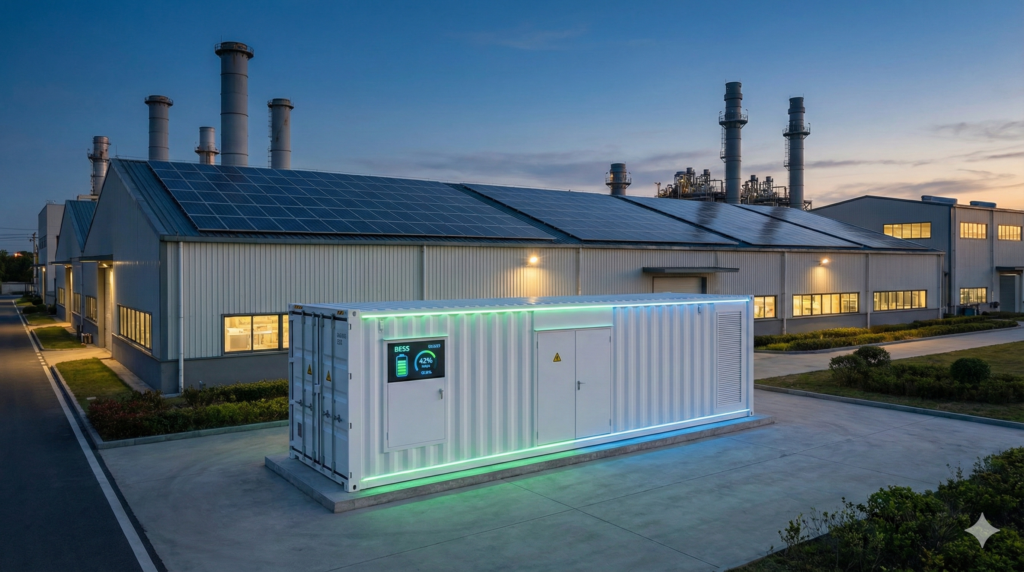
Battery Energy Storage for Manufacturing: When Does BESS Make Sense for Industrial Facilities?
Meta description: Industrial battery energy storage systems (BESS) – when is the investment worthwhile? Comprehensive analysis of use cases: peak shaving, PV integration, backup power. A practical guide for plant managers and energy directors.
Reading time: ~12 minutes
Last updated: December 2025
Introduction: The Industrial Energy Challenge in Europe
Industrial electricity prices across Central and Eastern Europe have reached critical levels. For energy-intensive sectors—steel production, chemicals, food processing—this directly threatens competitiveness and operational viability.
According to Eurostat data from the first half of 2025, Poland ranks second in the EU for electricity prices when adjusted for purchasing power (35 PPS per 100 kWh)—just behind Czechia. Moreover, Poland recorded the third-fastest electricity price increase in the EU (+20% year-on-year), surpassed only by Luxembourg and Ireland. Similar pressures affect manufacturers across Germany, Italy, and other European markets.
Simultaneously, wholesale price volatility has reached unprecedented levels. In the first ten months of 2025, day-ahead prices on the Polish Power Exchange (TGE) fluctuated between -500 PLN/MWh and +1,900 PLN/MWh (approximately -€115 to +€440/MWh). Negative pricing episodes—virtually unknown in the region just a few years ago—are becoming increasingly frequent, particularly during spring and summer months.
This volatility is a direct consequence of the energy transition. In June 2025, renewable energy sources generated more electricity than coal for the first time in Poland’s history (44.1% vs 43.7%). As intermittent renewable capacity continues to grow across Europe, price volatility will intensify further.
This raises a critical question: Can battery energy storage systems (BESS) address industrial energy challenges?
The answer is: it depends. BESS is not a universal solution for every manufacturing facility. However, in specific circumstances, it can deliver measurable benefits—both financial and operational.
This article examines:
- When BESS makes business sense for industrial facilities
- Quantifiable benefits of energy storage
- Industry-specific analysis and use cases
- When to wait or consider alternatives
When Does Energy Storage Make Sense for Industry?
Before examining the benefits, let’s identify situations where BESS can genuinely deliver value. Not every facility is a suitable candidate.
Scenario 1: High Demand Charges and Peak Load Spikes
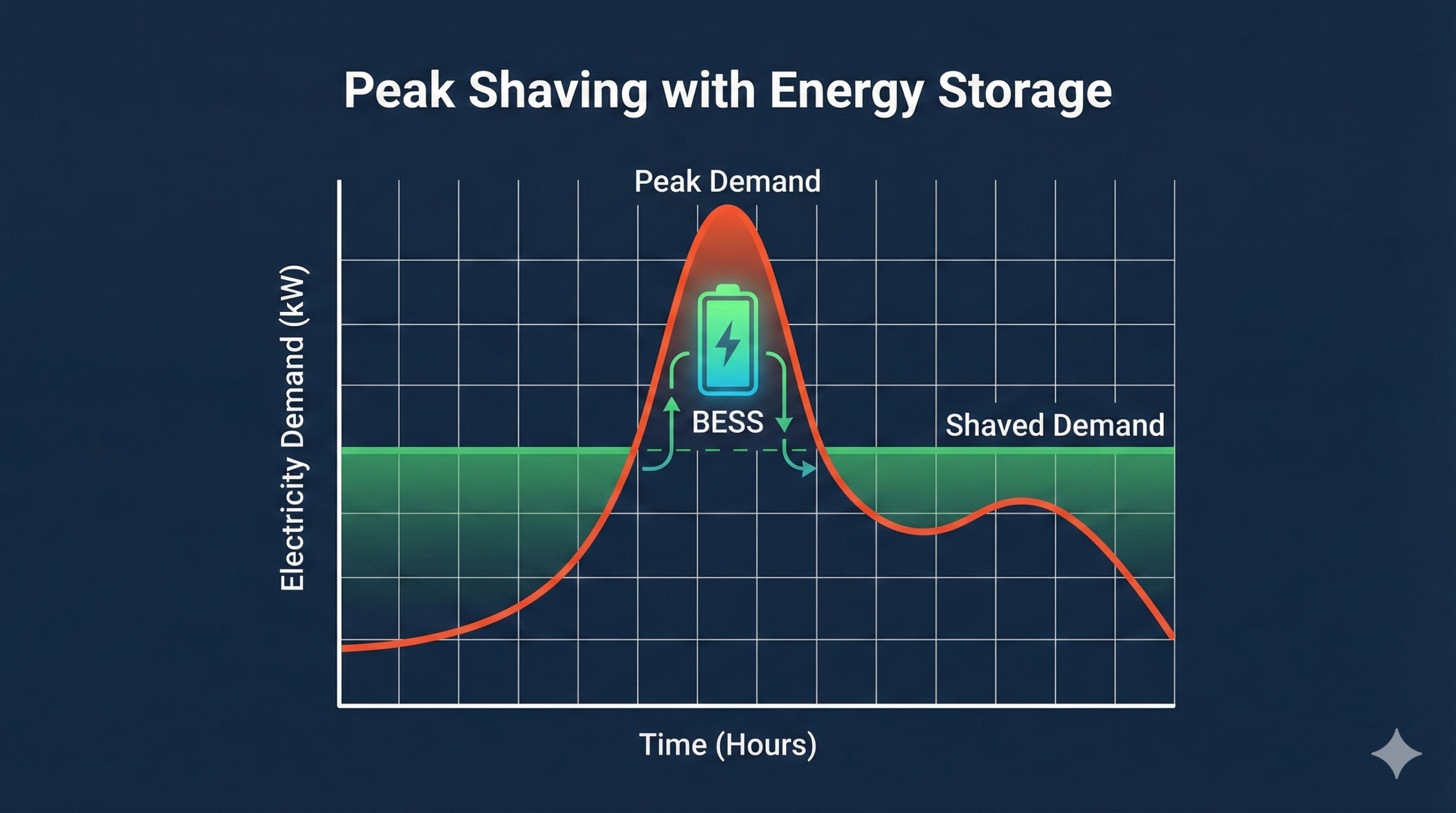
The Problem: Your facility has a distinctive consumption profile with pronounced peaks—for example, when starting production lines, activating furnaces, compressors, or refrigeration systems. These short-duration peaks (even 15-minute intervals) determine demand charges for the entire billing period.
Why BESS Helps: Energy storage can “shave” peak demand by supplying power during periods of highest consumption. Instead of drawing 2 MW from the grid, you draw 1.5 MW plus 0.5 MW from storage.
Optimal Applications:
- Facilities with short but intensive peaks (equipment startup)
- Variable load operations throughout the day
- Companies where demand charges represent a significant portion of energy costs
According to the U.S. National Renewable Energy Laboratory (NREL), for commercial and industrial customers, demand charges can constitute 30-70% of total electricity bills. European industrial tariffs show similar patterns, particularly in markets with capacity-based pricing mechanisms.
Scenario 2: On-Site PV Installation with Excess Generation
The Problem: You have rooftop or ground-mounted photovoltaic systems. During weekends, holidays, or peak solar hours, you generate more electricity than you consume. The surplus feeds into the grid at significantly lower rates than your purchase price.
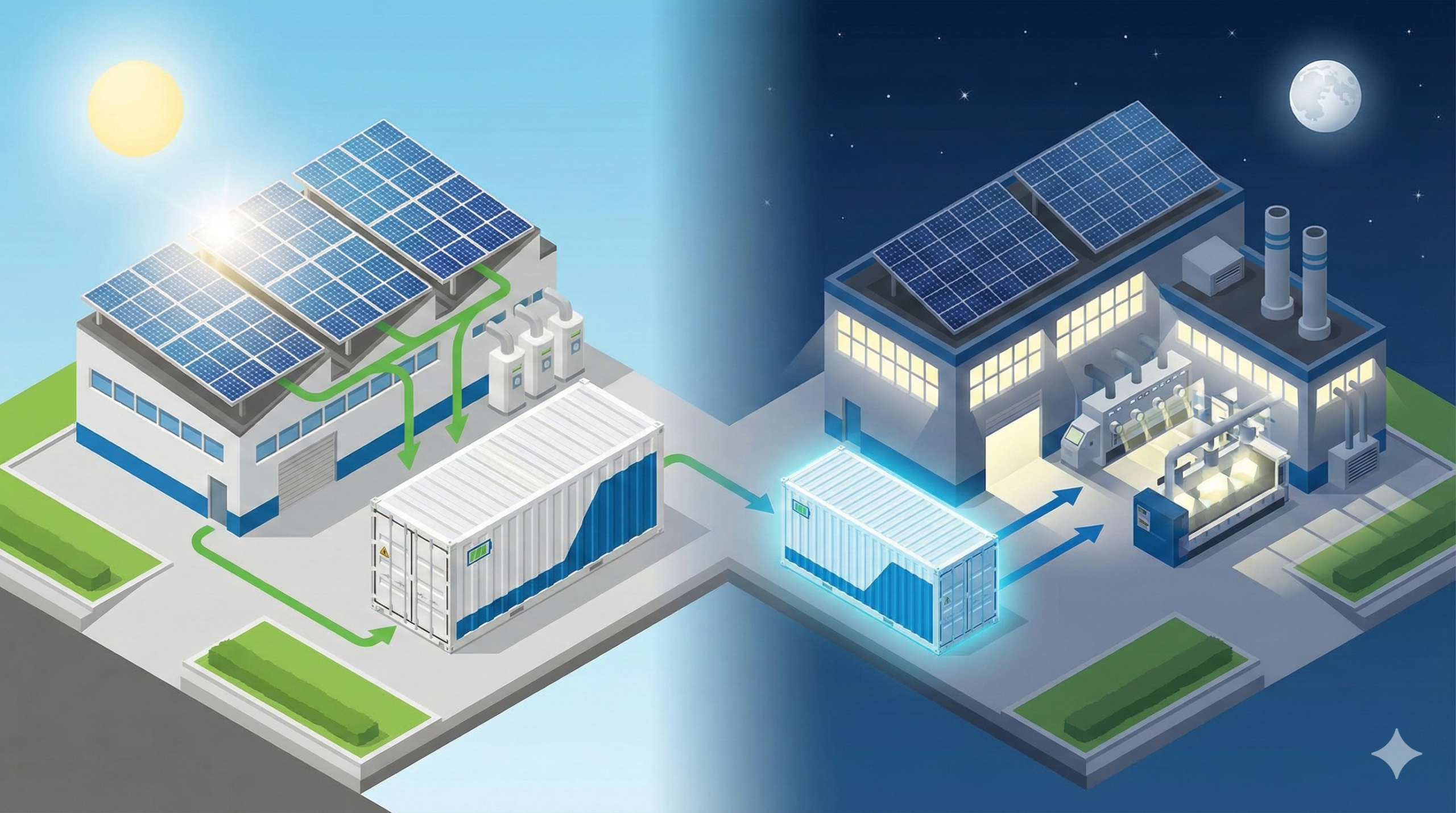
Why BESS Helps: Storage enables you to capture surplus generation and utilize it during evening hours, overnight, or Monday morning. You maximize self-consumption rather than exporting energy at unfavorable rates.
Optimal Applications:
- Facilities with PV installations and five-day operations (weekends = overproduction)
- Sites with timing mismatch between PV generation (daytime) and peak consumption (evening)
- Locations with grid export limitations
European Context: In 2024, total renewable energy curtailment in Poland reached 731 GWh. By September 2025, this figure had already exceeded 1,131 GWh—more than 50% higher than the entire previous year. Similar curtailment challenges affect grid-constrained regions across Germany, Spain, and other high-renewable markets. Storing surplus generation becomes increasingly valuable when the alternative is forced production curtailment.
Scenario 3: Critical Processes Requiring Power Continuity
The Problem: Your production processes are sensitive to power interruptions. Even brief outages (several seconds) can result in:
- Process interruption and batch loss
- Product spoilage or quality degradation
- Equipment damage
- Costly restart procedures
Why BESS Helps: Battery storage provides instantaneous switchover to backup power (milliseconds versus seconds for diesel generators). It can serve as a bridge until generator startup or grid restoration.
Optimal Applications:
- Food and beverage (cold chain continuity)
- Chemical processing (controlled reactions)
- Electronics and semiconductors (cleanroom environments)
- Continuous 24/7 operations
According to ABB’s “Value of Reliability” survey (2023), over two-thirds of industrial businesses experience unplanned downtime at least once monthly, with average costs of $125,000 per hour. ABB’s 2025 follow-up report indicates that 76% of respondents estimate downtime costs up to $500,000 per hour.
Scenario 4: Time-of-Use Tariffs and Dynamic Pricing
The Problem: You purchase electricity on wholesale markets or have time-differentiated tariffs. The spread between peak and off-peak prices is substantial.
Why BESS Helps: Energy arbitrage—charge storage when electricity is inexpensive (overnight, weekends), discharge when prices are high (daytime peaks). This is a fundamental BESS business model.
Optimal Applications:
- Facilities with flexible consumption profiles
- Companies purchasing on spot markets or with TOU tariffs
- Locations with significant price volatility
Regulatory Development: Since 2024, all major electricity suppliers in Poland must offer dynamic tariffs where prices change hourly based on wholesale market rates. Given current volatility (ranging from -€115 to +€440/MWh), arbitrage potential is significant. Similar dynamic pricing frameworks are expanding across EU member states under the Clean Energy Package. Effective arbitrage requires intelligent energy management systems (EMS) and smart metering infrastructure.
Scenario 5: Grid Connection Constraints
The Problem: You want to expand facility capacity, but:
- The distribution operator refuses to increase connection capacity
- Grid upgrade costs are prohibitive
- Lead time for new connections extends to years
Why BESS Helps: Storage can function as a “power buffer”—enabling temporary capacity exceedance without drawing additional power from the grid. Charge during low-demand periods, discharge when you need additional capacity.
Optimal Applications:
- Facilities in locations with constrained grid infrastructure
- Companies planning expansion without connection upgrade options
- Projects facing extended timelines for grid connection approval
Quantifiable Benefits of Industrial BESS
Let’s move from theory to concrete outcomes. These are the measurable benefits that energy storage can deliver in manufacturing environments.
- Energy Cost Reduction
Peak Shaving (Demand Charge Reduction):
- Demand charge reductions of 20-40%
- Results visible from the first billing cycle
- Greater savings with more “spiky” load profiles
A case study from Taiwan demonstrates that a manufacturing facility with a 125 kW / 250 kWh system achieved 28% monthly energy cost reduction through peak shaving and TOU optimization (source: EticaAG).
Energy Arbitrage:
- Purchase electricity when cheap, consume when expensive
- Particularly profitable given current European price volatility
- Requires active management through EMS
PV Self-Consumption Maximization:
- Increase PV utilization from 40-60% to 80-95%
- Avoid unfavorable feed-in tariff conditions
- Reduce exposure to wholesale market volatility
- Production Continuity and Downtime Protection
Instantaneous Backup:
- Battery switchover in milliseconds (versus 10-30 seconds for generators)
- No power “flicker”—critical processes remain uninterrupted
- Bridge power until generator startup or grid restoration
Downtime Cost Avoidance:
Industrial downtime costs can be substantial. According to Siemens’ “True Cost of Downtime 2024” report:
- Automotive sector: Up to $2.3 million per hour of downtime
- Large manufacturing facilities: $500,000 – $1 million per hour
- Heavy industry: Costs have increased 1.6x since 2019
For an automotive manufacturer producing 1,200 vehicles daily, a single day of downtime represents potential losses of $60 million.
Power Quality Improvement:
- Voltage stabilization
- Protection against switching transients during grid restoration
- Extended equipment lifespan for sensitive machinery
- Operational Flexibility
Grid Independence:
- Island mode operation capability
- Reduced vulnerability to grid disturbances
- Microgrid options for critical processes
Load Shifting:
- Flexibility in scheduling energy-intensive production
- Ability to respond to price signals
- Real-time cost optimization
Expansion Support:
- Increase effective capacity without grid upgrades
- Buffer capacity for new production lines
- Phased development capability
- ESG and Regulatory Benefits
Emissions Reduction:
- Lower Scope 2 emissions by shifting consumption to low-carbon hours
- Maximize utilization of on-site renewables
- Concrete metrics for CSRD reporting
EU Taxonomy Alignment:
- Energy storage qualifies as an eligible activity (4.10)
- Impact on taxonomy-aligned CAPEX and OPEX ratios
- Improved access to green financing instruments
- Additional Revenue Streams
Grid Services:
- Balancing market participation (at appropriate scale)
- Flexibility services for transmission system operators
- Demand response program participation
Capacity Markets:
- Storage assets can participate in capacity auctions
- Additional revenue stream (accounting for derating factors)
Virtual Power Plants (VPP):
- Aggregation with other distributed assets
- Wholesale market access through aggregator platforms
Industry Analysis: Where BESS Delivers Maximum Value

Food and Beverage Manufacturing
Industry Characteristics:
- Significant cooling demand (cold chain integrity)
- Variable loads (seasonality, production changeovers)
- Critical continuity for perishable products
- Often existing rooftop PV potential
BESS Applications:
- Cold storage and freezer facilities—backup plus peak shaving
- Bottling and packaging lines—power stability
- Industrial bakeries—managing oven demand peaks
Potential Benefits:
- Product loss prevention (inventory protection)
- Demand charge reduction from refrigeration compressors
- PV self-consumption maximization
Metals and Steel Production
Industry Characteristics:
- Extremely energy-intensive processes
- Electric arc furnaces create severe demand spikes
- Energy costs as significant percentage of production costs
- Sensitivity to power quality
BESS Applications:
- Peak shaving for arc furnace operations
- Voltage stabilization for precision processes
- Backup for control and safety systems
Potential Benefits:
- Significant demand charge reduction
- Equipment protection from voltage transients
- Arbitrage opportunities given high consumption volumes
Important Consideration: Energy consumption in steel production is substantial; BESS may address only a portion of requirements rather than providing a comprehensive solution.
Chemical and Pharmaceutical Manufacturing
Industry Characteristics:
- Continuous processes requiring stability
- Stringent safety requirements
- Costly process interruptions (batch losses)
- Regulatory continuity requirements (GMP compliance)
BESS Applications:
- Backup for reactors and batch processes
- Safety system power supply
- Laboratory and cleanroom stabilization
Potential Benefits:
- Batch loss prevention
- Regulatory compliance support
- Cold chain continuity (pharmaceutical)
Automotive and Electronics Manufacturing
Industry Characteristics:
- Just-in-time production (minimal inventory buffers)
- High downtime costs (supply chain impact)
- Precision processes (welding, assembly)
- Often large rooftop areas suitable for PV
BESS Applications:
- Assembly line backup power
- Peak shaving for welding and robotics
- PV system integration
Potential Benefits:
- Downtime minimization (supply chain cost avoidance)
- Stability for robotics and automation systems
- ESG targets (automotive sector under decarbonization pressure)
Logistics Centers and Warehouses
Industry Characteristics:
- Large rooftop areas (significant PV potential)
- Cold storage and refrigerated logistics
- Electric vehicle fleet charging (growing trend)
- Shift-based operations (variable loads)
BESS Applications:
- PV self-consumption maximization
- EV charger load buffering (avoiding grid upgrades)
- Backup for automated sorting systems
Potential Benefits:
- Avoiding grid infrastructure costs for EV charging
- Rooftop space monetization
- Reduced cold storage operating costs
When BESS May Not Be the Right Solution

An honest assessment—not every facility should invest in energy storage. Consider these scenarios where caution is warranted:
Flat Load Profile
If your consumption is stable throughout the day, week, and year, peak shaving benefits will be minimal. BESS performs best with “spiky” demand profiles.
Low Energy Prices or Fixed Tariffs
If you purchase electricity at fixed rates without demand components or time-of-use differentiation, arbitrage and peak shaving potential is limited.
No On-Site Renewables and No Plans
Without PV or wind generation, you lose a primary BESS value proposition (self-consumption maximization). Standalone arbitrage rarely justifies investment at current battery prices.
Short Investment Horizon
BESS is an 8-12+ year investment. If facility sale or relocation is planned within 3-5 years, payback may not be achieved.
Adequate Existing Backup Solutions
If you have reliable diesel generator systems and don’t experience power quality issues, the backup argument for BESS weakens—unless ESG considerations drive diesel phase-out.
Scale Mismatch
- Too small: Fixed BESS costs (systems, integration) don’t justify small capacity
- Too large: For extremely energy-intensive operations, BESS covers only a fraction of demand with marginal cost impact
How to Evaluate BESS for Your Facility
If you recognize your situation in the scenarios described, here are the steps to proceed:
Step 1: Load Profile Analysis
Data Collection:
- 15-minute interval data for the past 12 months
- Peak and valley identification
- Seasonality analysis
Key Questions:
- How do peaks compare to average consumption?
- When do they occur (time of day, day of week)?
- Are they predictable?
Step 2: Cost Structure Analysis
Electricity Bill Breakdown:
- Energy charges (consumption-based)
- Demand/capacity charges
- Applicable tariff structures (TOU, flat rate)
Opportunity Identification:
- Where are the greatest optimization opportunities?
- What drives costs—energy or demand?
Step 3: Asset Inventory
Existing Resources:
- PV installation? Capacity and generation profile?
- Diesel generators? Efficiency, fuel costs?
- UPS systems? Capacity, age?
Planned Investments:
- PV expansion?
- Fleet electrification?
- New production lines?
Step 4: Priority Definition
Primary Investment Objective:
- Energy cost reduction?
- Production continuity/backup?
- Renewable maximization?
- Grid connection constraint resolution?
- ESG targets?
Priority ranking influences technology selection and system sizing.
Step 5: Preliminary Sizing and Business Case
Parameters to Define:
- Power rating (kW)—peak discharge capability?
- Energy capacity (kWh)—duration of discharge?
- Operating mode—peak shaving, arbitrage, backup, hybrid?
Business Case Fundamentals:
- CAPEX (storage system, installation, integration)
- OPEX (maintenance, replacement reserves, insurance)
- Annual savings/revenue projections
- Payback period
- NPV/IRR over projected lifetime
Frequently Asked Questions
- What storage capacity for a 1 MW facility?
There’s no simple formula—it depends on load profile and objectives. For peak shaving, a common approach is 1-2 hours of capacity at power levels matching the peaks to be shaved. For backup, size for critical process requirements until alternative supply activation. Typical industrial behind-the-meter (BTM) installations range from 100 kWh to 10 MWh.
- Can BESS replace diesel generators?
It can complement but rarely fully replace. BESS provides instantaneous response (milliseconds) and short-term backup (minutes to hours). Diesel generators provide extended autonomy. The optimal solution is often hybrid: BESS as bridge power plus diesel for prolonged outages.
- What is the lifespan of industrial storage systems?
Typical warranties cover 5 years with extensions available to 10 or even 15 years, or specified cycle counts (e.g., 6,000-12,000 cycles). With proper operation, realistic lifespan is 12-15 years with capacity degradation to 70-80% of initial rating. A system at 70% capacity remains operational—you simply have reduced available energy.
- Is new electrical infrastructure required?
Typically yes—transformer, switchgear, cabling, EMS. Scope depends on installation size and existing infrastructure. This can represent 20-40% of total project costs.
- What permits are required?
For BTM installations, requirements are typically less complex than front-of-meter projects. Usually required: building permit (for containerized systems), distribution operator coordination, fire safety approval. Specifics vary by jurisdiction and scale.
- Can I start smaller and expand later?
Yes, many BESS systems are modular. However, plan infrastructure (transformer, physical space) for target capacity from the outset. Battery module expansion is relatively straightforward.
Summary
Energy storage can be a valuable tool for manufacturing facilities—but it’s not a universal solution.
BESS delivers maximum value when:
- ✅ You have a “spiky” load profile with high demand charges
- ✅ You have on-site PV with excess generation
- ✅ Critical processes require power continuity
- ✅ You experience significant energy price volatility
- ✅ Grid connection constraints limit expansion
Consider carefully when:
- ⚠️ Load profile is flat
- ⚠️ No on-site renewables and no plans to install
- ⚠️ Investment horizon is shorter than 7-10 years
- ⚠️ Scale is either too small or too large
The key is rigorous analysis of your specific situation. Industry benchmarks provide a starting point, but decisions should be based on your data—load profiles, cost structures, development plans, and business priorities.
How GreenEdge Solutions Can Help
GreenEdge Solutions supports industrial facilities in evaluating potential and implementing energy storage systems:
🔍 Energy Audit with BESS Perspective
- 15-minute interval load profile analysis
- Peak shaving and arbitrage potential identification
- Backup and continuity requirements mapping
📊 BESS Feasibility Study
- System sizing aligned with objectives
- Financial modeling (CAPEX, OPEX, ROI)
- Scenario analysis (standalone, PV-integrated, hybrid)
📋 Investment Process Support
- Financing documentation preparation
- Distribution operator coordination (grid connection)
- Technology and contractor selection oversight
🏗️ Project Delivery
- Full-scope development
- Owner’s Engineer services during construction
- Commissioning and acceptance testing
Contact us —we’ll analyze whether BESS makes sense for your facility.
You want to know more? Listen to our podcast!
Sources and References
This article was prepared based on:
- Eurostat data (H1 2025)
- Industry reports: Siemens “True Cost of Downtime 2024,” ABB “Value of Reliability” 2023/2025, NREL
- Polish Power Exchange (TGE) and Forum Energii data
- International case studies and market analysis
- GreenEdge Solutions project experience
Legal and market status: December 2025. Individual facility analysis is recommended before investment decisions.
This article is for informational purposes only and does not constitute investment or technical advice.
Related Articles
Complete Guide to BESS Project Delivery Models in Poland – EPC vs BoP
How to Choose an EPC Contractor for Your Battery Storage Project in Poland
BESS Project Development in Poland: Why Most Energy Storage Projects Never Get Built
BESS as Part of Your ESG Strategy: How Energy Storage Impacts Sustainability Reporting