Introduction
On June 22, 2026, in Munich, CATL — the world’s largest battery manufacturer — unveiled TENER Sodium, an energy storage system the company itself calls “the world’s first field-validated sodium-ion BESS.” It’s worth flagging immediately: that’s the manufacturer’s own description, on a product that has yet to reach customers. Deliveries to China are due to start in September 2026, with global deliveries not until June 2027. A previously signed 60 GWh contract with China’s HyperStrong is, according to CATL, the largest sodium-ion cell order in the world to date — but it’s still a contract for the Chinese market, not proof of operation anywhere else, including Europe.
In the same period CATL was celebrating its Munich launch, two Western pioneers of this technology — Northvolt and Natron Energy — had already ceased to exist. That’s not a side note; it’s the context in which every sodium-ion announcement is worth reading.
Sodium-ion (Na-ion) cells have spent the past few years appearing in conference materials as “the next big thing” after LFP: cheaper raw material, no lithium, cobalt or nickel, better cold-weather performance. The reality is more mundane: this is still a technology accounting for less than 1% of global lithium-ion cell production, with one genuinely mature supplier, a handful of real deployments outside China, and several high-profile bankruptcies to its name. The promise of the technology and the reality of the supply chain remain, often, two different stories.
In this article we check: how many companies are actually manufacturing and deploying sodium-ion cells, where those deployments actually work, how Na-ion differs from LFP in project practice — not in marketing materials — and what a realistic, not aspirational, timeline for this technology looks like in BESS projects. To jump ahead: for most BESS projects being planned in Poland today, the answer is “not yet,” and LFP remains the safer choice.
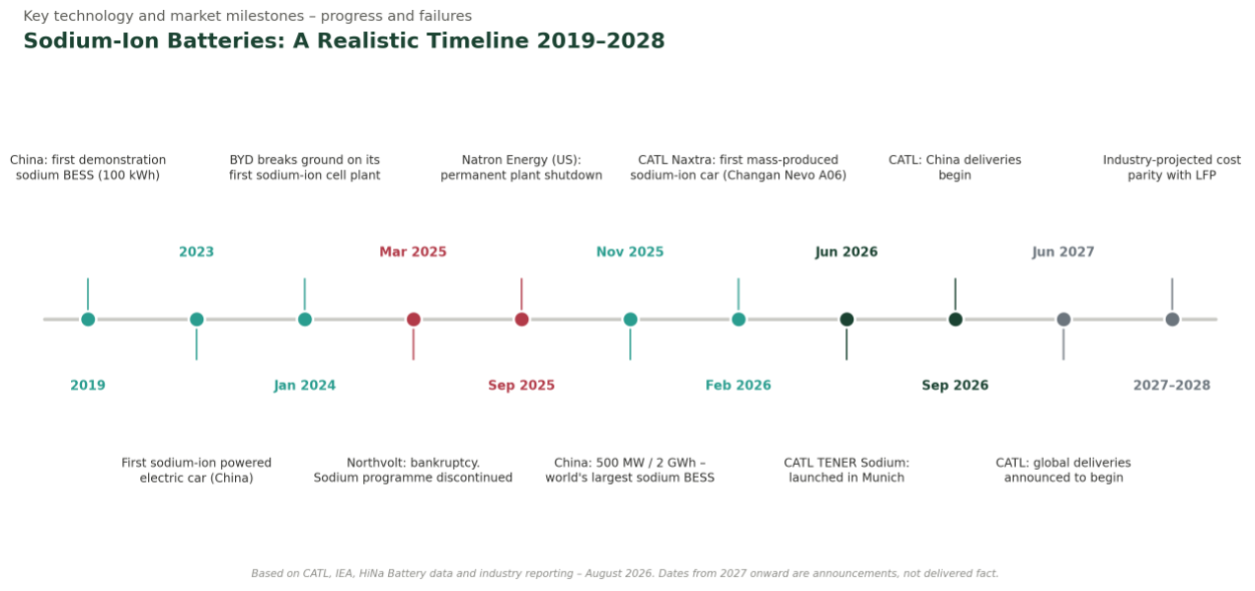
A realistic timeline of sodium-ion technology — launches and records alongside bankruptcies and delays. Sources: CATL, IEA, HiNa Battery.
Why sodium, why now
Sodium-ion technology isn’t new — the first lab work dates back to the early 1980s, running parallel to lithium-ion research. The difference is that lithium commercialization took off in 1991, while sodium research spent the following three decades in the shadows, simply because lithium worked better and was easier to source than it is today.
Renewed interest in sodium is being driven today by two concrete factors, not a general appetite for “something new.” The first is lithium price volatility — even though lithium prices remain about 70% below their 2022 peak, they doubled over the past year. For manufacturers maintaining several supply chains in parallel, sodium competence functions as an insurance policy against the next lithium price spike. The second factor is low-temperature performance, where sodium-ion cells do have a genuine edge over LFP — we’ll return to this in detail later.
Three main cathode chemistry families are commercializing today: layered oxides (the technology closest to large-scale commercialization, used by CATL among others), Prussian Blue/White Analogues (used by Natron Energy and Altris, among others), and polyanionic compounds, including sodium iron pyrophosphate (NFPP), which BYD and HiNa identify as the optimal path for grid-scale storage due to thermal stability and long cycle life. This isn’t one technology, but a family of competing solutions with different energy density, cost, and raw-material-intensity profiles — much as LFP, NMC, and NCA previously competed with each other in the lithium world.
The International Energy Agency (IEA) estimates that in 2025, global sodium-ion cell production accounted for less than 1% of lithium-ion cell production. That’s an important reference point before we get to more spectacular numbers. The sodium-ion cell is still a niche technology on the scale of the global battery market, even as it grows very quickly in China.
CATL in Munich: the first real sodium storage system, or another announcement with a firm date
The TENER Sodium launch deserves a detailed look, because it’s by far the most refined sodium-ion product aimed directly at the BESS market to date.
The system offers over 30 MWh of capacity per unit in a modular architecture — 34 modules make up a 1 GWh installation. CATL claims over 15,000 cycles at 25°C while retaining 70% capacity (said to correspond to 25–30 years of operation), over 10,000 cycles at 45°C, and more than 92% capacity retention at -20°C. On safety, the company cites: 40% lower cell expansion force, a maximum surface temperature of around 200°C during thermal runaway, 35% lower gas emissions, and an overcharge threshold raised to 140% SOC. The system also features a self-healing function — fault isolation in 200 milliseconds, restoration of the undamaged section’s functionality in 150 milliseconds.
That’s an impressive spec sheet. But three things are worth keeping in mind before you enter these numbers into your own project financial model.
- First — this is manufacturer data from the day of a new product launch, not data from years of field operation. CATL calls TENER Sodium “field-validated,” but we’re talking about a system whose deliveries to China have yet to start (September 2026), with global deliveries not until June 2027. As of this article’s writing, no European investor has a single full season of operating experience with this specific product.
- Second — 15,000 cycles and 25–30 years of service life is an extrapolation from accelerated testing, not an observation of an installation that has actually worked for three decades. It’s worth approaching these claims with the same caution we apply to LFP degradation guarantees — what matters is what the manufacturer actually guarantees in the contract, not what appears in a press release.
- Third — the 60 GWh contract with HyperStrong is real, signed in April 2026, and forms a carved-out portion of a much broader 10-year framework agreement (2026–2035) covering all of CATL’s cell types, which HyperStrong signed back in November 2025 (a minimum of 200 GWh for 2026–2028). This distinction matters: the 200 GWh figure isn’t a potential expansion of the sodium contract — it’s a separate, broader procurement commitment of which the sodium volume is one part. That distinction aside, the 60 GWh sodium contract itself remains real and the largest of its kind in the world — but it’s still a contract for the Chinese market. The scale of global expansion beyond China remains, for now, a declaration with a firm date, not an accomplished fact.
TENER Sodium isn’t CATL’s first sodium product — the company has been developing this technology for some time, alongside lithium cells, as part of its “dual-star” strategy. Earlier, in February 2026, Naxtra cells (175 Wh/kg, -40°C to 70°C operating range) went into the Changan Nevo A06 — the world’s first mass-produced passenger car running on sodium-ion cells, and the first sodium cells to pass the Chinese GB 38031-2025 traction battery safety standard. That demonstrates the company’s genuine technological maturity — but passenger-vehicle data doesn’t automatically translate to grid storage: it’s a different application, with a different cycling profile and different requirements.
China already has gigawatt-hours. The rest of the world — mostly announcements
According to IEA analysis based on Benchmark Mineral Intelligence data, nearly all current global sodium-ion cell manufacturing capacity is located in China, which also accounts for over 95% of announced manufacturing capacity through 2030. That’s the right starting point for understanding this technology’s actual geography.
In China
Beyond CATL, the second-largest player is BYD, which began construction of its first sodium-ion cell factory in January 2024, targeting automotive, grid storage, and industrial applications — the company has already launched sodium-ion forklifts, among other things. HiNa Battery, a smaller manufacturer but the first to power an electric vehicle with sodium-ion cells, is running real grid deployments: an installation in Qianjiang, Hubei province (first phase 100 MWh, ultimately 200 MWh), and a distribution-grid connection in Yongfu County, Guangxi, in March 2026, using its own polyanionic technology. In July 2026, HiNa and Tonly Heavy Industries launched China’s first sodium-ion mining truck — a 676 kWh pack, over 165 Wh/kg, more than 8,000 declared cycles. That’s a good example of the technology moving beyond pilots into everyday industrial work under demanding conditions.
The largest sodium-ion deployment in the world to date is the Xingkong Na Dazhou Maliu Industrial Park SIB Energy Storage Project, commissioned in November 2025 — by far the largest installation of this technology in the world to date, according to Rho Motion’s analysis. It’s worth distinguishing between two projects that are easy to confuse: that same month, the high-profile Anhui Conch Cement installation (500 MW/2 GWh) also came online in Tongliao, Inner Mongolia — the largest single standalone energy storage system commissioned in China to date, but it runs on LFP cells, not sodium-ion. Some industry materials incorrectly attribute sodium technology to it — worth keeping in mind, since it’s a good example of how easily even reputable sources can get this wrong in a still-immature industry.
Interestingly, even South Korea’s LG Energy Solution — the world’s third-largest battery manufacturer — built its sodium-ion pilot line not in Korea, but in Nanjing, China. That says a lot about where the mature ecosystem of suppliers, cathode materials, and hard carbon for anodes actually sits today.
Outside China: plenty of announcements, few gigawatt-hours
The European sodium-ion landscape looks different. France’s Tiamat — a CNRS spin-off backed by Stellantis Ventures, Arkema, and Bpifrance, among others — is ultimately planning a 5 GWh factory in Amiens, but the first phase (700 MWh) was originally scheduled for 2025 and has slipped to 2026, with full production capacity not expected until 2029. Sweden’s Altris, based on Prussian Blue technology, signed a partnership with Czech company Draslovka in January 2026 for cathode material production, and with Sweden’s Polarium for storage systems; its Ferrum installation is ultimately intended to enable 1 GWh of manufacturing capacity. Britain’s Faradion, a pioneer of the technology, has belonged to India’s Reliance Industries for several years and is developing primarily in India (transport, scooters, grid storage), where it plans to expand to 5 GWh.
Cautionary tales aren’t in short supply either. Sweden’s Northvolt, which loudly announced its own Prussian Blue-based sodium technology (160 Wh/kg) in November 2023, filed for bankruptcy in March 2025 — the largest bankruptcy in modern Swedish industrial history. Its assets were acquired in February 2026 by US-based Lyten (a lithium-sulfur cell manufacturer), which explicitly stated it would not continue the sodium direction. Northvolt’s sodium program has effectively ceased to exist. US-based Natron Energy — a Prussian Blue specialist targeting the data-center backup power market, which claimed as many as 25,000 cycles of service life — opened a factory in Michigan in 2024, but UL certification delays blocked $25 million worth of orders, and the company permanently shut down on September 3, 2025. The IEA itself cites this case as evidence of how difficult it is to build a competitive sodium-ion supply chain outside China. Britain’s AMTE Power met a similar fate, with its assets acquired by the Netherlands’ LionVolt.
The only actively developing sodium-ion player in North America today is Peak Energy, which signed a baseline 180 MW/720 MWh contract with Jupiter Power, with potential for expansion, and which has secured contracts totaling roughly 4.75 GWh worth $500 million. That’s a real but still isolated case set against a backdrop of over a dozen Western battery companies that failed between January 2025 and April 2026 — according to one industry analysis — despite having raised more than $20 billion in funding combined.
The takeaway from this section is simple: when someone shows you a slide listing ten sodium-ion companies worldwide, it’s worth asking how many of them are actually shipping product today, and how many are still hunting for funding for their first production line.
What it actually costs
This is the question hardest to answer clearly — and that difficulty is itself a signal of how immature this market still is.
Estimates of sodium-ion cell cost in 2026, published by various industry sources, range from around $50 to over $100/kWh, depending on cell format, cathode chemistry, and a given supplier’s production scale — and some of these estimates contradict each other even within the same source. That’s a good illustration of just how little standardized cost reporting exists in this industry so far. The IEA itself frames it more cautiously and more usefully: current lithium prices — despite last year’s rise — still aren’t high enough for sodium-ion cells to undercut LFP on price in most applications. In other words, sodium’s theoretical raw-material advantage (sodium carbonate costs an order of magnitude less than lithium carbonate) hasn’t yet fully translated into a cheaper finished cell.
Why not? The main bottleneck isn’t sodium itself, but the hard carbon anode — currently the only commercially mature anode material for sodium-ion cells, since the graphite used in lithium cells doesn’t work well with the larger sodium ion. Hard carbon accounts for as much as 35–45% of a cell’s material cost today. Chinese manufacturers are currently shifting from biomass precursors (coconut shells, with limited and uncertain supply) to coal/anthracite as a cheaper, scalable hard-carbon source, which has already brought prices below roughly $4,400 per tonne, with a target below $2,900/tonne. That’s real progress, but it also shows that sodium-ion cell cost today depends on the maturity of an entirely different supply chain than the one associated with “cheap sodium from table salt.”
The direction for the coming years appears fairly consistent across most analyses: as CATL and BYD production lines reach a scale of 30+ GWh annually (targeted for 2027–2028), sodium-ion cell costs are expected to approach or beat LFP parity. Until then, though — meaning within the horizon of investment decisions being made today — LFP remains the cheaper choice in most utility-scale applications, aside from specific niches we’ll return to in the forecast section.
It’s worth remembering that LFP isn’t standing still while sodium tries to catch up. According to BloombergNEF, lithium-ion pack prices for stationary storage fell 45% year-on-year in 2025, to around $70/kWh — the fastest decline of any battery market segment, driven largely by LFP itself. So sodium is chasing a target that keeps moving away. Even if CATL’s and BYD’s production lines hit their declared scale exactly on schedule, “LFP parity” in 2027–2028 will mean catching up to an LFP that’s far cheaper than today’s price lists suggest. That’s one reason to treat cost-parity forecasts with some reserve.
Sodium vs. LFP: the differences that matter to an investor
Setting marketing aside, here’s where the technologies actually differ in project practice.
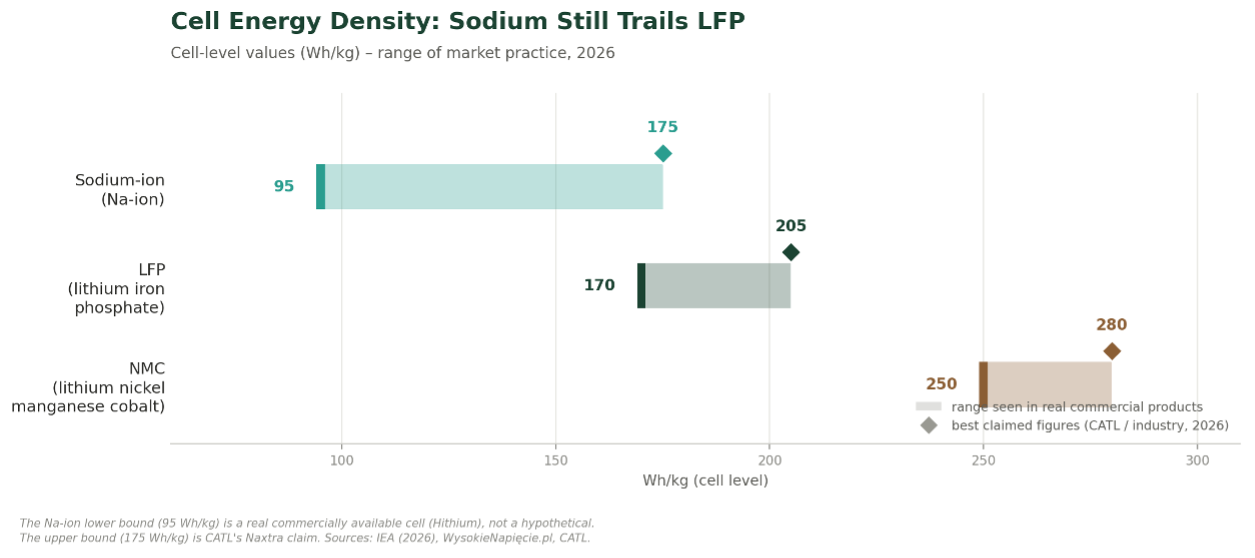
Manufacturers’ best declared results versus what’s actually being sold on the market today. Sources: IEA (2026), WysokieNapięcie.pl.
- Energy density and footprint. The best declared sodium-ion results reach around 175 Wh/kg today (CATL Naxtra), against up to 205 Wh/kg for LFP and up to 255–280 Wh/kg for NMC — IEA figures, consistent with independent Polish sources. But those are the best products on the market, not the average. In practice, sodium-ion cells run around 95–160 Wh/kg — as Ruben Valiente of Maxxen noted in an interview with WysokieNapięcie.pl, in the same container format where LFP fits 5 MWh, that same supplier’s sodium-ion cells fit around 2.5 MWh today. In practice, that means roughly double the land footprint for the same storage capacity — a concrete, calculable cost in land and infrastructure that’s easy to overlook when looking only at price per kWh of cell.
- Low-temperature performance — a real, confirmed advantage. This is the one parameter where virtually every independent source agrees: CATL claims over 92% capacity retention at -20°C for TENER Sodium, the IEA cites around 90% capacity retention at -40°C for the latest generation of sodium-ion cells, and FAW Jiefang road tests with HiNa cells (over 15,000 km across nearly seven months) confirmed over 90% capacity retention at -40°C under real, not just laboratory, operating conditions. LFP loses significantly more performance in low temperatures and requires more energy-intensive preheating. That’s why the first real interest from commercial customers — as Maxxen notes — is coming from Scandinavia, not from warmer parts of Europe. That said, it’s worth adding: for a typical utility-scale BESS project in Poland, where the container has HVAC or heating regardless of cell chemistry, this advantage rarely justifies on its own choosing a technology with lower energy density and a shorter operating track record. It’s a real benefit in specific applications, but not a universal argument.
- Charging speed. Sodium-ion cells allow charging at 1C rather than the 0.5C typical for LFP — a 1 MWh storage unit can be charged at 1 MW instead of a maximum of 0.5 MW. For applications requiring fast charging — some C&I projects, transport — that’s a real operational advantage. For a typical arbitrage or balancing-market storage system in Poland, where the market dictates the work profile rather than a physical charging limit, this advantage has marginal economic significance today.
- Cycle life — claims versus reality. Manufacturers today claim anywhere from 8,000 (HiNa) to over 15,000 cycles (CATL TENER Sodium), while Natron Energy previously advertised as many as 25,000 cycles for its now-defunct technology. It sounds impressive — but this is still, for the most part, data from accelerated testing or short field operation, since the first demonstration-scale sodium grid deployments only date back to 2019, and commercial scale really only began in 2023–2024. We don’t yet have a thirty-year operating history that can be verified in the field — we have extrapolations. It’s also worth remembering that in the residential product segment, there’s often a gap between the cycle count advertised and the limit actually written into warranty terms — the same warning applies to every battery technology regardless of chemistry: what matters is what’s written in the contract, and from our own experience, the numbers there are often quite different from what’s on the sales slides.
- Safety — a more complex picture than the marketing materials suggest. Sodium-ion cells are often promoted as inherently safer — they can be transported at zero voltage and don’t contain metals as reactive as some lithium chemistries. That’s partly true: a study by Newcastle University in collaboration with the Main School of Fire Service (SGSP) found sodium-ion cells have a higher thermal-runaway initiation temperature (220–260°C versus 170–220°C for NMC cells) and lower hydrogen content in post-explosion gases (around 30% versus 42% for LFP). But the same study stresses that safety rankings “are not universal, but strongly depend on the application scenario” — and LFP, regarded as the “safest” lithium chemistry, can emit significant amounts of hydrogen fluoride, which undercuts that reputation. Other peer-reviewed comparative studies paint an even more mixed picture: in some tests sodium-ion cells reach lower peak temperatures and a later thermal-runaway onset than LFP, while in others they generate significantly more gas per amp-hour and a wider explosive range. The honest answer is: sodium-ion and LFP have different, partly complementary fire-risk profiles, and that doesn’t mean one technology is safer than the other.
- Critical raw materials — also more complex than the marketing suggests. The slogan “no lithium, cobalt, or nickel” is only partly true. The IEA points out that the chemistries closest to large-scale commercialization — layered oxides, i.e., CATL’s technology — still use nickel and manganese, whose processing remains heavily geographically concentrated. Chemistries with genuinely lower critical-material intensity (polyanionic, Prussian Blue) exist, but aren’t today’s commercialization leaders. There is a real benefit, though: raw-material extraction for sodium-ion cells is more geographically diversified than for lithium — a genuine, if narrower than the marketing slogans suggest, advantage.
And what about Poland
Poland has its own genuine, if still early-stage, research thread in this technology. Professor Marcin Molenda’s team at the Faculty of Chemistry, Jagiellonian University in Kraków, has spent years working on sodium-ion cell materials. A few years ago, under the patronage of the Ministry of Climate and Environment, a cooperation agreement was formed in this area involving Grupa Azoty, Orlen, PGE, and KGHM Polska Miedź, along with academic centers — AGH, Warsaw University of Technology, Jagiellonian University, and University of Warsaw. According to the latest available information, the project is still seeking funding for the production-scaling stage, and Professor Molenda herself estimates the realistic horizon for building a Polish sodium-ion cell factory at 3–5 years from the point funding is secured. So we’re talking today about genuine scientific potential, not an operating production line.
At the market-product level, things are further along, though still niche. Estonia’s Freen already offers Polish prosumers residential sodium-ion storage — low-voltage 7.5 kWh and high-voltage 10.08 kWh variants. At the utility-scale and C&I level, the picture is more cautious — as Ruben Valiente of Maxxen summarized in an interview with WysokieNapięcie.pl, sodium-ion cells are still more expensive than LFP today because production is still scaling up, though real interest is already emerging, mainly from colder-climate markets.
Polish industry sources aimed at PV and residential storage investors are today reaching a fairly consistent, cautious verdict: sodium-ion technology is real and promising, but won’t reach the mass Polish residential market before 2027–2028 at the earliest. Today, LFP remains the only mature, proven choice for most projects — from residential to utility-scale. That’s not a pessimistic assessment, just a reflection of where this technology’s global supply chain actually stands today.
Questions worth asking before anyone offers you sodium instead of LFP
If a sodium-ion option shows up in a supplier’s offer, here are the questions that actually determine whether it’s worth considering:
- Is this a product available for purchase, or an announcement with a future date? CATL TENER Sodium has firm delivery dates for China (September 2026) and globally (June 2027) — but those are still future dates, not a delivery track record. Ask for references from installations that have actually been operating for at least 12 months, not a list of signed contracts.
- What is the actual energy density of this specific cell, not the best cell on the market? The difference between 95 Wh/kg and 175 Wh/kg is a difference in required land area of up to two times. Ask for the datasheet of the specific product, not marketing material for the whole technology category.
- What’s the degradation guarantee — in the contract, not the presentation? How many cycles and years does the supplier contractually guarantee, at what DoD and what temperature? Does the cell manufacturer have a long enough market history and financial stability to deliver on that guarantee 10–15 years from now? The same question is worth asking for every battery technology — the Northvolt and Natron Energy stories show that even well-financed, well-known players can disappear from the market within a matter of months.
- Does the supplier have independent safety certification for this specific chemistry? UL 9540A and its European equivalents were developed primarily with lithium cells in mind. Ask directly what tests the specific sodium chemistry being offered has passed, and who carried them out.
- What does service, spare parts, and technical support availability look like in Europe? With a technology where most manufacturers and the entire component chain — hard carbon, electrolytes — sit in China today, it’s worth asking directly about service response times and the location of the European spare-parts warehouse.
An honest forecast: when this will actually make sense in a BESS project
Let’s separate three distinct time horizons, because conflating them is the most common mistake in conversations about this technology.
Today, in 2026: a niche, not the mainstream. Sodium-ion cells make sense where low operating temperature is a real operational problem (unheated facilities, Scandinavian climates, or winter conditions in northern Poland), where charging speed matters more than energy density, or where a client wants to deliberately diversify its supply chain regardless of current price. For a typical utility-scale BESS project in Poland, where cost per MWh and proven bankability come first, LFP remains the rational choice.
2027–2028: potential, but not certain, provided CATL’s and BYD’s production lines actually reach their declared scale on the declared schedule. This is the horizon in which most industry analyses — and manufacturers’ own statements — point to approaching or reaching cost parity with LFP. It’s also the horizon in which Polish suppliers targeting the residential market expect the first real, mass-market sodium products in Poland. That date is worth treating with considerable reserve, though: it’s an industry forecast, not a guarantee, and these same sources made similar predictions in 2023 and 2024 that later slipped — as shown by the Tiamat factory’s history of being pushed back year after year. Even if the timeline holds, it would apply to cells produced at gigafactory scale in China, not to a finished, bankable product with European service, multi-year references, and insurer acceptance — the things that actually define a “mature” BESS technology in Poland today. There are usually still several years between those two thresholds.
After 2028: possible, but still uncertain, competition with LFP in the utility-scale segment, provided that by then China’s production scale actually translates into a mature, geographically diversified supply chain — including in Europe — rather than just more gigawatt-hours installed in China. According to the IEA, that condition remains the weakest link in the entire “sodium revolution” story today. It’s worth remembering that LFP won’t be standing still by then either — it will be cheaper, with an even longer operating track record and an even stronger position with insurers and banks.
Our recommendation for investors planning BESS projects in Poland today is this: treat sodium as a technology worth actively monitoring and considering in specific, narrow niches — cold-climate locations, projects prioritizing charging speed, deliberate supplier diversification — but not as the basis for the financial model of a main utility-scale project over the next 12–24 months, and probably longer. This technology’s history so far is, to a greater extent, a history of pushed-back deadlines than kept promises — and there’s no solid basis today to assume this latest round of announcements will be any different.
Summary
Sodium-ion cells are today a niche technology, concentrated almost entirely in China, with a short operating history and a list of spectacular Western failures — Northvolt and Natron Energy aren’t exceptions, they’re part of the same picture. At the same time, over the past two years the technology has moved from a laboratory curiosity to deployments genuinely measurable in gigawatt-hours – the CATL TENER Sodium launch in Munich and the commissioning of the Xingkong Na Dazhou Maliu Industrial Park project, by far the largest sodium-ion installation in the world, in China are facts, not announcements. The overall picture is mixed, not straightforwardly enthusiastic.
Three things worth remembering from this article:
- China holds a practical monopoly on manufacturing scale today — over 95% of announced production capacity through 2030, according to the IEA. European and American players exist, but most are still at the pilot stage, running delayed factories, or — in several high-profile cases — bankrupt.
- The only undisputed advantage of sodium-ion cells over LFP today is low-temperature performance and charging speed — and even that advantage applies to a narrow set of applications. Price still isn’t on sodium’s side, and LFP is getting cheaper faster than ever. Safety is a mixed picture, not a clear win for either technology.
- The horizon for real competitiveness with LFP in utility-scale projects is 2027–2028 at the earliest, provided the announced production scale actually materializes on schedule — and the industry already has a track record of pushing similar deadlines back by a year, two, or more.
For today’s investment decisions in Poland, that means one thing: this technology is worth tracking actively, but at the current state of knowledge, there’s no solid basis for building a BESS project’s main scenario around it. LFP remains the choice that would need to be justified for replacement — not the other way around.
How can GreenEdge Solutions help you?
Assessing whether a new cell technology genuinely fits your project — whether it’s still a manufacturer’s claim or a field-proven solution — and what that means for warranties, financing, and schedule, is one of the first things we check in every advisory engagement.
GreenEdge Solutions offers support at every stage of this process:
Technology selection support
- Assessing whether a given cell chemistry (e.g. sodium-ion) makes sense for the specific location, schedule, and operating profile of your project — whether it’s still a niche, or a genuine alternative to LFP
- Distinguishing between serial-production data and extrapolation from accelerated testing or press material
Supplier selection support
- Verifying manufacturer market maturity and financial stability — taking into account industry history (Northvolt, Natron Energy), which shows that even well-financed players can disappear from the market
- Checking real references: whether an installation has actually been operating for at least 12 months, or is a list of signed contracts with a future date
Technical specification
- Requirements that force disclosure of parameters for the specific product being offered — not the best result in the technology category
- Defining threshold parameters (energy density, degradation, low-temperature capacity retention) and how they’re measured under real-world conditions
Running tender processes
- Managing the entire RFI/RFP process: schedule, communication with bidders, evaluation and comparison of offers regardless of the cell technology proposed
- Final recommendation with technical and contractual justification
EPC/BoP contract drafting
- Preparing contractual provisions that account for the technology risk of less mature solutions — liability allocation, penalty clauses, acceptance conditions
Support with purchase agreement and LTSA negotiations
- Participating in discussions as a technical and contractual counterpart, with a specific list of points to negotiate
- Verifying what’s actually guaranteed numerically (cycles, DoD, temperature) in the contract and LTSA, versus what stayed in the sales presentation — including service and spare-parts availability in Europe
Listen to the podcast
🎙️ For more content like this, check out the “Best in BESS” podcast. Available on Spotify, Apple Podcasts, and YouTube.
Related articles
Anatomy of a BESS Container: What Are You Really Buying for Millions of Euro?
Sources
- IEA, Sodium-ion battery momentum grows, but challenges remain, February 2026 – https://www.iea.org/commentaries/sodium-ion-battery-momentum-grows-but-challenges-remain
- CATL, CATL Debuts World’s First Field-Validated Sodium-Ion BESS (press release), June 2026 – https://www.catl.com/en/news/6861.html
- CnEVPost, CATL pushes sodium energy storage to market with Tener Sodium launch, June 2026 – https://cnevpost.com/2026/06/22/catl-unveils-tener-sodium/
- Volta Foundation, Assessing the Promise and Potential of Sodium-ion Batteries in 2026, May 2026 – https://volta.foundation/assessing-the-promise-and-potential-of-sodium-ion-batteries-in-2026/
- Euronews, One year after Northvolt’s bankruptcy, Swedish green tech says it isn’t dead yet, March 2026 – https://www.euronews.com/next/2026/03/03/one-year-after-northvolts-bankruptcy-swedish-green-tech-says-it-isnt-dead-yet
- Manufacturing Dive, Sodium-ion battery maker Natron Energy shutters, halts NC factory plans (citing IEA), September 2025 – https://www.manufacturingdive.com/news/sodium-ion-battery-natron-energy-shutters-halts-NC-factory-plans/759479/
- pv magazine, All European sodium-ion battery manufacturers at a glance, March 2026 – https://www.pv-magazine.com/2026/03/02/all-european-sodium-ion-battery-manufacturers-at-a-glance/
- Energy-Storage.news, Consultation over 5 GWh French sodium-ion battery factory, April 2025 – https://www.ess-news.com/2025/04/25/consultation-over-5-gwh-french-sodium-ion-battery-factory/
- IDTechEx, Faradion Limited – timeline – https://www.idtechex.com/en/timeline/faradion-limited/c105376
- Gramwzielone.pl, Sodium-ion gigascale energy storage. Record CATL order, May 2026 – https://www.gramwzielone.pl/magazynowanie-energii/20358669/sodowo-jonowe-magazyny-energii-w-skali-giga-rekordowe-zamowienie-catl
- WysokieNapięcie.pl, LFP storage below PLN 420/kWh. Even sodium-ion is more expensive, November 2025 – https://wysokienapiecie.pl/115186-magazyny-energii-lfp-ponizej-420-zl-kwh-nawet-sodowo-jonowe-sa-drozsze/
- WysokieNapięcie.pl, Freen sodium-ion storage available to Polish prosumers, September 2025 – https://wysokienapiecie.pl/113753-sodowe-magazyny-energii-freen-dostepne-dla-prosumentow-w-polsce/
- NEXBE, Sodium-ion (Na-ion) energy storage – the future of energy storage?, April 2026 – https://www.nexbe.pl/blog/magazyny-energii-sodowo-jonowe-przyszlosc
- Wszystko co najważniejsze, Poland’s sodium-ion energy storage technology – a road paved with difficulty, June 2024 – https://wszystkoconajwazniejsze.pl/pepites/polska-technologia-magazynowania-energii-w-ogniwach-jonowych-droga-przez-meke/
- Murator Dom, Sodium-ion energy storage: is it worth replacing lithium? Facts and myths – https://muratordom.pl/instalacje/fotowoltaika/magazyn-energii-ktory-nie-boi-sie-mrozu-sod-zamiast-litu-w-twoim-garazu-rewolucja-sodowa-wchodzi-pod-polskie-strzechy-aa-fpEn-WZ2M-Fjao.html
- Energy-Storage.news, Comparing safety profiles of lithium-ion, sodium-ion and solid-state batteries (Newcastle University and SGSP study), February 2026 – https://www.ess-news.com/2026/02/11/comparing-safety-profiles-of-lithium-ion-sodium-ion-and-solid-state-batteries/
- ScienceDirect, Comparative safety analysis of current and next-generation battery technologies, February 2026 – https://www.sciencedirect.com/science/article/pii/S0378775326001783
- ScienceDirect, Comparative study on thermal and gas characteristics of 26700 sodium-ion and lithium-ion batteries, January 2025 – https://www.sciencedirect.com/science/article/abs/pii/S0378775325001065
- ScienceDirect, Comparison of thermal runaway and gas production behavior between copper-based/hard carbon SIB and LFP/graphite LIB, July 2025 – https://www.sciencedirect.com/science/article/abs/pii/S2352152X25025617
- Cell Reports Physical Science, HiNa Battery post-mortem analysis (DOI: 10.1016/j.xcrp.2026.103323), June 2026 – https://sector-signals.net/en/themes/ev-market/articles/hina-sodium-ion-battery-teardown-2026
- The Electric Viking, China’s Sodium-Ion Battery Industry Turns to Coal for Hard Carbon Supply, July 2026 – https://theelectricviking.com/chinas-sodium-ion-battery-industry-turns-coal-hard-carbon-supply/
- ScienceDirect, Sodium-ion battery cost projections and their impact on the global energy system transition until 2050, December 2025 –https://www.sciencedirect.com/science/article/pii/S2352152X2504575X
- MDPI Batteries, Sodium-Ion Batteries: Advances, Challenges, and Roadmap to Commercialization, April 2026 – https://www.mdpi.com/2313-0105/12/4/131
- Rare Earth Exchanges, Sodium-Ion Is Entering the Market, August 2026 – https://rareearthexchanges.com/news/sodium-ion-is-entering-the-market/
- SodiumBatteryHub, China’s First Sodium-Ion Dump Truck Starts Work, August 2026 – https://sodiumbatteryhub.com/2026/08/05/chinas-first-sodium-ion-dump-truck-starts-work/
- PatSnap, Sodium-ion battery technology landscape 2026 – https://www.patsnap.com/resources/blog/articles/sodium-ion-battery-technology-landscape-2026/
This article is for informational purposes only and does not constitute investment advice or a purchase recommendation for any specific technology. Manufacturer data cited in the text — in particular declared cycle counts, energy density, and prices — comes from manufacturers’ own materials or industry sources citing them, and may differ from parameters actually guaranteed contractually. Market and technology status: August 2026.