Introduction
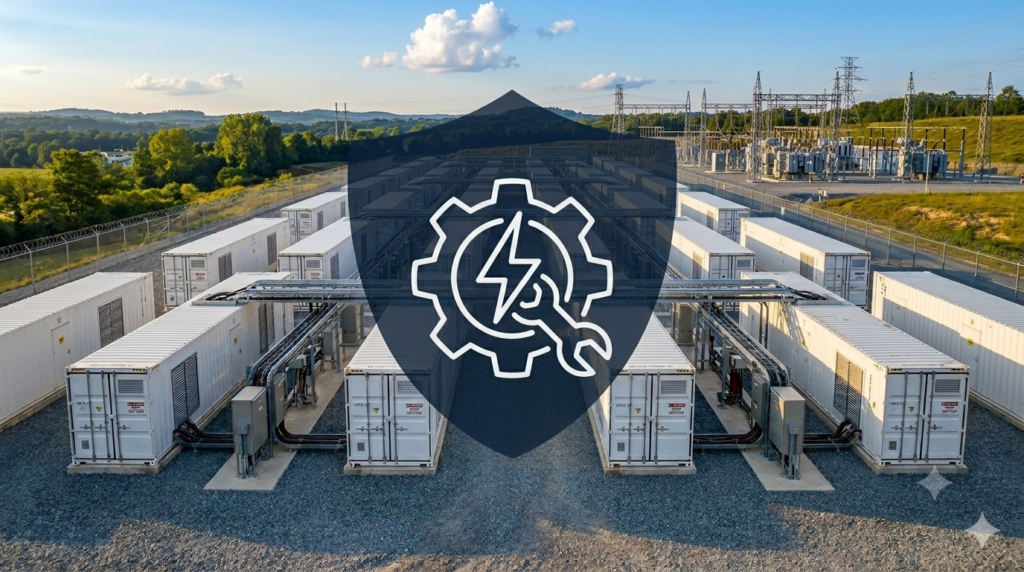
On 16 June 2026, the largest battery energy storage system in Europe was connected to Poland’s national grid — an installation in Nowa Wieś Ełcka (200 MW / 800 MWh). The record was set in Poland, and the system runs on BYD technology. A few months earlier, construction began on the Żarnowiec energy storage project — 262 MW, roughly 981 MWh, a contract worth PLN 1.555 billion gross — whose general contractor is LG Energy Solution Wrocław, the company operating the plant in Kobierzyce near Wrocław. The very same LG that, at the same location, produces cells for Volkswagen, Audi, BMW, and Porsche.
Two record-breaking projects, two completely different configurations of who actually stands behind the word “supplier” — and whether it’s worth checking exactly who you’re buying your BESS from.
When you receive an offer for an energy storage system, everything looks similar at first glance: a container, a spec sheet, a price per kWh, a 15–20 year warranty. But the company named on the offer documents and the logo on the container’s nameplate are often something entirely different from the entity that actually designed the cell, wrote the BMS code, and is responsible when, seven years into operation, capacity fades faster than the datasheet promised.
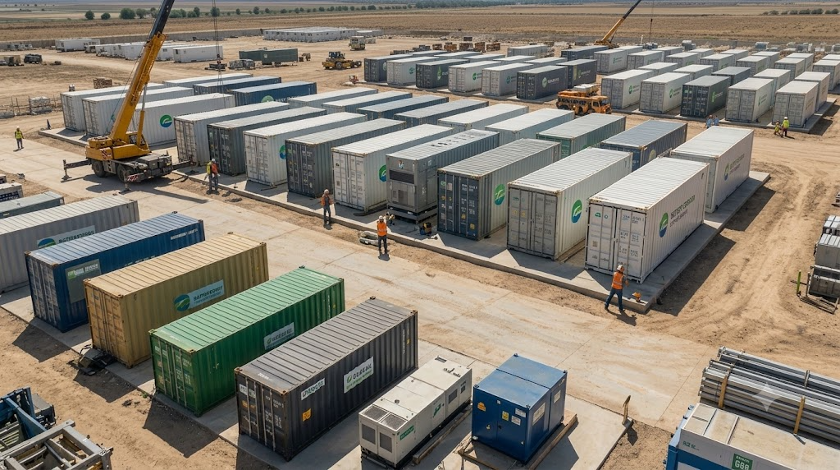
We already wrote about what is physically inside a BESS container — from the cell, through the module and rack, to the cooling system and BMS. But before you ask “what am I buying,” it’s worth asking the question below.
Who are you really buying from — and how much of what you see in the container did that company actually design and manufacture itself?
Three fundamentally different supplier models operate on the market today:
- Vertically integrated manufacturers — they produce their own cells, modules, and containers, have their own BMS, and most often their own EMS.
- System integrators — they don’t manufacture cells (they buy them from producers such as CATL, EVE Energy, or AESC), but they design and build everything else, often with proprietary EMS software as their main competitive advantage.
- So-called “white label” (OEM/ODM) — they buy a complete, ready-made container from an external manufacturer, most often Chinese, and sell it under their own logo, sometimes adding a proprietary EMS. This is today’s most common model among smaller suppliers, including Polish ones.
None of these models is inherently “worse.” But each carries entirely different risks, a different warranty structure, and different questions you need to ask before signing a contract. In this article, we break the BESS supplier market down into its component parts — with concrete examples from both the global and Polish markets.
The supply chain hierarchy: before asking “who,” let’s establish “what”
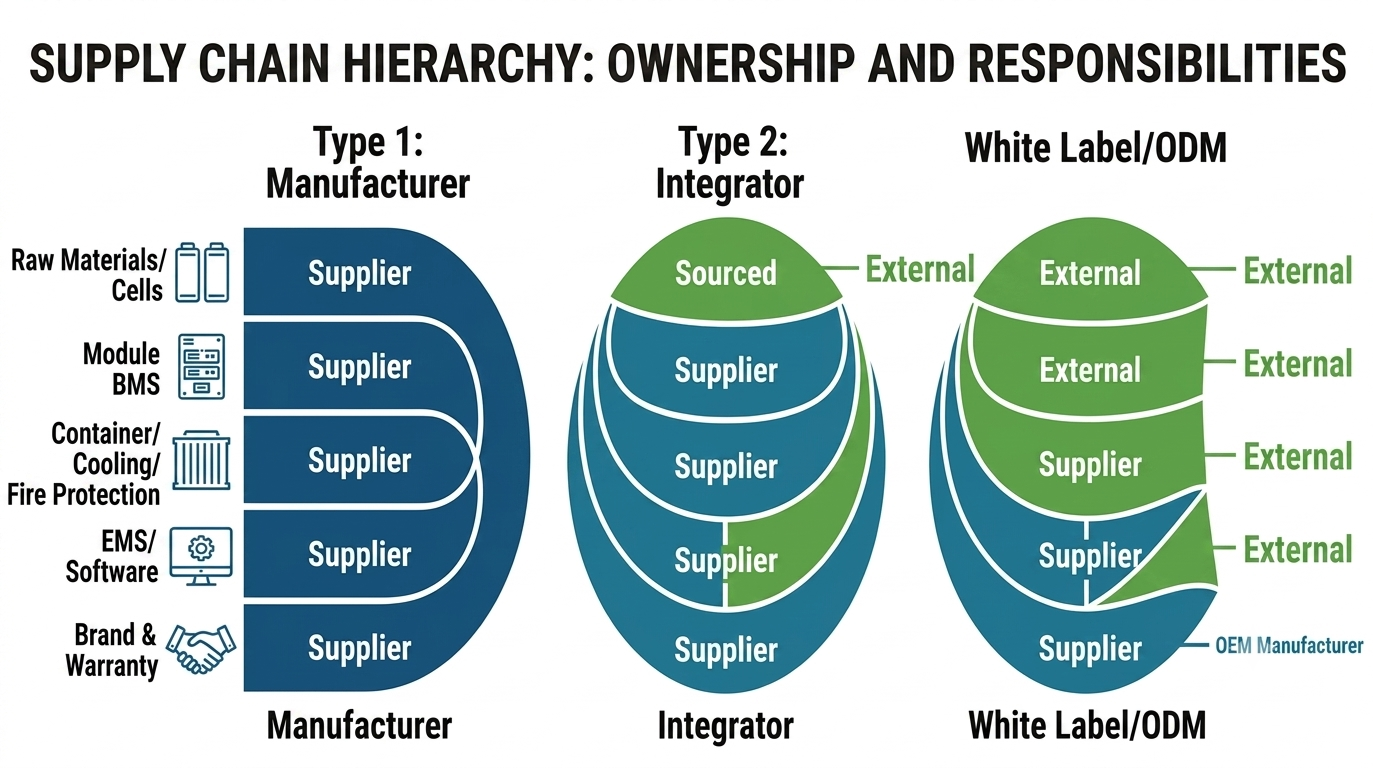
In a previous article, we showed the physical hierarchy of energy storage components: cell → module → rack → container. That map still holds, but to understand suppliers we need one more layer — the chain of OWNERSHIP and RESPONSIBILITY laid over that same hierarchy.
A typical industrial energy storage system passes through five layers before it reaches your construction site:
- Raw materials and cells — LFP chemistry, cathode, anode, and electrolyte production, cell assembly. This is the most capital-intensive layer: a cell factory is a multi-billion-dollar investment.
- Module and pack with first-level BMS — connecting cells into a module, adding a BMU that monitors the voltage and temperature of each cell.
- Container: mechanics, PCS, cooling, fire safety — the enclosure, the DC/AC converter, the thermal system, fire detection and suppression.
- EMS / management software — the installation’s “brain”: optimisation, communication with the energy market, the grid operator, and the aggregator. This is also the layer with the greatest cybersecurity relevance — and, as we show further below, not necessarily the layer where “the supplier’s own EMS” is an advantage.
- Brand, sales, warranty, service — who signs the contract with you, who is liable under warranty, who shows up when something breaks.
Company A may control all five layers. Company B may control only the fifth layer, buying a ready-made product for layers 1–4 from someone else. That difference is exactly what defines the three supplier types described in this article.
Type 1: Vertically integrated manufacturer — everything owned, from cell to container
This is the most “complete” model: the company manufactures its own cells, designs its own module and BMS, builds its own container with cooling and fire-safety systems, and most often supplies its own EMS as well. One entity, one warranty, one phone number to call for service.
BYD is perhaps the clearest example of this model in the world. The company manufactures its own Blade LFP cells at its own factories — including Shenzhen and Changsha — and integrates them into its own systems: Chess Plus for the C&I segment, and MC Cube-T and the newer Haohan for utility-scale installations. Chess Plus combines BMS, distributed management control (DMC), an energy management and control unit (EMCU), EMS, and air conditioning in a single enclosure. This is structurally unusual — most large integrators, including Sungrow, Fluence, and Wärtsilä, buy cells from external manufacturers. BYD captures margin at both the cell-manufacturing layer and the system-integration layer at once.
This is not purely theoretical knowledge for a Polish reader — the largest battery energy storage system in Europe, mentioned at the start of this article and commissioned in June 2026 in Nowa Wieś Ełcka, runs on BYD technology. The project is being developed by Portuguese developer Greenvolt, and Greenvolt and BYD have since signed agreements for a twin project in Turośń Kościelna and for a third, even larger system — BESS Siedlce (600 MW / 2.4 GWh).
CATL, the world’s largest manufacturer of energy-storage cells, also offers fully integrated systems — the EnerOne and EnerC lines, and the flagship TENER, including the TENER Stack with 9 MWh in a single cabinet. CATL manufactures its own cells and its own three-tier BMS (CSC–SBMU–MBMU), and its containers communicate with the EMS layer via CAN — depending on project configuration, that layer may belong to CATL or be integrated with the client’s own system.
One note on CATL’s market-share figure, since different sources report different numbers. For full-year 2025, SNE Research puts CATL’s share of global energy-storage cell shipments (measured by GWh volume) at around 30%. Other datasets, including InfoLink/EnergyTrend and IndexBox, show a distinctly different trend: a steady decline in CATL’s share from roughly 32% in 2023, to 29% in 2024, down to 20–22% in 2025, as rivals (EVE Energy, CALB, Hithium, BYD) rapidly scale up capacity dedicated to energy storage. The gap mostly comes down to methodology (when in the year the snapshot is taken, and whether only cells or also finished systems are counted) and to the fact that the overall market grew faster in 2025 than CATL’s own shipments. Whatever the exact figure, the direction is clear: CATL remains the leader, but its edge in cell supply is eroding faster than in EV batteries, where it still controls around 39% of the global market. Despite having its own system-level products, CATL remains primarily a cell supplier to other integrators — that is still its core market position.
The most interesting example for a Polish investor, however, sits literally outside Wrocław. At the LG Energy Solution plant in Kobierzyce — formally the entity LG Energy Solution Wrocław, and today the largest lithium-ion battery factory in the European Union — a production line for LFP cells and complete energy storage systems is being commissioned. According to the company itself, thanks to the plant near Wrocław, LG Energy Solution is the only ESS manufacturer in Europe able to produce products from cell to complete system at a single location. The first major contract is the Żarnowiec storage system for PGE mentioned above, delivered on a turnkey (EPC) basis with completion due 30 April 2027 — built entirely on a local-content basis: a new cell type (JF2S) and the entire system are made in Poland.
Advantages and limitations
- Advantages: one coherent warranty for the entire system; the manufacturer has full control over cell quality and availability throughout the warranty period and doesn’t depend on someone else’s supply chain; usually the highest bankability, since lenders and insurers can more easily assess the risk of a single, well-documented entity.
- Limitations: less configuration flexibility — you get what’s in the manufacturer’s portfolio, less often a truly bespoke solution; typically longer production queues during periods of high demand (lead times around 90–120 days at the largest players); a strong concentration of geopolitical and tariff risk in a single supplier — if the manufacturer ends up on a sanctions list or facing export tariffs, your entire project depends on one country of origin.
- EMS cybersecurity risk: since the manufacturer also supplies the EMS, this often means servers and communication architecture located outside the EU — in practice, in China. Under NIS2, this is a question you need to ask directly, regardless of how strong the rest of the offer looks.
Type 2: System integrator — cells from outside, everything else on its own account
In this model, the company does not manufacture cells. It buys them from one or more Tier 1 producers, but independently designs the BMS architecture, the container mechanics, cooling, fire safety, and sometimes its own proprietary EMS. Here, software and system integration are the main competitive advantage, not cell chemistry.
Fluence, the world’s second-largest BESS integrator, has no cell factory of its own. It has signed long-term supply agreements with CATL and with AESC — whose Smyrna, Tennessee plant was converted in 2025 from automotive cell production to stationary LFP cells. Fluence designs its own system-level products (its flagship Smartstack delivers 7.5 MWh of usable capacity in a single unit with integrated power electronics) and its own management software: Fluence IQ and the FluenceOS platform. The company builds its brand around software, not cell chemistry. Importantly from an NIS2 perspective, this entire software layer is developed within a company that originated as a joint venture between Siemens and AES, with significant engineering operations in Germany (its Erlangen office) — not within a Chinese cell manufacturer’s ecosystem.
This is actually a good illustration of exactly the risk this article is about. In March 2026, AESC — under pressure from U.S. Foreign Entity of Concern (FEOC) rules restricting Chinese-linked participation in supply chains eligible for tax credits — sold the Smyrna plant to U.S. company Fixx Energy, retaining only a technology-licensing agreement. Fluence quickly signed a new, multi-year supply agreement with the new owner to keep production running and preserve eligibility for U.S. domestic-content incentives. For an investor whose storage system was built a year earlier with cells from that same factory, this means the entity actually standing behind those cells changed mid-warranty — precisely the scenario worth asking about at the due-diligence stage.
Wärtsilä follows a similar path. The Finnish energy group signed a multi-year agreement to supply LFP cells from China’s EVE Energy for its GridSolv Quantum system — one of the first on the market certified to the 2023 revision of NFPA 855. Wärtsilä’s real asset, however, is its EMS platform, GEMS, acquired along with California-based Greensmith Energy in 2017 (a USD 170 million deal) and developed since then as an independent product — now in its seventh generation, capable of managing multi-gigawatt-hour asset portfolios.
Sungrow, the world’s second-largest BESS supplier by volume, buys cells from CATL among others, and for its newest PowerTitan 3.0 platform developed a dedicated 684 Ah cell together with Sunwoda — the first cell of that size to reach mass production in the industry. Sungrow designs its own PCS (with SiC technology reaching over 99% efficiency) and its own BMS, and takes a hybrid approach at the EMS layer: for smaller C&I systems it offers its own, fully integrated platform, while for utility-scale installations Sungrow’s systems have open interfaces that let EPCs and aggregators plug in a third-party EMS suited to the specific market application.
Advantages and limitations
- Advantages: the integrator isn’t hostage to a single cell production line — it can switch suppliers if a quality issue or a better price comes up, which in theory increases supply-chain resilience; usually the strongest software layer and the most developed market-optimisation capabilities; greater flexibility to configure a project-specific solution.
- Limitations: since cells are bought in, the capacity-degradation warranty in practice rests on a chain of two entities — the integrator and the cell manufacturer. You need to check whether the cell manufacturer’s warranty actually flows down into your contract with the integrator (a back-to-back clause), or whether the integrator assumes the full risk itself.
- EMS origin matters: an integrator may supply a “proprietary EMS,” but where the servers actually sit and who has access to them varies dramatically between suppliers — this is an NIS2 question, not just a functional one.
It’s also worth remembering that integrators themselves are not immune to financial trouble. Powin — at the time the third-largest BESS integrator in the US, supplier for the then record-setting 1.9 GWh Waratah Super Battery in Australia — filed for Chapter 11 bankruptcy in June 2025, eight months after taking on a USD 200 million revolving credit facility from KKR. Headcount fell from roughly 500 employees at the start of the year to 85 by the time of the filing; tariffs on Chinese LFP cells reaching 40% or higher, combined with uncertainty over Investment Tax Credits, were cited among the causes. Through a 184-day bankruptcy process, the court approved the sale of nearly all of Powin’s assets — software, hardware, and spare-parts inventory — to rival FlexGen, which also took over support for Powin’s already-operating projects. In short, a supplier’s financial health deserves the same scrutiny as its technical specification.
Type 3: Own brand and ODM — ready-made container, added value in service and local support
The third model looks different from the first two: the company manufactures no hardware layer at all. It buys a complete, ready-made container — cells, modules, BMS, PCS, enclosure — from an external manufacturer, most often in China, and sells it under its own brand. This is today the most widespread model among smaller and mid-sized suppliers in the European market, including Poland.
The industry distinguishes two variants here:
- White label — a Chinese manufacturer supplies a ready-made product with a fixed hardware and software architecture. The brand has very limited influence over BMS configuration, EMS logic, cooling strategy, or firmware. The advantage is speed to market and a low investment barrier; the drawback is a lack of real product differentiation beyond price and customer service. Today you can find a great many suppliers of this type who nonetheless describe the product as “theirs.”
- ODM (Original Design Manufacturer) — a more advanced variant, in which the brand works with the factory on a certain level of customisation: its own EMS logic, adaptation to local grid requirements, sometimes modification of the safety architecture. This is exactly the variant in which a local supplier “equips the system with a proprietary EMS” — keeping the hardware from an external manufacturer, but building its own software layer and, importantly, its own service responsibility.
Manufacturers in China openly advertise this service. CoPow, one of the Chinese OEM/ODM suppliers, states outright that it serves “various energy storage brands, distributors, EPC companies, and enterprises seeking to establish their own brand,” offering full PCS and EMS integration, communication-protocol adaptation, and brand packaging. This isn’t a hidden practice — it’s an openly offered B2B service, available off the shelf at trade shows and in online catalogues.
In the Polish market, this model comes in different shades of sophistication. Some companies openly communicate their business model — Power LAB, one of the larger Polish energy-storage manufacturers, states plainly on its website that it has a long-standing partnership with trusted Chinese suppliers and a stable supply chain for LiFePO4 cells and components used in its projects. Other companies go a step further toward the ODM model: Arinea, maker of the ARINEA TITAN storage family, states that it uses Tier 1-grade LFP cells, Danfoss power converters, and integration with Siemens SICAM EMS, and carries out final assembly, EMS programming, and container prefabrication at its own facility in Poland. ZPUE, a long-established Polish manufacturer of transformer stations, has gone even further, developing its own proprietary SCADA/PPC-class EMS software called SPS-Control, which integrates the storage system, on-site renewables, and the transformer station under one supervisory system.
Contrary to first impressions, this model doesn’t have to mean lower quality. Its real value lies elsewhere: a local warranty enforceable in a Polish court and in złoty (though even this can vary), familiarity with Polish grid-connection requirements (NC RfG, IRiESD), Polish-language service with response times measured in hours rather than days, and — increasingly — experience securing domestic funding (KPO, FEnIKS, NFOŚiGW). These are real advantages, hard to match with a global integrator serving you from a head office in Helsinki or Houston.
EMS, SCADA, and NIS2 — why “who supplies the EMS” is no longer just a matter of functionality
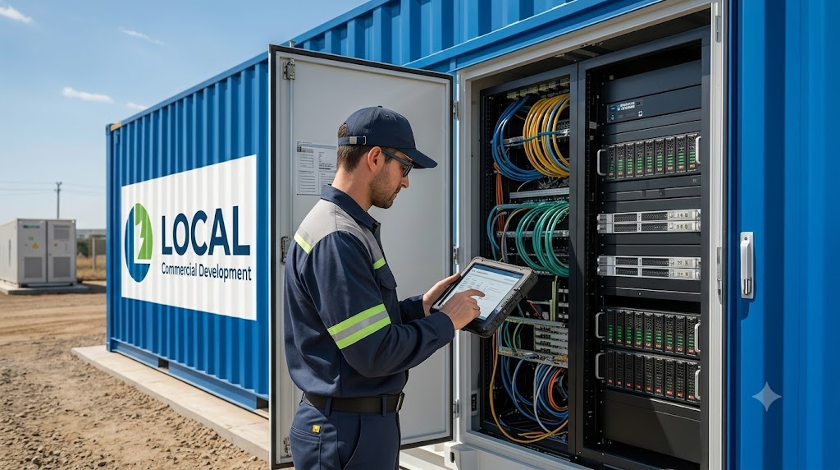
Throughout this article, we note that owning the EMS is an advantage — the supplier retains full control over optimisation and isn’t dependent on a third party. That’s still true from a functional standpoint. But viewed through the lens of the NIS2 directive and the cybersecurity requirements now facing entities connected to the power grid, “an EMS supplied by the hardware vendor” is today more often a risk than an advantage — or at least a question that needs to be asked far more precisely than simply “is the EMS proprietary?”
The reason is straightforward: in practice, a BESS manufacturer’s or integrator’s responsibility for the IT/OT layer typically ends at the local controller that collects signals from the BMS and communicates with the PCS. Selecting and integrating the PPC (Power Plant Controller), the EMS, and the SCADA system — the layer that actually connects the storage system to the grid operator, the energy market, and (often) the manufacturer’s own servers — is, in practice, the responsibility of the investor or the EPC contractor, not the container supplier. And this is precisely where a concrete NIS2 requirement comes in that many investors are unaware of: it is the investor or the EPC contractor who bears responsibility for ensuring that this IT layer has no uncontrolled remote-connection capability to servers located outside the EU.
That’s why, when choosing an EMS, it’s worth distinguishing not just “is it proprietary,” but where it actually comes from and where it is hosted. Fluence offers a useful counterpoint to most Chinese suppliers here: the company was formed as a joint venture between Siemens and AES, has substantial engineering operations in Germany (its Erlangen office) and the US, and its FluenceOS platform is developed within that environment — not within a Chinese cell manufacturer’s ecosystem. This represents a different risk profile than EMS platforms tied to CATL or BYD. That doesn’t automatically mean one solution is “secure” and the other “insecure” — it means this is a question that needs to be asked at all, and asked at the technical-specification stage, not after the contract is signed.
Questions worth adding to your technical specification:
- Where are the servers that the EMS/SCADA communicates with physically located, and who has administrative access to them?
- Does the system architecture allow for fully local (on-premise) operation, without a persistent connection to the manufacturer’s cloud outside the EU?
- Who — the container supplier, the EMS integrator, or the EPC contractor — formally bears responsibility for the IT/OT layer’s compliance with NIS2 and Poland’s National Cybersecurity System Act (KSC)?
- Does the service agreement permit remote diagnostic access from abroad, and under what logging and access-control rules?
A legal obligation many investors forget
A company that sells an energy storage system manufactured by someone else under its own brand or logo is not, under the law, “just a reseller.” Under the EU Battery Regulation (EU 2023/1542, Article 3(1)(33)), an entity that “manufactures a battery or has a battery designed or manufactured, and markets that battery under its own name or trademark” is legally its manufacturer.
That translates into a specific, enforceable set of obligations — regardless of what the parties agreed between themselves in a commercial contract:
- Drawing up an EU declaration of conformity and completing the relevant conformity-assessment procedure.
- CE marking, plus a model, batch, or serial-number identifier on the battery itself.
- Maintaining and making available technical documentation for as long as the battery remains on the market.
- Supply-chain traceability, and — for large economic operators (consolidated net turnover above EUR 40 million) — a due-diligence policy covering raw-material sourcing.
- Registration under an extended producer responsibility (EPR) scheme, and responsibility for the battery’s end-of-life stage, including collection and recycling.
- Eventually, as the regulation’s phased rollout continues — participation in the digital battery passport system, intended to track the parameters and operating history of every large industrial battery.
In advisory practice, we most often see two mistakes. The first: an investor assumes that because the container arrives with a Polish company’s logo on it, that company is only responsible for sales and service, while the manufacturer obligations still sit with the factory in China. That’s not correct — the regulation explicitly transfers manufacturer status to the entity that places the battery on the market under its own brand, regardless of who physically built it. The second mistake: the EPC or supply contract has no clause specifying which party formally acts as the manufacturer under the regulation and who is responsible for EPR registration — and that is a liability that can’t be effectively shifted to a subcontractor by a commercial-contract clause alone, if the subcontractor doesn’t actually meet the criteria in Article 3(1)(33).
For debt-financed projects, this carries extra weight: lenders and insurers increasingly ask directly who formally qualifies as the battery manufacturer under the Battery Regulation — because that determines who bears the cost of a potential product recall, or who is liable for non-compliance found during an audit. This is exactly the kind of question we check during the technical and legal due diligence of EPC and supply agreements — before, not after, the contract is signed.
Why it matters — questions that apply regardless of the model
None of the three models is automatically a bad choice. We see utility-scale projects built on each of them — including the storage systems commissioned in Poland in 2026. The problem arises when you don’t know which model you’re dealing with and treat every offer as if it were identical.
Before you sign a contract, ask directly:
- Who is the cell manufacturer — and is that information written into the contract, or was it only mentioned verbally in a meeting?
- Is the capacity-degradation warranty issued directly by the cell manufacturer or by the system seller — and what happens to it if the seller leaves the market?
- Is the EMS owned by the supplier or licensed from a third party — and who will provide software updates in eight years?
- If the supplier is importing a complete system from outside the EU — does it formally take on manufacturer obligations under the EU Battery Regulation?
- What is the supplier’s financial health, whether it’s a global integrator or a local company — will it still exist for the 15–20 years your warranty covers?
- Where are spare parts and the service team physically located — in Poland, elsewhere in the EU, or do you have to wait for a shipment from Asia?
- Where are the EMS/SCADA servers physically located, and does the architecture allow for local operation without a persistent connection to servers outside the EU — who is responsible for this layer’s NIS2 compliance, the supplier or you as the investor/EPC contractor?
From practice: we’ve sat down at the negotiating table with an investor convinced they were buying a system from “the manufacturer” — only to find that the financial documents and the service agreement named a completely different company from the one whose logo appeared on the container and in the marketing materials. That doesn’t necessarily mean the seller was being dishonest — sometimes it’s simply a consequence of corporate group structure or a distribution model. But if you don’t ask directly, you’ll only find out the first time you file a warranty claim.
Summary
The market for energy storage suppliers is not uniform, and the name on the container rarely tells you the whole truth about who actually built it.
Key takeaways:
- Type 1 (vertically integrated manufacturer) offers the simplest liability structure — one entity, one warranty — at the cost of flexibility and sometimes longer production queues. LG Energy Solution near Wrocław shows that this model can also work locally, in Poland.
- Type 2 (system integrator) bets on software advantage and flexibility, but requires checking whether the cell warranty actually passes from the manufacturer to the integrator — and whether the integrator itself is financially sound.
- Type 3 (brand / ODM) dominates among smaller suppliers, including Polish ones — and doesn’t have to mean lower quality, as long as the brand takes quality control, service, and EU Battery Regulation compliance seriously.
- No model exempts you from due diligence. Questions about the cell manufacturer, warranty structure, EMS ownership, and the supplier’s financial health matter equally, no matter which type you’re talking to.
Choosing an energy storage supplier is a 15–20 year decision — exactly as we wrote when covering the anatomy of the container itself. The difference this time is that the question isn’t “what’s inside,” but “who is really behind it.”
How can GreenEdge Solutions help?
Identifying which type of supplier you’re actually dealing with — and what that means for warranty structure, risk, and project financing — is one of the first things we check in every advisory engagement.
GreenEdge Solutions offers support at every stage of the procurement process:
🔍 Supplier verification
- Establishing who actually manufactures the cells, BMS, and EMS in a given offer — and which of the three models from this article you’re actually looking at
- Analysis of the corporate group structure, track record, and financial health of the supplier — whether it’s a global integrator or a local brand
📐 Technical requirements preparation
- Technical specifications that force full supply-chain transparency (who manufactures what at each of the five layers)
- Defining performance thresholds (RTE, degradation, availability) and how they are measured under real operating conditions, not just on the datasheet
- Cybersecurity requirements (NIS2) for the EMS/SCADA/PPC layer — including server location and remote-access rules
📄 Supply and LTSA contract review
- Reviewing the supply contract for back-to-back clauses, scope of liability, and risk allocation between the cell manufacturer and the system seller
- A separate review of the LTSA (Long-Term Service Agreement) — whether it aligns with the hardware warranty terms or leaves gaps
🤝 Negotiation support
- Participating in supplier negotiations as your technical and contractual counterpart, with a concrete list of points to negotiate
- Preparing arguments and fallback positions — where it’s worth pushing, and where it isn’t
🛡️ Understanding what the warranty actually covers
- Translating warranty terms into concrete scenarios: what happens if the seller leaves the market, who is liable for service in ten years, whether the cell manufacturer’s warranty genuinely “flows down” into your contract
- Identifying the gap between what was promised verbally and what is actually enforceable in the document
📋 RFI/RFP preparation
- Drafting requests for information (RFI) and tender documentation (RFP) that force comparable, complete responses from all bidders
- A question set tailored to the type of supplier you’re dealing with (different questions for a vertically integrated manufacturer than for an integrator or a brand/ODM)
📊 Tender process management
- Managing the entire process: timeline, bidder communication, clarification rounds, apples-to-apples evaluation and comparison of offers regardless of supplier model
- A final recommendation with technical and contractual justification
Contact us: contact@greenedge-solutions.com
Listen to the podcast
🎙️ This article expands on Episode 6 of the “Best in BESS – ENG” podcast — “Choosing a BESS Supplier.” Listen on Spotify, Apple Podcasts, and YouTube.
Related articles
Anatomy of a BESS Container: What Are You Really Buying for Millions of Euro?
How to Choose an EPC Contractor for Your Battery Storage Project in Poland
Sources
- InfoLink Consulting / EnergyTrend — Global Energy Storage Cell Shipment Rankings, Q1 2026
- SNE Research (via The Battery Magazine) — CATL’s energy storage market share, 2025
- IndexBox — BESS Market Report: 320 GWh Installed in 2025
- S&P Global Energy — 2026 Tier 1 Cleantech Companies List (via pv magazine)
- BloombergNEF — Tier 1 Reports (methodology)
- Energy-Storage.News — AESC sells its Smyrna plant to Fixx Energy, new agreement with Fluence
- Energy-Storage.News — Wärtsilä’s GEMS 7 and the Greensmith Energy acquisition
- pv magazine USA — Powin’s bankruptcy and FlexGen’s asset acquisition
- pv magazine — Sungrow PowerTitan 3.0, 684 Ah cell (June 2025)
- PRNewswire — Sungrow PowerTitan 3.0 technical documentation
- Energy-Storage.News — BYD Chess Plus, C&I product documentation
- Wärtsilä — press release on completing the Greensmith Energy acquisition (2017)
- PGE / LG Energy Solution Wrocław — press release on the Żarnowiec storage contract (7 March 2025)
- Gramwzielone.pl — the largest energy storage system in Europe, Nowa Wieś Ełcka
- ISBtech.pl — Greenvolt and BYD, the BESS Siedlce agreement
- Power LAB — manufacturer website
- Arinea — manufacturer website (ARINEA TITAN)
- ZPUE — SPS-Control product page
- EUR-Lex — Regulation (EU) 2023/1542 (EU Battery Regulation), Article 3(1)(33)
Article prepared by GreenEdge Solutions based on an analysis of the global and Polish market for energy storage suppliers. July 2026.
Disclaimer: Information about the companies named in this article is based on publicly available sources, as of 18 July 2026. This article is intended for educational purposes only and does not seek to promote or discredit any of the suppliers mentioned.