Introduction
Most investors treat BESS project insurance as the last item on the pre-energisation checklist — something like registering a vehicle: technically required, but available on demand. Three weeks before the planned commissioning date, someone calls a broker, the broker issues a policy, and the matter is closed.
The market no longer works that way.
Insurers specialising in energy storage projects have lived through several high-profile fires, revised their risk models, and now assess a BESS project with the same rigour as a financing bank — using different tools. They may challenge the site layout, request specific test documentation, restrict the scope of cover, or price the premium in a way that undermines the project’s financial model entirely. In extreme cases they may decline to underwrite at all — and a project without an insurance policy will not obtain bank financing.
This may sound like a worst-case scenario, but it accurately describes the operational reality of the European and global BESS insurance market in 2025 and 2026. Poland is a country where utility-scale BESS projects are entering the phase of large-scale realisation — and where investors are confronting these requirements for the first time in live transactions, not during planning.
This article has one purpose: to ensure you know what to expect before it is too late to make changes.
Why BESS Is Not “Standard Property” for an Insurer
Before addressing specific requirements, it is worth understanding the insurer’s perspective. Conventional property insurance — covering industrial facilities, offices, machinery — is a product built on decades of loss history from which insurers can construct reliable risk models. Utility-scale battery energy storage did not exist as an asset class until relatively recently. Large-scale projects today have, in many cases, fewer than five years of operational history. That is insufficient to build a validated, reliable actuarial model — and it is precisely why insurers approach BESS conservatively, with a tendency to price uncertainty upward.
There is also the fundamentally different character of fire risk. A BESS fire is not a warehouse fire, and it is not a conventional power plant fire. The mechanism known as thermal runaway involves the failure of a single cell triggering a chain reaction: temperatures rise, adjacent cells overheat, flammable and toxic gases are released, and an entire module or container becomes a source of fire that cannot be suppressed by conventional means. One of the most significant initiation mechanisms is lithium dendrite formation — microscopic structures that develop inside a cell through uneven electrochemical reactions, which over time can pierce the separator and cause an internal short circuit with no prior warning signals.
The loss history is specific and well-documented. On 19 April 2019, an explosion occurred at the McMicken Energy Storage Facility in Arizona in which four HAZMAT firefighters sustained serious injuries — one suffering traumatic brain injury, pneumothorax, a broken leg, and severe burns — with nine people hospitalised in total. The suppression system (Novec 1230) had operated as designed, but was fundamentally unsuited to cascading thermal runaway — a limitation that manufacturer 3M had been aware of since 2017. For nearly three hours, firefighters waited outside the sealed container as smoke continued to emerge, with no established procedures for this scenario. When they finally opened the door, the accumulated gases exploded.
In July 2021, Tesla’s Moorabool battery storage facility in Australia caught fire and required days of intervention by dozens of firefighters before the blaze was brought under control.
LFP chemistry, which dominates utility-scale projects in Poland today, is thermally safer than older NMC chemistries. But “safer” does not mean “safe” in absolute terms. Thermal runaway remains possible, can still be cascading, and can still produce fires that are difficult to control for days at a time. An insurer issuing a policy on a BESS project assumes the risk of total loss of an asset worth tens or hundreds of millions of zloty, combined with an extended operational downtime during which the project generates no revenue. That risk is statistically rare — but when it materialises, it is catastrophic.
This is the context from which the requirements described below derive.
Two Project Phases, Two Types of Insurance — Both Matter
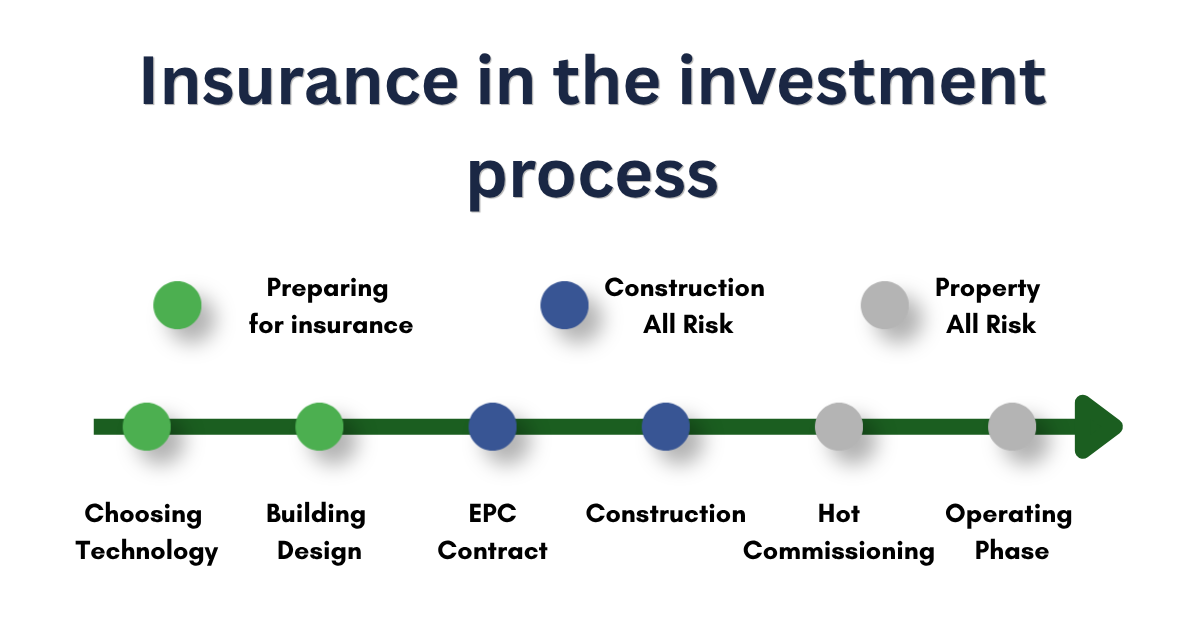
A BESS project passes through two distinct phases from an insurance perspective, each requiring different products and governed by a different underwriting logic.
Construction Phase: CAR / EAR
Construction All Risks (CAR) or Erection All Risks (EAR) insurance is the standard product for any project delivered by a general contractor under bank financing. It protects the investment from the first day of site works through to final acceptance (PAC), covering all damage to works, materials, and equipment that is not expressly excluded under the policy conditions. It is a true all-risks product: the insurer covers unnamed perils, not a defined list — including testing and commissioning activities, which are typically included within the scope of cover.
A point that investors frequently confuse: depending on the EPC contract structure, the CAR/EAR policy may be procured by the contractor, with the investor named as co-insured. This is standard practice in the energy project market, consistent with Munich Re’s typical conditions. It does not, however, relieve the investor of responsibility. The investor must actively verify that they are properly named as co-insured, that the insured sum reflects the full investment value (not only the EPC contract scope), and that the contractor’s policy actually extends to the risk associated with battery installation. The contractor’s public liability (OC) policy protects third parties from claims arising from the contractor’s actions — it does not substitute for CAR/EAR and does not protect the investment itself against accidental loss. These are two distinct products; the absence of either leaves a gap.
CAR/EAR premiums typically fall in the range of 0.1–3% of the contract value. A BESS project — given its fire risk profile, the specialist nature of the erection works, and the value of the components — will sit toward the higher end of that range, though the precise rate depends on the project’s specific profile, the contractor’s experience, the suppression system, and location. For a project with a contract value of PLN 50 million, this translates to a premium of several tens to over one hundred thousand zloty for the construction phase — a line item that rarely appears separately in the project budgets we review on the investor side.
Operational Phase: Property All Risks + Business Interruption
After energisation, the project requires a separate operational policy. The Polish market has been evolving quickly: Compensa was one of the first domestic insurers to incorporate BESS assets co-located with renewable installations into its revised general terms and conditions from April 2025, applying industrial all-risks standards to standalone projects. But “a policy is available” does not mean “a policy without limitations” — the conditions, exclusions, and prevention requirements are what matter most.
An operational BESS policy typically covers four areas. Property damage — physical damage to batteries, PCS units, transformers, and management systems resulting from fire, flooding, electrical surge, theft, or natural catastrophe. Machinery breakdown — not covered by a standard property policy because a mechanical or electrical failure of a PCS unit or cooling system is an internal event, not a fortuitous one. Business Interruption — loss of revenue during downtime, from the date of the loss event to the restoration of full operational capacity. And third-party liability — towards neighbouring properties and infrastructure.
Operational BESS insurance costs on European markets with longer project histories run at approximately 0.3–1.2% of project value per annum, based on data from specialist energy storage brokers. The Polish market, in the absence of its own loss history and with a limited number of completed projects, may price differently — either higher due to the absence of actuarial data, or lower if competitive pressure among insurers proves a factor. For a 10 MW / 40 MWh project with a total value in the range of PLN 40–50 million, European benchmarks indicate annual premiums of PLN 120,000 to PLN 600,000. Over a 15-year project life — between PLN 1.8 million and PLN 9 million. This figure rarely appears in the financial models we see; it is either buried in a single “OPEX — other” line or absent entirely.
An important note regarding the Polish utility-scale market: domestic insurers — PZU, Warta, Ergo Hestia — are still building products and underwriting capacity for larger-scale BESS projects. Investors developing projects above a few megawatts may effectively need to access the London market (Lloyd’s) or specialist European brokers who place BESS risk on an annual basis. This is a further reason to address insurance early in the project timeline, not at the point of energisation.
Two phases of BESS project insurance
| CAR / EAR | Property All Risks + BI | |
|---|---|---|
| When | From first day of construction through to PAC | From energisation throughout the operational period |
| What it covers | Works, materials, and equipment during erection | Property, revenue, third-party liability |
| Who procures it | EPC contractor or investor as co-insured | Investor / project SPV |
| Premium | 0.1–3% of contract value, one-off | 0.3–1.2% of project value per annum |
| Without cover | No asset protection during construction | No bank financing |
What the Underwriter Assesses — and What They May Challenge
When an investor approaches a broker with a BESS insurance enquiry, the process that follows resembles a bank’s due diligence far more than a motor insurance quotation. The following are the elements that in practice determine the conditions — or availability — of cover.
System Test Documentation and the “Insurability Trail”
There is no single, uniform certification requirement imposed by all European BESS insurers — the market is not regulated to that degree. What underwriters are actually looking for is documented evidence that the system behaves predictably under abnormal conditions.
Two reference frameworks are worth understanding in this context. UL 9540 — covering the energy storage system as a whole — and UL 9540A, which tests fire propagation during thermal runaway at module and installation level, are the standards that dominate the global insurance context and are increasingly cited by specialist European brokers as the benchmark for documentation. The European system-level equivalent within IEC certification is IEC 62933-5-2 for the full ESS, while IEC 62619 addresses safety at cell and module level — both are relevant reference points for grid connection requirements in Poland. VdS 3103, the German guidelines for fixed suppression systems in battery installations, is also increasingly referenced across European markets.
In practical terms, an underwriter expects: fire propagation test results conducted by the manufacturer or an independent laboratory; suppression system activation logs from the commissioning phase; BMS operational data across a range of temperature conditions; and FAT and SAT test protocols. A supplier with a documented test history and delivered reference projects represents a materially lower risk to the underwriter than one without a European track record — regardless of how strong the datasheet parameters appear.
An investor who has this documentation compiled before the first meeting with an underwriter is in a fundamentally different negotiating position than one who does not have it and does not know where to find it.
What the underwriter assesses — and what it means for the investor
| What the underwriter assesses | Consequence for the investor |
|---|---|
| System test documentation | Supplier without operational history: higher premium or declined cover |
| Container spacing and site layout | Clearances below 2–3 m: higher PML, higher premium |
| 24/7 monitoring + fire service emergency plan | No O&M agreement: restricted scope of cover |
| Component supply chain | Lead times of 12+ months: higher BI exposure, higher premium |
Site Layout and Container Spacing
This is the element that most frequently surprises EPC designers and contractors, because underwriters’ requirements go beyond what engineering standards mandate. Specialist BESS insurers expect minimum clearances of 2–3 metres between containers or container groups, with many citing a preferred standard of 2.4–3 metres — while building regulations often permit smaller separations.
The logic is straightforward. The underwriter estimates PML — Probable Maximum Loss, meaning the maximum loss in a realistic adverse scenario — for grouped units, not for a single container. If four containers are positioned close together and one initiates thermal runaway, the underwriter assumes fire propagation across all four. A project with adequately separated containers carries a lower PML, and therefore a lower premium.
Changing the site layout after foundations have been completed is expensive. A project designed with space efficiency and CAPEX in mind, but without underwriter consultation, may face questions for which there is no good answer after the fact.
24/7 Monitoring and Emergency Response Planning with the Fire Service
Active risk management — round-the-clock operational monitoring of the BESS with BMS alarm response procedures — is not only an operational requirement for a well-run project; it is a direct factor in determining policy conditions. Underwriters require that the emergency response plan be developed in coordination with the local fire service, which must understand that a thermal runaway event is a categorically different type of hazard from a conventional fire. The McMicken incident was in part a consequence of the absence of such procedures.
A project without an O&M agreement with an operator who has BESS alarm response procedures in place, without an emergency plan, and without a confirmed engagement with the local fire brigade — is a higher-risk project in the underwriter’s assessment, even if the system itself is technically sound.
Supply Chain and Recovery Timeline
This is a connection that is almost entirely absent from investor discussions, yet it has a direct bearing on Business Interruption pricing. In estimating BI exposure, the underwriter must assume how long the project will remain non-operational following a loss event. If a critical component — PCS unit, battery modules, MV transformer — carries a lead time of 12–18 months from order placement, the underwriter must factor this into the loss estimate and price the BI premium accordingly, or limit the indemnity period.
A project with a supplier maintaining a European spare parts inventory and a confirmed delivery window measured in weeks carries a materially different BI PML than one in which a damaged component must be sourced directly from Asia via ocean freight. Disclosing these dependencies at the underwriting stage enables precise rather than conservative pricing — which is in the investor’s interest.
When the Underwriter Says “No” or “Yes, but at a Price”
The pool of specialist insurers willing to underwrite utility-scale BESS projects in the European and global market is relatively narrow. This is not a mass market with dozens of competing offers — it is a small number of players, each with their own risk model and appetite that shifts with the loss experience in their portfolio. The limited competitive pressure means there is no effective market mechanism driving premiums downward in the way that characterises, for example, the motor insurance market.
Which projects attract declinatures or restrictive terms?
Projects with a battery supplier that lacks a documented operational history, or with a novel suppression system without a deployment track record. Underwriters are explicit that they require at least five years of operational data before accepting new mitigation technologies on standard terms. A project using equipment from a supplier without references in comparable installations will attract higher premiums or a narrower scope — even if the system is technically capable.
Projects with inadequate container separation or sited near residential areas, industrial facilities, or critical infrastructure. The potential scale of loss in such scenarios is impossible for the underwriter to ignore — third-party liability exposure increases sharply when a fire could spread to an adjacent facility or installation.
Projects without an O&M plan and operational monitoring. A project that has been built and accepted but has no 24/7 monitoring agreement with an operator with appropriate procedures in place is a project without active risk prevention. The underwriter will price this accordingly.
And finally — projects where technical documentation is incomplete or unavailable at the time of underwriting. If a broker cannot present system certifications, test results, commissioning protocols, and a single-line diagram, the underwriter has nothing to assess — and will price the uncertainty conservatively.
A declination in practice means one thing: a project that cannot obtain an operational policy on acceptable terms will not obtain bank financing. This is not an optional element of the project structure — it is a prerequisite for financial close.
Insurance and Project Bankability
This thread deserves separate emphasis, as it is the strongest argument for addressing insurance early in the project lifecycle rather than at energisation.
Polish banks financing BESS projects — a group whose active membership is visibly expanding — increasingly require, or will require, as a condition of facility drawdown both a construction-phase insurance policy (on the contractor’s or investor’s side, depending on the structure) and a confirmed operational insurance plan. Policy assignment to the bank — the transfer of policy rights to the financing institution — is a standard element of the security package in project finance. The bank needs certainty that in the event of a loss, the indemnity payment flows to the lender rather than to a project company that may have no other assets.
This means that the ability to obtain insurance on acceptable terms is effectively a component of the bank’s project assessment — on a par with the financial model, technical due diligence, and revenue structure. An investor who has not tested the insurability of their project before submitting a credit application may discover the problem at a point when the financing process is already well advanced — and when changing anything in the project is costly or impossible.
When to Address This
The answer is straightforward: at the design stage, not before energisation.
In concrete terms, this means three things.
First — the selection of the battery supplier and suppression system should incorporate insurability as a criterion. The availability of fire propagation test documentation, reference projects in comparable installations, a European service presence, and spare parts lead times are factors worth verifying with a specialist broker before signing a term sheet with a supplier. They are not the only selection criteria — but the cost of ignoring them will appear in the insurance premium across the entire project lifetime.
Second — the site layout should be reviewed with an underwriter or specialist broker at the building design stage. Container spacing, proximity to adjacent structures, and emergency vehicle access are decisions that are costly to reverse once foundations are in place, and practically irreversible once the facility has been built.
Third — the O&M agreement, emergency response plan, and fire service coordination protocol should be prepared before the project is submitted for final underwriting. These are documents the insurer may wish to review before issuing terms.
The transition between coverage phases also warrants attention. CAR/EAR covers the construction and commissioning phase but does not extend to revenue or operational risks that become real from the moment of energisation. The operational policy must be active from that same date — and negotiating and placing it takes time. The commissioning and early operation phase is frequently when the first operational surprises emerge. A project entering this phase without an active operational policy carries exposure that no one has priced.
Summary
BESS project insurance is not a formality. It is a link in a chain of decisions that begins with technology selection, runs through site design, and concludes — or fails to conclude — at the underwriting table.
Two points that should stay with every investor after reading this article.
First: a project that cannot pass underwriting on acceptable terms will not obtain bank financing — regardless of how strong the financial model is or how competitive the position negotiated with the supplier.
Second: underwriter requirements — test documentation, site layout, monitoring, fire service planning — come into conflict with project and procurement decisions precisely when it is too late to change them without cost. The later the stage, the higher the cost of correction.
Sources
- Krzysztof Lis (PZU SA), Magazyny energii w Polsce – wyzwania underwritingowe na nadchodzącą dekadę, Gazeta Ubezpieczeniowa, April 2026 — gu.com.pl
- Tomasz Szejnoch (Compensa TU S.A.), Ubezpieczenia OZE i magazynów energii – jak chronić inwestycje w transformację energetyczną, Inżynier Budownictwa, November 2025 — inzynierbudownictwa.pl
- Finansowanie magazynu energii w banku: stan gotowości sektora 2026, EkoPrime, May 2026 — ekoprime.pl
- The Evolving Perception of BESS Risk and Insurance, Arthur J. Gallagher Specialty, August 2025 — specialty.ajg.com
- Battery Energy Storage Systems (BESS): Risk Trends and Insurance Implications, Arthur J. Gallagher Australia, March 2026 — ajg.com
- James C. Markos (WTW), Battery energy storage reliability: Lithium-ion improvements and key risks to share with partners, September 2024 — wtwco.com
- From first sparks to long-term liabilities: The ripple effects of BESS failures, WTW, October 2025 — wtwco.com
- BESS Insurance Requirements: What Climate Risk Data Do Underwriters Need?, Repath Earth, March 2026 — repath.earth
- What are battery storage insurance requirements in 2026?, Solarif, January 2026 — solarif.com
- Should you get BESS insurance before construction starts?, Solarif — solarif.com
- How does BESS insurance work for commercial projects?, Solarif — solarif.com
- What is Battery Energy Storage System (BESS) Insurance?, PIB Insurance, August 2025 — pib-insurance.com
- Navigating the Future of Battery Energy Storage Systems: Challenges and Insights, Amwins, July 2024 — amwins.com
- What insurers want battery developers to understand right now, Energy Storage News, November 2025 — ess-news.com
- Four Firefighters Injured In Lithium-Ion Battery Energy Storage System Explosion – Arizona, UL FSRI, July 2020 — fsri.org
- APS says runaway thermal event caused 2019 battery explosion, Utility Dive, July 2020 — utilitydive.com
- Dispute Erupts Over What Sparked an Explosive Li-ion Energy Storage Accident, IEEE Spectrum, June 2021 — spectrum.ieee.org
- Moorabool burning, pv magazine, October 2021 — pv-magazine.com
- CE Marking vs. UL 9540: Understanding Global Safety and Compliance for BESS, Jensen Hughes, August 2025 — jensenhughes.com
- Ubezpieczenie Budowlano-Montażowe CAR/EAR, gwarancjeonline24.pl — gwarancjeonline24.pl
This article was prepared by GreenEdge Solutions based on an analysis of the BESS insurance market in Poland and across European markets, drawing on specialist underwriting and energy industry sources. Market data as of May 2026. This article is informational in nature and does not constitute insurance or legal advice — for specific projects, we recommend engaging a broker specialising in energy sector risks.