Introduction
On 15 April 2026, Poland’s Journal of Laws published the Act of 13 March 2026 amending the Energy Law and certain other acts (Journal of Laws 2026, item 516), known in the industry as UC84. The Act enters into force 14 days after publication, with a handful of provisions taking effect earlier or with a delay — I note the specifics where relevant. This is one of the most comprehensive amendments to Polish energy law in years, spanning dozens of articles and reshaping the market across grid connections, consumer protection, and wholesale energy market integrity.
UC84 did not emerge in a vacuum. Over the past several years, Poland’s power system accumulated dozens of gigawatts of reserved grid capacity — held by projects that existed solely as a stack of administrative decisions with no realistic construction plans. Grid connection conditions secured, land lease signed, project listed in the portfolio as “active development” — and nothing more. The mechanism effectively blocked grid capacity for investments that actually had a chance of being built. I covered this in detail in the zombie projects article — recommended reading as context for everything below.
UC84 is the legislative response to that problem. It is, however, a complex one — containing changes I consider unambiguously positive, changes that raise serious concerns, and elements that create very real financial risk for projects already in progress. In this first part I cover the grid connection block: shortened validity of connection conditions, three new financial instruments, milestone requirements, and two new types of connection agreements. Part two addresses cable pooling for BESS, no-connection zones, pre-licensing activity, and — the most controversial element of the Act — retroactivity.
The legislative timeline is also worth noting. The UC84 draft was published by the Government Legislation Centre on 24 March 2025. Following consultations and government-level work, it was submitted to the Sejm on 13 January 2026 as parliamentary print no. 2150. The Senate introduced amendments on 4 March 2026, which the Sejm accepted, after which the Act was sent to the President for signature. Nearly a year from first draft to publication — a short timeline for legislation of this complexity. The pace reflects the Act’s link to KPO milestones — the National Recovery and Resilience Plan, whose energy sector reform conditions Poland must meet to unlock further EU tranches.
Shortened Validity of Grid Connection Conditions — From Two Years to One
Let’s start with a change that needs to be stated plainly, as a correction to information still circulating in the market. Prior to UC84, grid connection conditions for the electricity network were valid for two years from the date of delivery. The amended Article 7(8i) of the Energy Law cuts that period to one year. If no connection agreement is signed within that window, the conditions lapse. Exceptions are narrowly defined: offshore and nuclear — 10 years, railway — 2 years. For standard OZE and BESS projects, one year applies.
This sounds like a technicality. In practice it is a fundamental shift in the development process — and understanding why requires knowing how that process actually works.
Standard market practice is for a developer to apply for a building permit covering only the storage facility itself — without the cable route or the grid connection point. This is rational: the cable route requires separate negotiations with individual landowners, and the technical conditions of the grid connection are worked out with the operator in parallel, not in sequence. A building permit for the BESS facility alone is therefore an achievable milestone within a reasonable timeframe, and this approach is widely used across the market.
There is, however, a real risk embedded in this approach that needs to be stated clearly. If a developer secures a building permit for the storage facility and then discovers the cable route cannot be secured — whether due to landowner refusals, infrastructure conflicts, or inability to agree on a routing with the network operator — the project is effectively unviable. Development costs and permit costs have been incurred, time has been lost, and the asset is worthless. This is not an abstract scenario — it is a live risk the industry faces, particularly in locations with complex infrastructure surroundings.
This is precisely where UC84 does something significant: it increases the financial and time pressure on developers so that generating projects that will never be built is no longer commercially viable. The Act addresses the problem of frozen grid capacity — situations where entities reserve network capacity without executing or materially progressing their investments (preamble and explanatory memorandum to Journal of Laws 2026, item 516). Cutting the validity of connection conditions to one year, combined with the new fees and deposits described in the next section, dramatically increases the cost of holding a weak project in a portfolio. That is the intent of the legislation — and viewed through that lens, it is justified.
What does this mean in practice for a developer operating in good faith? One year between receiving connection conditions and signing the grid connection agreement requires running all processes simultaneously: cable route analysis, preliminary land securing for the route, operator negotiations, and building permit documentation — in parallel, not in sequence. Receiving grid connection conditions must be preceded by a serious feasibility analysis of the whole project, not just the storage facility itself. Signing a grid connection agreement without prior assessment of the cable route and the realistic ability to secure it is a decision that carries risk — risk that, under the new cost structure, is simply too expensive to ignore.
For investors buying a project: verify not just the date of the grid connection conditions but also the status of cable route security. A project with valid connection conditions and an unsecured cable route is not a ready-to-build asset — it is a project with an open, material execution risk.
The Act also delivers one genuinely positive change in this area. Under Article 7(3a2), the transmission system operator and distribution operators serving at least 100,000 customers will be required to maintain publicly accessible IT platforms allowing electronic submission of connection applications with a qualified electronic signature, real-time tracking of application status, and visibility of available grid capacity. Today this information is essentially unavailable — investors submit applications with no visibility into what is ahead of them in the queue or how long they will wait. Operators have 24 months to implement these platforms, so the first practical effects will not arrive before 2028.
Three New Financial Instruments — And Their Real Costs
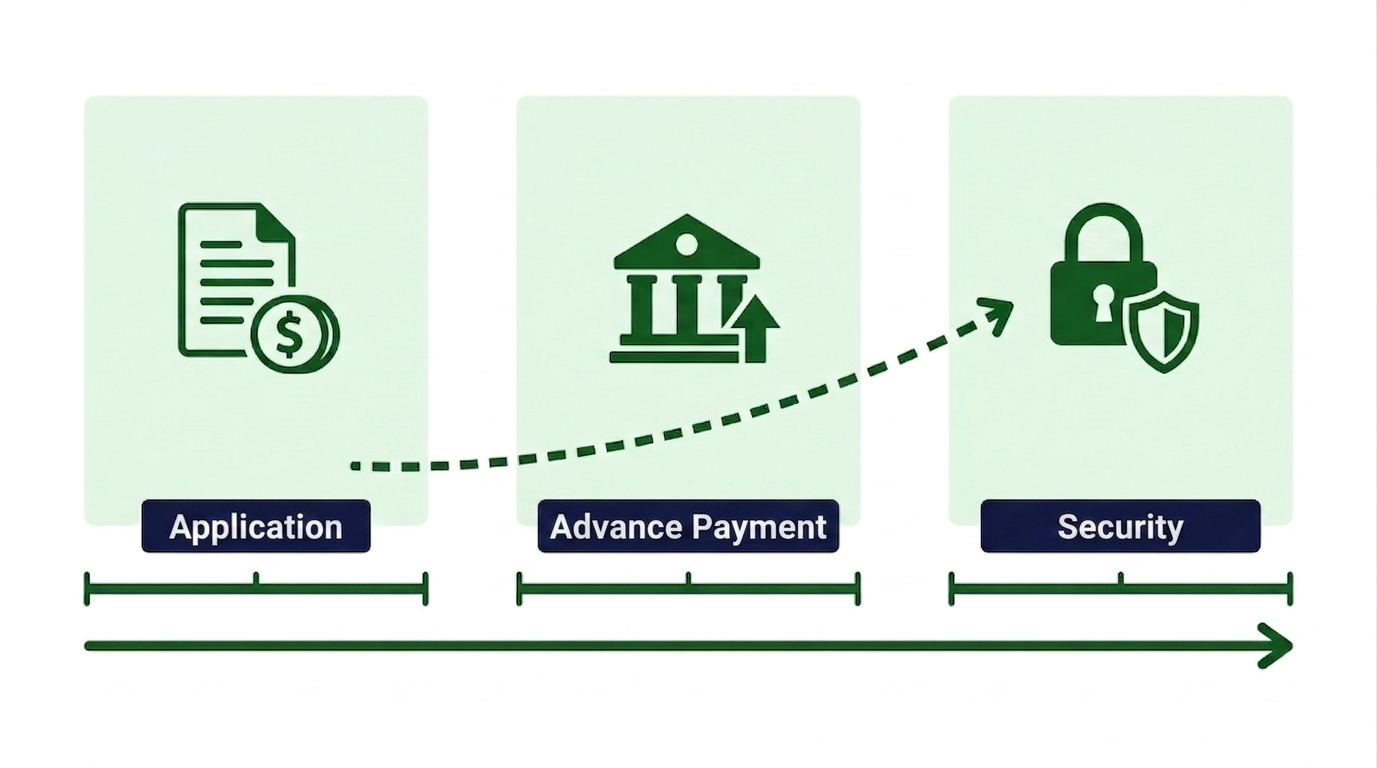
The second area of change concerns fees. Precision matters here, because UC84 introduces three separate financial instruments, each striking at a different stage of the process and falling on different parties.
Application Fee
A complete novelty — nothing like it existed before. Under Article 7(8b1) of the Energy Law, the fee is PLN 1 per kilowatt of requested connection capacity, capped at PLN 100,000. It is non-refundable and must be paid separately for each connection point — failing to do so means the application is left without consideration.
Doubled Advance Payment Toward the Connection Fee
Under Article 7(8a), the advance payment rises from PLN 30 to PLN 60 per kilowatt of connection capacity specified in the application, with a maximum cap of PLN 6 million.
New Performance Security for the Connection Agreement
Under Article 7(8c1), the security amounts to PLN 30 per kilowatt for installations up to 100 MW and PLN 60 per kilowatt for installations above 100 MW, with a maximum cap of PLN 12 million. It must be lodged within 14 days of signing the connection agreement — failure to do so results in the agreement lapsing by operation of law (Article 7(8c9)). Acceptable forms include a cash deposit in an interest-bearing account, a bank or insurance guarantee, or a parent company surety with a minimum credit rating of BBB (Fitch/S&P) or Baa2 (Moody’s) (Article 7(8c2–8c4)).
What This Means in Numbers
To illustrate the scale: a 20 MW project at the point of signing the connection agreement faces an application fee of PLN 20,000, an advance payment of PLN 1.2 million, and a performance security of PLN 600,000 — nearly PLN 1.9 million committed before the project has bank financing or any certainty it will proceed. For a 50 MW project the figures grow proportionally: PLN 50,000 application fee, PLN 3 million advance payment, PLN 1.5 million security — over PLN 4.5 million in total. Above 100 MW the security rate jumps to PLN 60 per kilowatt, though the overall figure is capped at PLN 12 million.
A Structural Market Shift and What It Means for Smaller Investors
This is a fundamental change to the cost structure of entering a project — and it is worth being direct about it, because it affects not just developers but the profile of investors who can realistically participate in this market going forward.
Over the past several years, a portion of investors approached BESS exactly as they once approached small-scale photovoltaics — as a passive investment, something you build, connect, and forget. The result was a market filled with 1–2 MW installations: often poorly designed, without professional operational oversight, without active charge-discharge strategy management, without degradation monitoring. Instead of generating returns, they are losing money. BESS is not panels on a rooftop. It is a complex energy asset that requires active management throughout its entire operational life, and its financial performance is a direct function of the quality of that management.
UC84 raises the entry threshold — both financially and in terms of competence. Several million zloty committed simultaneously across multiple projects in fees and securities is a position that a small investor without substantial capital backing may simply be unable to sustain. There is a certain harshness to this — the consolidation effect that industry organisations warned about during the legislative process. On the other hand, if a higher financial threshold filters out projects that have neither capital, nor competence, nor a realistic operational strategy behind them, that may be precisely the market correction that was needed.
For investors entering the BESS market with genuine capital and a long-term perspective, UC84 is not an insurmountable barrier. It is, however, a clear signal that this business requires a rigorous approach — with thorough analysis of the location, cable route, and revenue model before a single application is filed. The cost of professional advisory at the project preparation stage is a fraction of the cost of fees and deposits committed to a project that turns out — as it should have been identified from the start — to be unviable. That is not a sales pitch — it is arithmetic.
Due Diligence Implications for Project Acquisitions
The new financial instruments have a direct impact on valuation and due diligence for projects changing hands. When acquiring a development-stage project, it is now necessary to verify precisely not just the formal status of the connection conditions, but which of the three instruments have already been paid, in what amount, in what form, and when their renewal or top-up deadlines fall. An advance payment lodged under the previous regulatory framework — PLN 30 per kilowatt — will require a top-up to the new level within the timelines set by the transitional provisions. A performance security not yet lodged must be factored into the transaction payment schedule. Overlooking these elements in pre-transaction analysis is not a formal oversight — it is a material risk that can result in the connection agreement lapsing by operation of law, with no warning and no way to reverse the outcome.
Milestones — The End of the “Buy and Wait” Model
The third change is the introduction of mandatory milestones in grid connection agreements for networks with a rated voltage above 1 kV. This is a change I consider unambiguously positive.
How does the mechanism work? Under Article 7(2a) of the amended Energy Law, every connection agreement lapses by operation of law if the investor fails to notify the operator of having obtained a final building permit within the specified timeframe. For photovoltaic and BESS projects the base deadline is 24 months from the date the agreement is signed. For wind projects — 36 months.
The required scope of the building permit is defined on a threshold basis. For installations containing photovoltaic modules and converters — at least 80% of the installed electrical capacity covered by the agreement. For battery energy storage systems — 80% of installed capacity and simultaneously 80% of the installation’s energy capacity covered by the agreement. For BESS, this is therefore a double threshold: power and energy.
The intent is clear and justified. Twenty-four months to obtain a building permit is sufficient time for an active development process. Under standard conditions, accounting for documentation supplements and typical consultations, a building permit is obtained within 3 to 6 months. If a project has difficulty obtaining a permit within two years, it usually means those difficulties existed from the outset — the milestone simply surfaces that reality earlier, rather than allowing the project to sit in a portfolio for years.
The Act does, however, provide a closed list of circumstances that prevent automatic lapse. Article 7(2b) states that the agreement does not lapse where the investor failed to meet the requirements due to circumstances beyond their control. The list includes natural disasters, acts of war, terrorism, global supply chain disruptions, and — importantly for development practice — administrative delays, provided the investor demonstrates due diligence in filing applications and responding to requests on time. In such cases an extension of up to 24 months can be requested, but this requires lodging an additional security of PLN 60 per kilowatt, capped at PLN 12 million (Article 7(2i)). The request can be made only once.
My practical recommendation: do not build project timelines on the assumption that the force majeure clause can always be activated. The list is closed, demonstrating due diligence requires documentation, and the additional security is a real cost. Run processes in parallel wherever possible and actively monitor every stage of the approval process.
Milestones definitively end the model of buying connection conditions, waiting for market conditions to improve, and selling to a larger player. That model worked as long as conditions were valid for two years and no one verified progress. It no longer will.

Flexible and Configurable Connection Agreements — Two Very Different Things
The fourth element of UC84 is two new types of grid connection agreements that require careful distinction. Despite their similar-sounding names, their implications for a project’s financial model are fundamentally different.
Flexible Connection Agreement — An Opportunity, With Conditions
The flexible connection agreement, governed by new Article 7¹ of the Energy Law, works as follows: an operator may conclude a flexible agreement where full unrestricted connection would require network expansion that cannot be achieved using existing infrastructure. The investor may then bring the installation online earlier — before the network expansion is complete — but subject to temporary limitations on energy import or export. The key provision: those limitations apply until the network is expanded, but no longer than three years from the date the entire connected facility is completed and the final occupancy permit is obtained.
The three-year cap is a positive feature. The investor knows the limitations have a finite horizon, and the financial model can be built around a clearly defined period of constrained operation followed by full capacity once the network is upgraded. Operating under temporary constraints is preferable to waiting several years for grid expansion to reach the required capacity.
The critical question, however, is whether operators will actually be willing to issue flexible agreements. The Act gives them the tool but does not impose an obligation to use it wherever investors might expect. From a DSO perspective the situation is ambiguous — a flexible agreement commits the operator to network expansion within a defined horizon and to removing the limitations once expansion is complete. That represents a real investment commitment on the operator’s side. Not every DSO will have both the resources and the willingness to take that on, particularly when the network development plan is already heavily loaded with other priorities. Experience with cable pooling — also a statutory instrument, used in its first full year by just five of nearly two hundred operators — warrants caution here.
If an operator proposes a flexible agreement, the key things to analyse are the depth and direction of the limitations — whether they apply to import, export, or both — the planned network expansion timeline, and whether that timeline is actually included in the operator’s approved development plan. A limitation that is nominally temporary but backed by no real expansion date in the plan is, in practice, an indefinite limitation — and it should be treated as such in any financial model.
Configurable Connection Agreement — A Risk That Must Be Understood
Article 7² introduces the configurable connection agreement — and this is where serious questions about project bankability arise. A configurable agreement allows for limitations that vary over time, tied to real-time network operating parameters. The Act lists examples: time intervals, network operating parameters at the connection point or in a given area, operating parameters of third-party installations, system reserve levels. And — this is the critical provision — those limitations may apply indefinitely. The system operator that has concluded a configurable agreement is not obligated to take any action to eliminate the limitations (Article 7², paragraphs 4–5).
It is worth asking the question directly: will operators prefer issuing configurable agreements over flexible ones? From the DSO’s perspective, the answer is almost obvious. A configurable agreement gives the operator full control over what flows into the network and when — without any commitment to infrastructure investment and without a deadline after which limitations must end. It is a network management tool that is systemically convenient for the operator but carries serious financial consequences for the private investor.
Translated into financial terms: you sign a connection agreement for 50 MW. Under certain network conditions, the operator can curtail your available capacity — with no defined end date and no obligation on the operator’s part to eliminate the curtailment. Your financial model assumes revenues based on a certain level of full-capacity availability. If for a significant portion of the year you operate at curtailed capacity, revenues are proportionally lower — in a way that cannot be precisely forecast in advance.
From a project financing perspective, this creates a serious practical problem. A financing institution prices a project’s creditworthiness on the basis of projected, stable revenues. A configurable agreement with no time limit introduces an element of systemic unpredictability into those projections that no bank or infrastructure fund will accept as the basis for financing full installed capacity — meaning the project either fails to obtain financing at all, or obtains it on materially worse terms than the base case assumed.
If an operator proposes a configurable agreement, the priority is to understand precisely the frequency, depth, and directionality of possible limitations, and whether and how they are defined parametrically — that is, whether the investor can know in advance under what network conditions and to what extent curtailments will be activated. The less precise the contractual definitions, the greater the uncertainty in the financial model and the harder the conversation with the financing party. Revenue projections must be built on a pessimistic curtailment scenario, not an optimistic one — and the difference between those scenarios can amount to several percentage points of project IRR.
Summary — What to Review Now
The changes UC84 introduces in the grid connection process are significant and require a review of every active project in your portfolio.
First — verify the issuance dates of grid connection conditions for each project and assess what the Act’s transitional provisions mean for your specific situation. Adaptation deadlines are short, and missing them can mean the conditions lapse or the connection agreement expires by operation of law. I cover the transitional provisions in detail in part two.
Second — revise project budgets to account for the new fees and deposits, and verify the status of cable route security. A project with valid connection conditions and an unsecured cable route is not an RTB asset — it is a project with an open, material execution risk.
Third — if you are processing new applications for connection conditions, confirm that the location does not fall within an area designated by the operator as closed to new connections in the network development plan. The non-refundable application fee is lost if the application is left without consideration due to insufficient capacity at the relevant substation. I address no-connection zones in part two.
Part two covers the extension of cable pooling to energy storage — something the market has been waiting for — as well as the retroactivity of the new provisions and the specific implications for projects already in your portfolio.
Frequently Asked Questions
Does the shortened validity of connection conditions apply to projects that already have conditions issued?
Not directly. Conditions issued before UC84 entered into force retain their existing validity period. However, the Act’s transitional provisions impose new financial obligations — topping up the advance payment and lodging the performance security — on entities with conditions already issued or agreements already signed, within short deadlines running from the Act’s entry into force. I cover this in detail in part two.
Can a small BESS project — say 2 MW — still be viable after UC84?
The Act does not technically close the market to small projects. The application fee for 2 MW is PLN 2,000, the advance payment PLN 120,000, the security PLN 60,000 — figures incomparably smaller than for utility-scale projects. The challenge lies elsewhere: a 1–2 MW BESS installation, to generate real returns, requires active charge-discharge strategy management, battery health monitoring, professional O&M, and typically an aggregator relationship for balancing market participation. The fixed costs of that management are broadly similar regardless of scale, which means margins at small installations are thin and operational risk is proportionally greater. UC84 does not kill small BESS projects, but it makes rigorous financial and operational modelling a prerequisite before any investment decision is taken.
How do you distinguish a flexible agreement from a configurable one if an operator presents a draft contract?
The decisive criterion is the duration of the limitations. A flexible agreement must contain a deadline after which the limitations expire — no later than three years from the occupancy permit. A configurable agreement contains no such deadline — limitations can run indefinitely. If a draft agreement contains no clear provision specifying when or under what conditions limitations end, treat it as configurable and adjust the financial model accordingly. Also verify whether the network expansion schedule that would justify calling the agreement “flexible” is actually included in the operator’s approved development plan — if it is not, any representation about the limitations being temporary is a representation without substance.
Is it worth engaging an external advisor to assess a BESS project before filing for connection conditions?
UC84 has raised the stakes of that decision considerably. A project that proves unviable after the application has been filed and fees paid — because the cable route cannot be secured, the substation is at capacity, or the revenue model does not close at realistic O&M costs — costs significantly more today than it did a year ago. The cost of a thorough feasibility analysis conducted by someone who has been through this process many times and understands operator behaviour in specific locations is a fraction of that. Running documents through AI, having a lawyer with no BESS market knowledge review the application, or relying on representations from a developer selling the project — these approaches were already risky under the previous regulatory framework, and under the new one they are simply expensive. At GreenEdge Solutions, this is precisely the kind of analysis we carry out — before anyone commits the first zloty to fees and deposits.
Sources
- Act of 13 March 2026 amending the Energy Law and certain other acts, Journal of Laws 2026, item 516: https://www.prawo.pl/akty/dz-u-2026-516,22258309.html
- Sozosfera — Amendment to the Energy Law on Renewable Energy Sources, April 2026: https://sozosfera.pl/prawo/nowelizacja-ustawy-prawo-energetyczne-oze/
Listen to the Podcast
More on the UC84 changes in episode 4 of the GreenEdge — Best in BESS podcast.
Related Articles
The Balancing Market and BESS Certification in Poland — A Practical Guide for Investors
Financing Energy Storage in Poland: How to Finance a BESS Project in 2026
BESS + PV: Why Hybrid Projects are the Future of Poland’s Renewable Energy Market