Introduction
In the first part of this article I covered the grid connection block of UC84: the shortening of grid connection condition validity to one year, three new financial instruments, mandatory milestones and two new types of connection agreements — flexible and configurable. In this part I work through the remaining elements of the act: the extension of cable pooling to energy storage, zones closed to new grid connections, generation and storage operations before obtaining a licence, and finally — retroactivity, the most controversial and most widely discussed element of the entire amendment.
Cable Pooling for BESS — the Change the Market Needed
This is the best news in the entire UC84 package, at least from the perspective of hybrid projects and retrofits of existing photovoltaic farms.
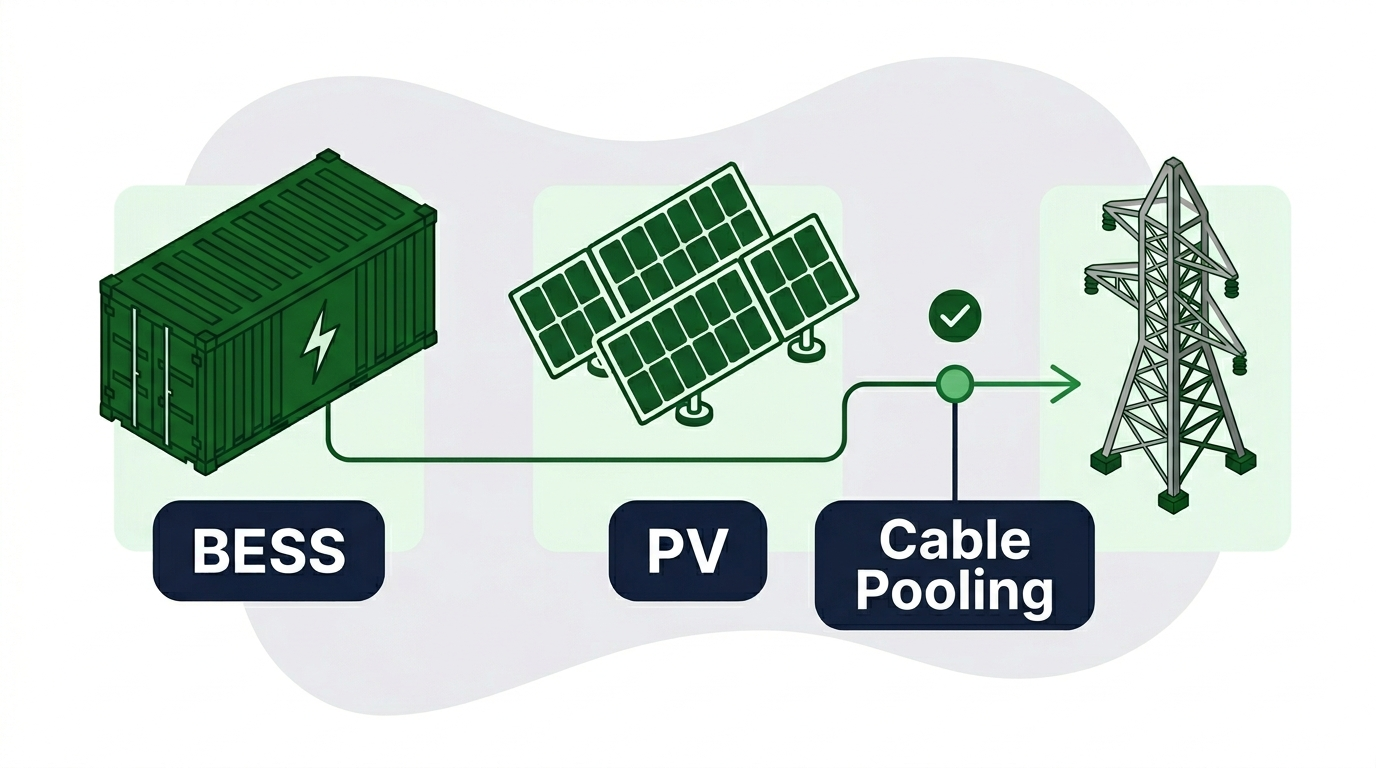
For the past several years, cable pooling under Polish energy law was available exclusively to renewable energy sources — a wind farm and a solar farm could share a single grid connection point because their production profiles complement each other and together they exceed the agreed connection capacity less frequently than either would on its own. Energy storage systems were formally excluded from this mechanism. The consequence was straightforward: adding a BESS to an existing PV farm required obtaining new, separate grid connection conditions, designing a new cable route and going through the full administrative process — with all the costs and timelines that entails.
The amended Article 7(1f) of the Energy Law changes this directly. Under its wording, two or more installations or two or more electrical energy storage systems belonging to one or more entities may be connected to a power grid with a rated voltage higher than 1 kV at a single connection point. The provision does not restrict the combination to renewables — a storage system can enter cable pooling both with a renewable installation and with another storage system, and the owners of individual installations do not need to be the same legal entity. The act also changes the terminology in key provisions — from “renewable energy source” to “electrical energy storage systems” and “system users” — formally legitimising the hybridisation of Polish energy infrastructure at the statutory level.
The specific provision that has direct implications for retrofit economics: when connecting an additional installation or storage system to an existing connection point without increasing the agreed connection capacity, no advance payment towards the connection fee is collected (Article 7(1h)). For a PV farm owner who wants to add a BESS to existing infrastructure and stay within the available connection capacity, this means real upfront savings and a simplified process — the legislator anticipated this scenario directly.
How does this work in practice? Imagine a 20 MW PV farm with a 20 MW grid connection. The farm’s capture rate is declining, curtailment during peak solar hours is increasingly frequent — I wrote about the scale of this phenomenon in my article on PV and BESS hybrids. Until now, adding a storage system required a new grid connection through the full administrative process. Now the storage system can enter the existing connection point if the combined profile of both installations stays within the available connection capacity. During hours when PV is not generating — BESS charges or discharges using the same connection point. At the peak of PV production — BESS absorbs the surplus instead of losing it to curtailment or selling it at deeply negative prices. This is a mechanism that can materially improve the economics of installations already in operation.
There is, however, one caveat that needs to be stated plainly. The wording of the provision is only half the journey. When cable pooling for renewables entered into force in 2024, only a few dozen applications were filed in the first year of operation — a very modest result against the scale of market opportunity. The main reason was that individual distribution system operators approached the new mechanism very differently: no standardised instruction, different interpretations of technical requirements, and DSO internal documentation appearing months after the legislative change took effect. There is no reason to expect cable pooling for BESS will be any different — which is precisely the argument for having someone alongside you who knows the local dynamics of the specific operator, not just the text of the provision.
Power Guardian, No-Connection Zones and Other Changes
UC84 introduces several technical and administrative solutions that do not make big headlines but have direct operational consequences for hybrid projects and new grid connection applications.
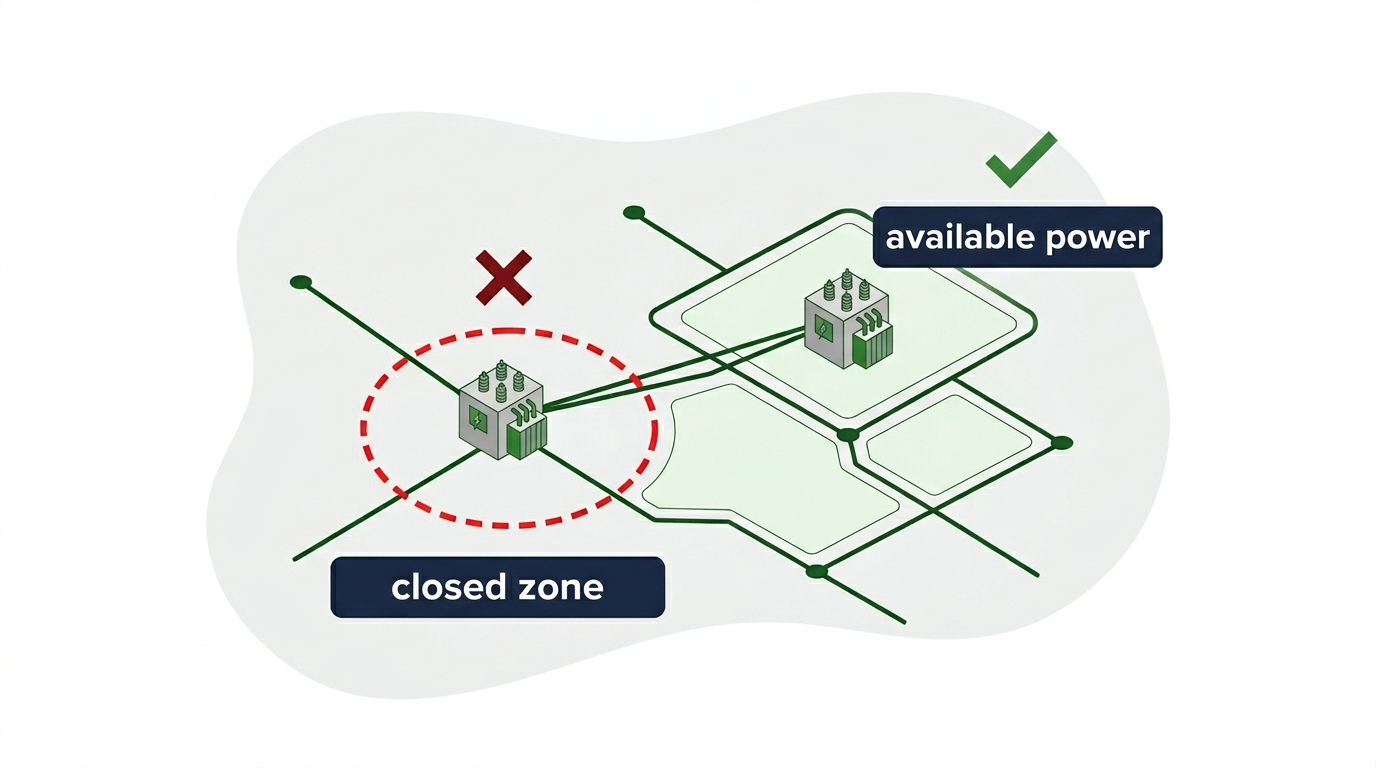
The first is the ability for operators to designate areas closed to new grid connections within their network development plans (Article 16(8¹)). Applications filed for such areas are left without consideration. From a network management perspective the logic is straightforward — the operator indicates where there is physically no more capacity and stops spending time on applications that would end in refusal on technical grounds anyway. From an investor’s perspective this is a clear instruction: before filing an application, verify whether the location falls within a closed zone. The non-refundable application fee I described in the first part is forfeited if the application is left without consideration — and network development plans, once operators have deployed their IT platforms, are to be publicly available. Until those platforms are operational, which will not be before 2028, directly checking available capacity at the specific primary substation before every application is a mandatory step.
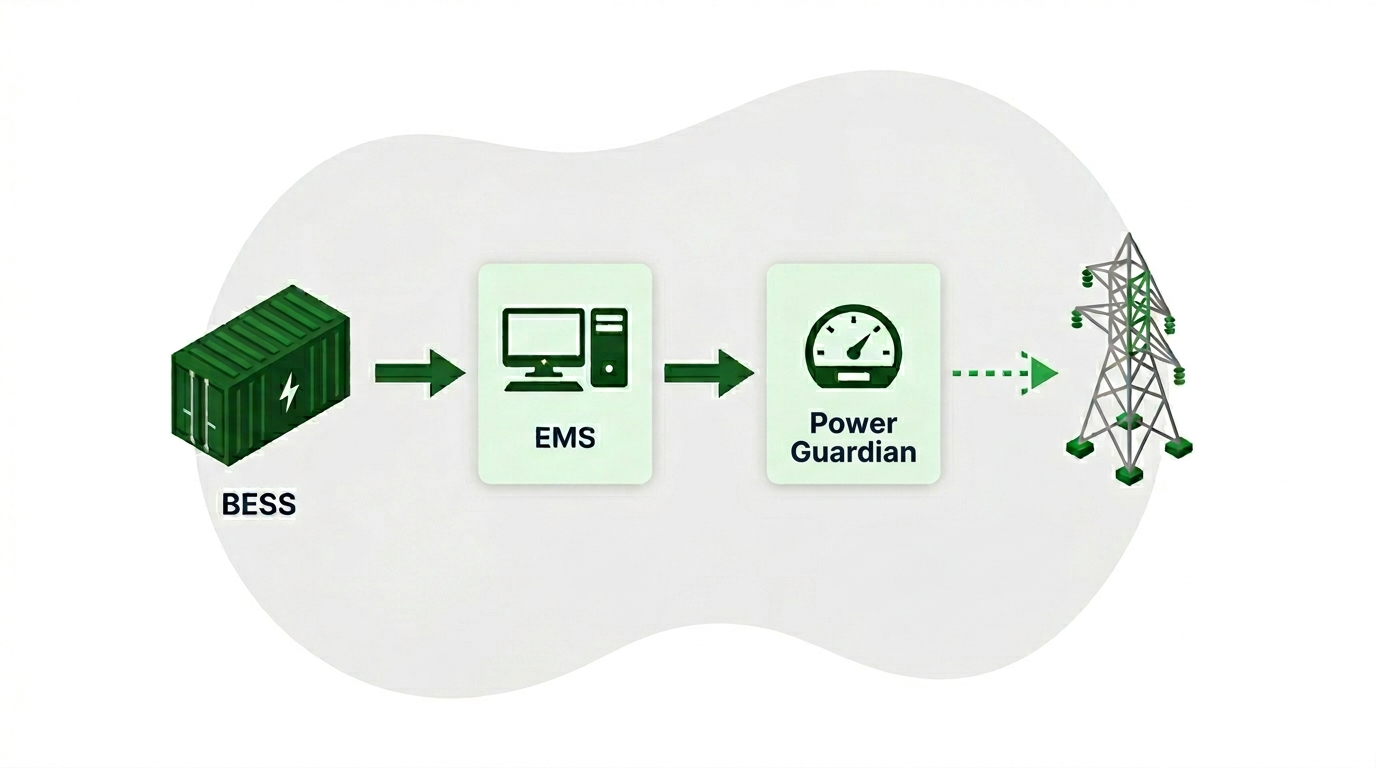
The second solution concerns the power guardian — the system controlling energy flow at the connection point for installations operating under cable pooling, whose total installed capacity exceeds the connection capacity in a given direction. Under Article 7(2²), the operator may suspend the injection of energy into the grid or withdrawal of energy from the grid in the event of malfunction of the devices serving to safeguard the technical capability of not exceeding the connection capacity, or in the event of the connection capacity being exceeded — and is obliged to resume supply immediately upon restoration of correct device operation. This has direct and cost-related consequences for the architecture of hybrid projects: the requirements for the energy management system (EMS) for cable pooling installations must be precisely defined at the RFQ stage with the system supplier — not at commissioning. The cost of an advanced management system must be reflected in the CAPEX from the first iteration of the financial model, and the EMS supplier must confirm that their solution complies with the technical requirements of the specific DSO before the grid connection application is filed.
The act also introduces the possibility of having multiple energy off-take points (PPE) within a single connection point — without the need to obtain separate grid connection conditions for each of them (Article 5(1bb) and Article 5(1bg)). This is particularly relevant for hybrid projects where the PV farm and the BESS have different owners or different financing structures and require independent commercial settlement. Creating an additional PPE requires filing an application with the operator, and the operator is required to install an additional metering and billing system at the applicant’s cost within 30 days of being notified that technical requirements have been met.
A separate procedural simplification concerns generation and storage operations before obtaining a licence. The new Articles 33a and 33b of the Energy Law allow such operations to be conducted — including participation in the balancing market and the provision of system services — for 12 months from the date of first energy injection into the grid without holding a licence, provided that an application for one has been filed. This period may be extended once by a maximum of 6 months by filing the relevant notification with the President of the Energy Regulatory Office no later than 30 days before the end of the basic period. This is not an exemption from the obligation to obtain a licence — it is a deferral of the moment at which the absence of a licence becomes an obstacle to operations. It is also worth noting that energy generated or stored during this period is not covered by the right to support schemes or guarantees of origin.
Retroactivity — Who Is Affected and to What Extent
Retroactivity is the element of UC84 that triggered the loudest industry opposition during the legislative process. I am addressing it at the end of this article not because it is less important than the other changes, but because assessing its consequences for a specific project requires first understanding the full architecture of the new provisions.
The mechanism of retroactivity lies in the fact that UC84 applies new financial requirements — the doubled advance payment, the new performance security and the obligation to demonstrate the milestone of a building permit — not only to projects filing applications for grid connection conditions after the act enters into force, but also to projects with already-issued conditions or already-signed grid connection agreements. The transitional provisions set specific deadlines for compliance, and failure to meet them can lead to the expiry of a grid connection agreement or the lapse of validity of grid connection conditions — by operation of law, without any administrative procedure and without any possibility of reversal.
The act differentiates the effects of retroactivity depending on the stage the project had reached on the date the act entered into force — and that difference is material. The key transitional provisions are Articles 9, 11, 13 and 14 of the act.
Advance payment. If before the act entered into force you have received grid connection conditions but have not yet signed a grid connection agreement, you have 6 months from the date the act enters into force to top up the advance payment to the new level of PLN 60 per kilowatt (Article 9(1)). Failure to meet this deadline results in the lapse of validity of the grid connection conditions. If you have filed an application that has not yet been processed — the deadline for topping up the advance payment is 60 days from the date the act enters into force (Article 9(2)(2)), and for entities for which an advance payment was not previously required — the same applies.
Security for projects with grid connection conditions but no agreement. Under Article 11(1), if you have received grid connection conditions but have not yet signed an agreement, the security to be provided upon signing the agreement equals one quarter (25%) of the standard amount under Article 7(8c1) — to be provided within 14 days of signing the agreement, failing which the agreement expires by operation of law.
Security for projects with a signed agreement. If you signed a grid connection agreement before the act entered into force and the connection deadline specified in that agreement falls later than 3 years from the date the act enters into force, you provide security equal to one quarter (25%) of the standard amount, within 6 months from the date the act enters into force (Article 11(3)). This security is credited towards the connection fee. If the connection deadline in your agreement is shorter than 3 years from the date the act enters into force — Article 11(3) does not apply, and any security previously provided under the contractual provisions of the agreement is credited towards the new security by operation of Article 11(7).
Milestones — deadlines for demonstrating a building permit. This block of provisions — Articles 13 and 14 — enters into force not on the date the act enters into force, but 6 months later (Article 38(2)). For projects with agreements signed within the last 48 months (Article 13), the deadline for demonstrating a final building permit for at least 80% of capacity for BESS and PV is 30 months from the date those provisions enter into force; for wind and biogas — 42 months. For projects with agreements older than 48 months (Article 14), the deadline is 3 months for BESS and PV, 6 months for wind — counted from the same date of Article 14 entering into force. There is an important exclusion that the industry rarely discusses: Article 14 does not apply to agreements under which at least part of the installation covered by the agreement was connected to the grid before the act entered into force (Article 14(2)). Projects that were partially connected before the act enters into force fall outside the three-month regime.
Additional security for an extension request. Both for Article 13 and Article 14, a request for a deadline extension by a maximum of 24 months — filed before the expiry of the primary deadline and only once — requires an additional security equal to half (50%) of the amount under Article 7(2i)(2), i.e. half of PLN 60 per kilowatt with a cap of PLN 12 million, giving a maximum of PLN 30 per kilowatt with a cap of PLN 6 million (Article 13(2) and Article 14(3)).
Were the Senate’s amendments sufficient? Industry organisations — PIME and PSFiME — had throughout the legislative process called for the complete exclusion of retroactivity and the application of new rules exclusively to projects filed after the act entered into force. The logic of this position was straightforward and correct: an investor made the decision to enter a project within a defined regulatory framework, committing capital and resources on the basis of defined rules. Changing those rules after the fact violates the elementary principle of legal certainty — regardless of how justified the systemic objective of that change may be. The Senate’s compromise softens the financial consequences but does not eliminate the underlying problem: projects in the course of development were subjected to a change of rules mid-game.
The ministerial argument, however, is that without retroactively subjecting existing projects to the new financial and timeline requirements, the owners of zombie projects would have had no incentive to abandon them. A project sitting idle for four years could comfortably sit for another two, because the new provisions would not apply to it anyway. I understand that argument — particularly in relation to projects that had been dormant for years. The problem is that the same transitional provisions hit projects in active development, at various stages of progress, whose owners had made real capital commitments. And that is precisely the part of retroactivity that leaves behind legitimate questions about the predictability of the Polish regulatory environment.
That question is not abstract. Foreign institutional investors, infrastructure funds and banks financing renewable energy and BESS projects treat regulatory stability as one of the key parameters in deciding whether to enter a given market. The signal that binding grid connection agreements can be de facto renegotiated by legislation with retrospective effect — even in a softened version relative to what was originally planned — is not a signal that attracts long-term capital. Poland needs tens of billions of zlotys in private investment to achieve its energy transition targets, and the cost of regulatory unpredictability is real, even if difficult to measure precisely.
Summary — What You Need to Check and Do Now
UC84 is an act whose assessment depends on perspective. From the perspective of the power system — the direction is right, it was overdue to free up grid connection capacity blocked by projects that would never be built. From the perspective of investors and developers — some changes are positive, cable pooling for BESS is a step in the right direction, but retroactivity leaves behind real costs and legitimate questions about how Polish energy law will treat projects in active development at future legislative amendments.
Regardless of that assessment — the deadlines under the transitional provisions are short and they do not wait. If you have projects in your portfolio, three things require immediate action.
First — identify the dates on which grid connection conditions were issued and the dates on which grid connection agreements were signed for each project, and map them onto the specific deadlines under the transitional provisions. The 6-month deadline for topping up the advance payment and providing security runs from the date the act entered into force — not from the date you realised such an obligation existed.
Second — if you have a grid connection agreement older than 48 months and have not yet obtained a final building permit, Article 14 applies to you from the moment it enters into force (6 months after the act is promulgated). The three-month deadline for demonstrating a building permit is then a critical deadline — unless the connection of at least part of the installation had already taken place before the act entered into force, which removes you from this regime. If a building permit is not achievable, the only path is an extension request with documented due diligence and an additional security deposit.
Third — if you have an existing PV farm and have been considering adding BESS, the extension of cable pooling to energy storage is precisely the moment when a retrofit feasibility analysis should be commissioned seriously. The economics of this solution changed on the day UC84 entered into force.
Frequently Asked Questions
Does cable pooling for BESS mean I can add a storage system to an existing PV farm without new grid connection conditions?
As a general rule — yes, provided that adding the BESS does not require an increase in the agreed connection capacity. The amended Article 7(1f) allows the connection of a storage system within an existing connection point, and Article 7(1h) confirms that no advance payment is collected when the connection capacity does not change. In practice, however, each DSO will have its own technical requirements regarding EMS configuration and the power guardian. Before filing an application it is worth establishing with the specific operator what technical documentation is required and what the current interpretation of the provisions is in its area of operation — divergences between DSOs in the first year after a legislative change should be treated as a certainty, not a risk.
I have a grid connection agreement signed three years ago and have not yet obtained a building permit. Is my agreement at risk of expiry?
An agreement signed within the last 48 months falls under the regime of Article 13, which enters into force 6 months after the act is promulgated. You then have 30 months to demonstrate a final building permit for at least 80% of capacity and 80% of storage volume for BESS. In parallel, check two things: whether you topped up the advance payment to PLN 60 per kilowatt within 6 months of the act entering into force, and whether — if the connection deadline in your agreement falls later than 3 years from the date the act entered into force — you provided security equal to 25% of the standard amount within that same period.
I have a grid connection agreement older than 48 months and have not yet obtained a building permit. What can I do?
Article 14 enters into force 6 months after the act is promulgated and then gives you 3 months to demonstrate a final building permit for BESS and PV. However, if at least part of your installation was already connected to the grid before the act entered into force — Article 14 does not apply to you at all (Article 14(2)). If a building permit is not achievable within the three-month deadline and the exclusion under Article 14(2) does not apply, the only path is an extension request for a maximum of 24 months — filed before the deadline, only once — with an additional security of half the amount under Article 7(2i)(2), which for standard BESS projects means PLN 30 per kilowatt with a cap of PLN 6 million. Documenting due diligence at every stage of administrative proceedings is a condition for the effectiveness of such a request.
How do I calculate the retroactive security for a project with an existing grid connection agreement?
The base rate is one quarter (25%) of the standard security under Article 7(8c1), provided that the connection deadline in the agreement falls later than 3 years from the date the act entered into force. For installations up to 100 MW the standard rate is PLN 30 per kilowatt — the retroactive rate is therefore PLN 7.50 per kilowatt. For installations above 100 MW the standard rate is PLN 60 per kilowatt — the retroactive rate is PLN 15 per kilowatt, subject to a proportional cap. The filing deadline is 6 months from the date the act entered into force. Permitted forms of security are a cash deposit in an interest-bearing account, a bank or insurance guarantee, or a guarantee from a parent company within the same capital group (without a rating requirement, but with a notarial declaration of submission to enforcement) or a guarantee from an entity outside the capital group with a rating of at least BBB from Fitch or S&P, or Baa2 from Moody’s (Article 7(8c2)–(8c4)).
Is it worth commissioning a portfolio review for UC84 compliance?
The transitional deadlines are short and the consequences of missing them are final — expiry of a grid connection agreement or lapse of validity of grid connection conditions by operation of law, without warning and without any possibility of reversal. A portfolio review requires mapping the dates on which grid connection conditions were issued, the dates agreements were signed and the connection deadlines specified in those agreements, the building permit status and the advance payments made for each project individually, and then cross-referencing that data against the wording of the transitional provisions — because each of those variables determines which article of the act applies and what deadline is in force. At GreenEdge Solutions we carry out this scope as a standalone service — both for investors managing their own portfolios and for entities considering the acquisition of a project from an external developer, where verification of the legal status of the grid connection is an integral part of transaction due diligence.
Sources
Act of 13 March 2026 amending the Energy Law and certain other acts, Journal of Laws of 2026, item 516: https://www.prawo.pl/akty/dz-u-2026-516,22258309.html
Sozosfera — Amendment to the Energy Law Act on Renewables, April 2026: https://sozosfera.pl/prawo/nowelizacja-ustawy-prawo-energetyczne-oze/
Listen to the podcast
More on UC84 changes in episode 4 of the GreenEdge – Best in BESS podcast
Related articles:
UC84: New Grid Connection Rules for BESS and Renewables in Poland
The Balancing Market and BESS Certification in Poland — A Practical Guide for Investors
Financing Energy Storage in Poland: How to Finance a BESS Project in 2026
This article is based on the text of the Act of 13 March 2026 amending the Energy Law and certain other acts (Journal of Laws of 2026, item 516). Legal status: April 2026. This article is for informational purposes only and does not constitute legal advice or investment advisory.